[Good Morning Market] Decline Expected in Weak US Stock Market on 'Last Trading Day'
Domestic Stock Market Expected to Start Down Within 1%
All Three Major US Indexes Declined the Previous Day
Surge in COVID-19 Cases in China Also Affects Investor Sentiment
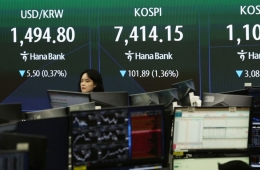
[Asia Economy Reporter Kwangho Lee] On the last trading day of the year, the domestic stock market on the 29th is expected to start with a decline within 1%. The weakness shown by most stocks in the U.S. stock market is expected to directly affect the domestic market. The surge in COVID-19 cases in China is also expected to act as a negative factor for the stock market.
On the previous day at the New York Stock Exchange (NYSE), the Dow Jones Industrial Average closed at 32,875.71, down 365.85 points (1.10%) from the previous trading day. The S&P 500 index, centered on large-cap stocks, closed at 3,783.22, down 46.03 points (1.20%). The Nasdaq index, focused on technology stocks, ended at 12,130.29, down 139.94 points (1.35%).

All 11 sectors of the S&P 500 index declined. In particular, energy stocks recorded the largest drop due to falling oil prices. By sector, energy (-2.22%), technology (-1.64%), real estate (-1.59%), communication services (-1.51%), and materials (-1.50%) sectors saw significant declines.
Big tech companies also could not avoid the downward trend. The leading stock Apple fell 3.05% amid forecasts of decreased iPhone shipments, closing at the lowest level in the past 1 year and 6 months. Other companies such as ▲Netflix -2.57%, ▲Alphabet (Google’s parent company) -1.57%, ▲Microsoft -1.03%, and ▲Meta Platforms (Facebook’s parent company) -1.08% also experienced stock price declines.
Electric vehicle maker Tesla, whose stock price plunged more than 11% the previous day, closed up 3.3% on the day due to bargain buying. Lucid also closed up 2.9%. Meanwhile, Nikola fell 5.44%.
However, there is also a possibility of bargain buying inflows due to the recent sharp decline in the stock market.
Sangyoung Seo, a researcher at Mirae Asset Securities, said, “Tesla, which had been driving down Korean stock-related stocks amid recent weakness, rose due to a rebound buying triggered by valuation improvement, which will have a positive impact.” He added, “Furthermore, the fact that economic indicators in the U.S. suggest that the economic contraction may be limited is also favorable.” He continued, “Due to the imbalance in supply and demand between individuals and institutions, a stock market characterized by individual stock trends is expected to continue amid expanding changes.”
Meanwhile, it is also noteworthy that Chinese companies are showing weakness as the number of new COVID-19 cases in China exceeds tens of millions per day due to the easing of China’s COVID-19 policies.
Hot Picks Today
!["Rather Than Endure a 1.5 Million KRW Stipend, I'd Rather Earn 500 Million in the U.S." Top Talent from SNU and KAIST Are Leaving [Scientists Are Disappearing] ①](https://cwcontent.asiae.co.kr/asiaresize/93/2026051414165763158_1778735817.jpg) "Rather Than Endure a 1.5 Million KRW Stipend, I'd Rather Earn 500 Million in the U.S." Top Talent from SNU and KAIST Are Leaving [Scientists Are Disappearing] ①
"Rather Than Endure a 1.5 Million KRW Stipend, I'd Rather Earn 500 Million in the U.S." Top Talent from SNU and KAIST Are Leaving [Scientists Are Disappearing] ①
- "If That's the Case, Why Not Just Buy Stocks?" ETFs in Name Only, Now 'Semiconductor-Heavy' and a Playground for Short-Term Traders
- [Breaking] Two Days Before Strike... Central Labor Relations Commission Chair Park Soogeun Says "Differences Narrowing... Possibility of Agreement"
- Individual Investors Absorb Foreign Sell-Off... Concerns Over Becoming "Cannon Fodder" Emerge
- "No Cure Available, Spread Accelerates... Already 105 Dead, American Infected"
Jiyoung Han, a researcher at Kiwoom Securities, explained, “The sharp increase in new cases and deaths after reopening appears to be restricting the normalization of economic activities of the Chinese people.” She added, “Major countries such as the U.S. and Japan are strengthening entry regulations for Chinese nationals to prevent the spread of COVID-19 within their countries, which is causing a gap between expectations and reality regarding economic and corporate performance changes after reopening.”
© The Asia Business Daily(www.asiae.co.kr). All rights reserved.