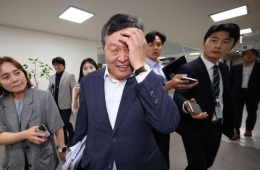
"Failed to Capture MZ Vote"... Even a 97-Year-Old Political Giant Couldn't Beat the Trend
Political Alliance Homeland Movement Fails to Secure a Single Seat
Fails to Attract Support from MZ Generation
Unable to Absorb Support Base Due to Political Isolation
Hints at Retirement Following Poll Results
![Malaysian Prime Minister Mahathir Mohamad <br>[Photo by Yonhap News]](http://www.asiae.co.kr/news/img_view.htm?img=2018082010043036155_1534727066.jpg)
[Asia Economy Reporter Lee Ji-eun] In the Malaysian general election held on the 19th (local time), former Prime Minister Mahathir Mohamad (97) suffered a crushing defeat. Major foreign media analyzed that his failure to build an alliance front and gain the support of young voters led to his loss.
The Malaysian Election Commission announced on the 20th that the Pakatan Harapan (PH) coalition secured 82 out of 200 parliamentary seats in the general election held the previous day. Pakatan Harapan (PH) is an opposition coalition led by former Deputy Prime Minister Anwar Ibrahim. Following them, the Perikatan Nasional (PN) coalition, led by former Prime Minister Muhyiddin Yassin who resigned over the failure of COVID-19 measures, won 73 seats. The Barisan Nasional (BN), to which current Prime Minister Ismail Sabri Yaakob belongs, came in third with 30 seats.
This is the first time in Malaysian electoral history that the leading party has failed to secure a majority of seats. In the 14th general election, Pakatan Harapan (PH) defeated Barisan Nasional (BN), which had lost public trust due to corruption and other issues, winning 113 seats and achieving Malaysia's first democratic regime change since independence.
On the other hand, the Homeland Movement (GTA), a coalition formed by Mahathir, failed to secure a single seat in the general election. Former Prime Minister Mahathir also ranked fourth out of five candidates in his Langkawi constituency.
Major foreign media analyzed that the reason political heavyweight Mahathir suffered a crushing defeat in this general election was largely due to his failure to attract the support of the MZ generation (Millennials + Generation Z), who make up nearly half of the electorate. He failed to use social networking services (SNS) effectively and did not present agendas that appealed to the younger generation.
In fact, former Prime Minister Muhyiddin attracted the attention of young voters by posting a dancing video on TikTok, a Chinese video-sharing platform, during this election. The video showing Muhyiddin dancing to music while brushing off the logo of a rival party with his hand spread widely on SNS and gained great popularity. However, Mahathir only posted political content unilaterally on his Facebook account, which has 4 million followers.
Japan's Nihon Keizai Shimbun pointed out, "Malaysian youth want new leaders who understand economic issues and the climate crisis faced by their generation," adding, "Even a political heavyweight in Southeast Asia could not keep up with the times."
It was also cited as a cause of defeat that Mahathir failed to build alliances with other parties and thus could not absorb all the support base. Unlike the 14th general election, Mahathir chose an isolationist path instead of political alliances, losing the votes of Malay, Chinese, and Indian voters.
Chinese and Indian voters critical of the current administration turned to Pakatan Harapan (PH) led by Anwar Ibrahim, while Malay voters, who make up 70% of the population, chose Perikatan Nasional (PN) led by Muhyiddin. Nihon Keizai explained, "In the last general election, Mahathir created momentum for regime change by joining forces with former Deputy Prime Minister Anwar. However, in this election, he was politically isolated and lost to the well-organized and well-funded Pakatan Harapan (PH) and Perikatan Nasional (PN)."
Before the vote count, when polls predicted Pakatan Harapan (PH) would lose, Mahathir hinted at retirement. In an interview on the 17th, he stated, "I will retire. Since people no longer need me, I do not want to interfere in politics," expressing his intention regarding his future.
Meanwhile, as no party secured a majority in this general election, the King was tasked with selecting the ruling party. Malaysian King Abdullah notified each party to inform the royal household of coalition formation and the prime ministerial candidate they support by 2 p.m. on the 21st. The King plans to appoint the prime minister based on this.
Hot Picks Today
!["Rather Than Endure a 1.5 Million KRW Stipend, I'd Rather Earn 500 Million in the U.S." Top Talent from SNU and KAIST Are Leaving [Scientists Are Disappearing] ①](https://cwcontent.asiae.co.kr/asiaresize/93/2026051914165468840_1779167814.png) "Rather Than Endure a 1.5 Million KRW Stipend, I'd Rather Earn 500 Million in the U.S." Top Talent from SNU and KAIST Are Leaving [Scientists Are Disappearing] ①
"Rather Than Endure a 1.5 Million KRW Stipend, I'd Rather Earn 500 Million in the U.S." Top Talent from SNU and KAIST Are Leaving [Scientists Are Disappearing] ①
- Brilliant Korean Technology Flows Overseas... Subsidies Granted, but "No Product Launch Allowed"
- "If That's the Case, Why Not Just Buy Stocks?" ETFs in Name Only, Now 'Semiconductor-Heavy' and a Playground for Short-Term Traders
- Singer Kim Minjong Responds to MC Mong's Gambling Allegations: "Clearly False... Legal Action to Follow"
- "No Cure Available, Spread Accelerates... Already 105 Dead, American Infected"
Malaysia is a federal constitutional monarchy where the rulers of the nine states on the Malay Peninsula take turns serving as King for a five-year term. The prime minister is usually appointed by the King from the leader of the party that commands the most confidence in the majority.
© The Asia Business Daily(www.asiae.co.kr). All rights reserved.
![Cheaper Than Candy, Yet Impossible to Find... Fears of a 'Pediatric Medical Crisis' as Pharmaceutical Companies Halt Production [Why&Next]](https://cwcontent.asiae.co.kr/asiaresize/307/2026051910065268365_1779152813.jpg)