Semiconductor Industry Embracing 'Sustainability'... "Government Support Must Complement Corporate Efforts"
Semiconductor Leaders Gather to Discuss 'Sustainability'
Samsung Electronics and SK Hynix Join RE100
Domestic Renewable Energy Infrastructure Insufficient
"Priority Supply Needed for High Power Consumption Companies"

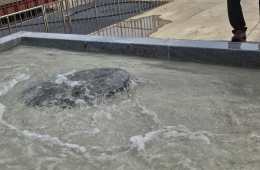
A pond created with purified water at the Green Center in Samsung Electronics Hwaseong Campus / Courtesy of Samsung Electronics
View original image[Asia Economy Reporter Kim Pyeonghwa] As the importance of Environmental, Social, and Governance (ESG) permeates all industries, sustainability challenges have emerged in the semiconductor sector as well. Following the announcement of a 2050 net zero (carbon neutrality) goal for the global semiconductor supply chain, Samsung Electronics and SK Hynix have also officially committed to RE100 (100% renewable energy usage).
However, in South Korea, the renewable energy infrastructure is insufficient compared to overseas, and regulatory loopholes make it difficult to advance RE100 initiatives. Experts advise that renewable energy should be preferentially supplied to RE100 member companies that consume large amounts of electricity.
This Year’s Key Topic in the Semiconductor Supply Chain is ‘Sustainability’… Samsung Electronics Joins RE100 Following SK Hynix
According to the semiconductor industry on the 6th, the Semiconductor Equipment and Materials International (SEMI) held the International Trade Partners Conference (ITPC) from May 30 (local time) to June 2 on Hawaii’s Big Island. ITPC is an annual event where semiconductor industry stakeholders gather to discuss global supply chains and related challenges. This year’s theme was ‘Promoting Sustainable Industrial Growth,’ with participants including Samsung Electronics, US-based Qualcomm and Micron, Germany’s Infineon, and Japan’s Kioxia. A SEMI official explained, “Since sustainability is a major topic in the industry, we have recently been conducting several related activities.”
On June 2, SEMI also announced the establishment of the ‘Semiconductor Climate Consortium.’ This consortium was formed to reduce greenhouse gas emissions across the global semiconductor supply chain. Founding members include overseas companies such as Taiwan’s TSMC, US-based AMD and Micron, as well as domestic companies like Samsung Electronics, SK Hynix, and Dongjin Semichem. The Semiconductor Climate Consortium plans to share reduction progress annually and aims to achieve net zero by 2050. From June 8 to 10, the consortium will participate in the 27th Conference of the Parties to the United Nations Framework Convention on Climate Change (COP27) in Egypt to announce its launch and goals externally.
Musumi Bhatt, Vice President of SEMI’s Global Sustainability Program, emphasized the rising sustainability challenges in the industry, stating, “All founding members recognize the semiconductor industry’s impact on the climate and the importance of industry-wide cooperation for sustainable growth moving forward.”
The domestic semiconductor industry is actively responding to these industrial trends. Samsung Electronics announced its RE100 membership in September through its ‘New Environmental Management Strategy.’ It also proposed projects such as developing ultra-low power semiconductors and replenishing water resources equivalent to the amount of water used. At the extraordinary shareholders’ meeting held on June 3, it appointed Heo Eun-nyung, Vice Dean of the Graduate School of Engineering at Seoul National University and an environmental and energy expert, as an outside director.
SK Hynix, which announced its RE100 membership in 2020, recently unveiled its ESG strategy framework called PRISM and published its first Task Force on Climate-related Financial Disclosures (TCFD) report this quarter. PRISM includes targets to reduce emission intensity and water intake intensity by 57% and 35%, respectively, by 2026.

Partial interior view of SK Hynix Icheon Campus equipped with a wastewater recycling system / Source=SK Hynix Newsroom
View original image"Priority Supply Needed for RE100 Member Companies with High Electricity Usage"
However, the semiconductor industry explains that there are considerable challenges in implementing various goals, including RE100. Due to the nature of the industry, electricity consumption is high, with Samsung Electronics and SK Hynix ranking first and second in industrial power usage last year, and carbon emissions generated by operating factories 24/7 are significant. In particular, the lack of renewable energy infrastructure in South Korea compared to overseas is cited as a major obstacle.
In fact, Samsung Electronics has already succeeded in converting to 100% renewable energy at overseas sites in the US, Europe, and China, where renewable energy use is more feasible. SK Hynix also expects to achieve RE100 at its overseas sites by this year. This is why the industry views achieving RE100 as a problem that cannot be solved by corporate efforts alone. Last year, renewable energy supply accounted for only 7.5% (43 TWh) of South Korea’s total power generation of 577 terawatt-hours (TWh).
Experts point out that, compared to overseas, South Korea’s wind and solar resources are not abundant, and even the renewable energy produced is not adequately supplied to the private sector. They also suggest that the government should devise operational strategies to prioritize supplying renewable energy to RE100 member companies with high electricity consumption alongside efforts to secure renewable energy.
Professor Yoo Seung-hoon of the Department of Energy Policy at Seoul National University of Science and Technology said, “Domestic renewable energy is mainly solar power, and related operators receive 170 to 180 KRW per kilowatt-hour (kWh) when contracting with private companies, but they receive 330 KRW when selling to Korea Electric Power Corporation (KEPCO), so they do not attempt to supply the private sector.” He criticized, “Our country is excessively subsidizing renewable energy.”
Hot Picks Today
 If They Fail Next Year, Bonus Drops to 97 Million Won... A Closer Look at Samsung Electronics DS Division’s 600M vs 460M vs 160M Performance Bonuses
- Opening a Bank Account in Korea Is Too Difficult..."Over 150,000 Won in Notarization Fees Just for a Child's Account and Debit Card" [Foreigner K-Finance Status]②
- "While Others Rest, Nearly 3 Million May Work Substitute Public Holidays Without Extra Pay"
- "Better Than the Lottery": Reporting Collusion Could Earn Hundreds of Billions... KFTC Announces Administrative Notice to Abolish Whistleblower Reward Cap
- "Who Is Visiting Japan These Days?" The Once-Crowded Tourist Spots Empty Out... What's Happening?
Professor Yoo added, “Since the government will reform related systems from 2024 and proceed with a bidding system, if prices drop, renewable energy operators may attempt to supply the private sector. However, since the amount of renewable energy is limited, policies prioritizing supply to RE100 member companies with high electricity consumption are necessary.”
© The Asia Business Daily(www.asiae.co.kr). All rights reserved.

!['WHO Declares International Public Health Emergency' Why the Untreatable 'Variant Ebola' Is More Deadly Than COVID-19 [Reading Science]](https://cwcontent.asiae.co.kr/asiaresize/307/2026052110164072055_1779326201.png)
!["Please Help Us": How Much Do Those Bowing 90 Degrees These Days Actually Earn? [Data Pick]](https://cwcontent.asiae.co.kr/asiaresize/307/2026052010120870131_1779239528.png)



