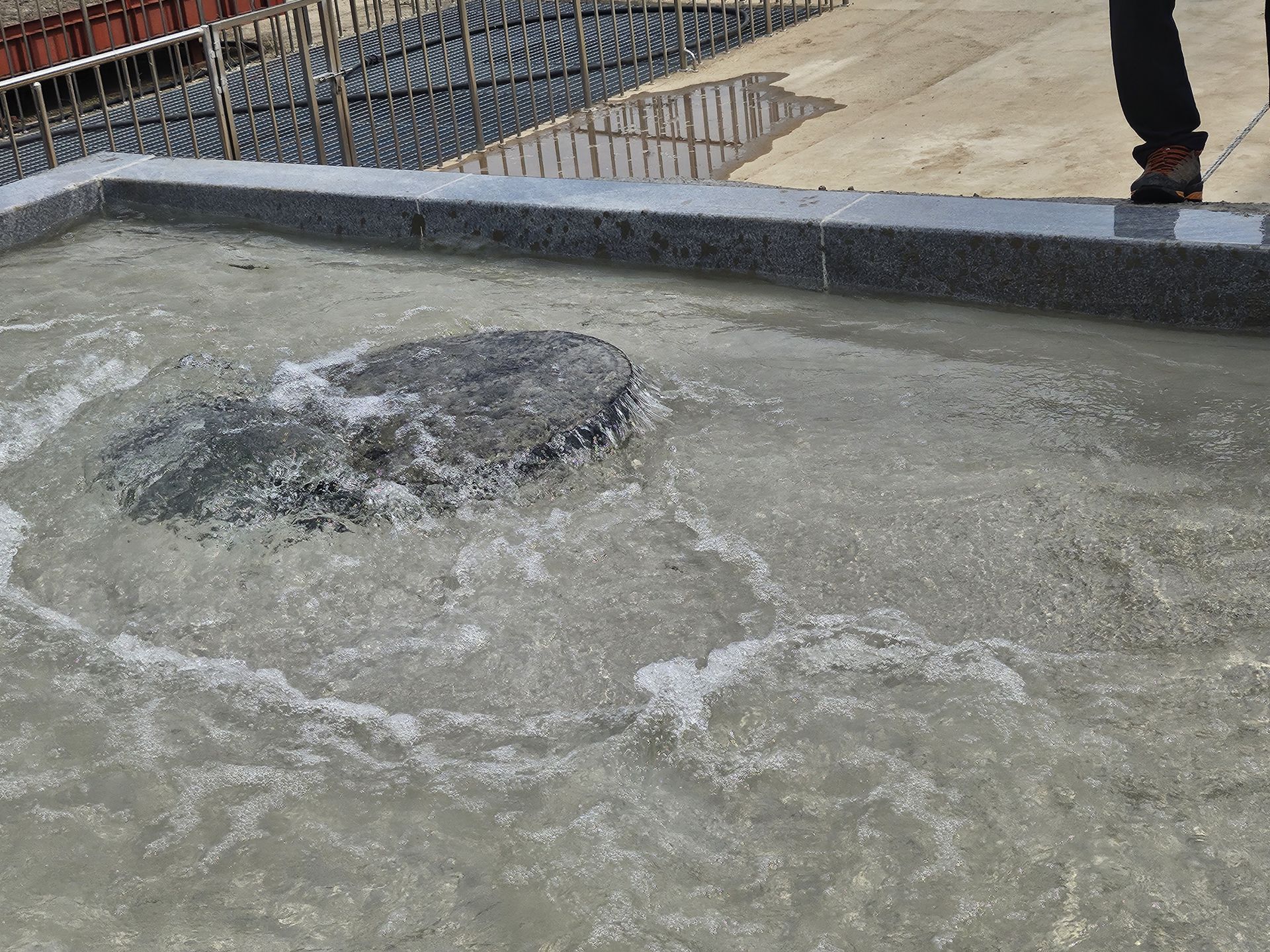
About 10 seconds after the water began to flow, the surface of the manhole suddenly started to shake. Two seconds later, with a dull metallic clang, the steel manhole cover shot upward. This was due to the massive water pressure pushing up from below the manhole.
On May 19, at the River Experiment Center of the Korea Institute of Civil Engineering and Building Technology (KICT) in Andong, North Gyeongsang Province, the research team blocked the lower part of the stormwater pipe and released a large volume of water, vividly replicating the 'manhole cover detachment' scenario that occurs repeatedly in urban areas during torrential downpours.
Through the manhole gap that opened in an instant, a fierce column and vortex of water burst out. A brief gasp of amazement escaped from the reporters present on site.
The 'manhole detachment test field' unveiled on this day was established to analyze pressure changes and stormwater pipe blockages that occur during urban flooding. The research team was quantitatively measuring under what conditions manhole covers are lifted, and at what level of pressure the risk of pedestrian accidents increases.
Recreating Gangnam's 6-Lane Flooding... Real-Scale Stormwater Inlets, Pipes, and Drainage Tunnels

Heavy rain suddenly gathered water all at once, resulting in roads and sidewalks being submerged in water in an instant. Photo by Kim Jonghwa
원본보기 아이콘The research team then moved to a separately constructed 'Urban Flood Pilot Test Site' to demonstrate the recreation of Gangnam-style urban flooding. As the experiment began, a massive amount of water gushed out simultaneously from four large blue pipes. The water quickly flowed down a sloped surface designed to mimic an actual road, rapidly filling a low-lying urban area. The ground at the site was constructed to closely resemble a real city, complete with lane markings, curbs, and stormwater inlets. The water was sucked into the stormwater pipes and drainage tunnels, but as the inflow exceeded the drainage capacity, water overflowed onto parts of the road.
The 'Urban Flood Pilot Test Site' unveiled by KICT is not just a simple water tank facility. Applying Seoul's Gangnam road design standards, the test site recreates a six-lane road, stormwater inlets, stormwater pipes, underground storage facilities, pumping stations, and drainage tunnels at full scale—effectively replicating real urban flood infrastructure. Four pipes, each capable of supplying up to 1.2 cubic meters of water per second, are connected to the site. Based on the area of the site, it can simulate extreme rainfall events of up to 5,400 millimeters per hour.
Jung Sanghwa, head of the KICT River Experiment Center, explained, "Urban flooding is not simply a matter of heavy rainfall, but occurs the moment drainage infrastructure reaches its limits. The key is to quantitatively analyze under what conditions flooding and manhole detachment happen."
On-site, demonstrations of the drainage tunnel and stormwater pumping station continued. The massive blue pipes funneled water into underground storage facilities beneath the road, and then the water was pumped back out to external waterways. This structure is a scaled-down model of an actual urban underground drainage system.
Flood Prediction Time Reduced from 30 Minutes to 1 Minute with AI

Park Seongyu, President of the Korea Institute of Civil Engineering and Building Technology, is introducing the institute's work. Photo by Kim Jonghwa
원본보기 아이콘KICT's ultimate goal is not simply to recreate inundation scenarios. The core objective is to link the data obtained from these experiments to artificial intelligence (AI) flood forecasting technology. As of May 21, the Ministry of Climate and Energy's Flood Control Center is utilizing an AI flood forecasting platform developed by KICT. The number of flood warning points has been expanded from 75 to 223 nationwide, with a significant increase in the proportion of local rivers covered.
Kim Jongmin, a senior researcher at KICT, explained, "While conventional physics-based prediction models took 30 to 40 minutes to generate results, the AI-based system can provide nationwide prediction information within one minute after real-time data is entered."
KICT is currently working to advance its AI technology to enable 'six-hour-ahead flood forecasting.' The AI system is being trained in real time on large-scale hydrological data such as rainfall, water levels, flow rates, and dam discharge volumes to predict flood risk. Looking ahead, the institute plans to implement an 'AI-physics hybrid model' that combines AI with physics-based numerical analysis, as well as AI agent technology that supports the entire flood forecasting process.
The research team described AI as "an auxiliary brain for forecasters." The goal is to support not only numerical calculations, but also comprehensive decision-making on the issuance of flood warnings.
89% Reduction in Flood Fatalities After AI Forecasting Introduced
Flood Fatalities Reduced by 89% Source: Korea Institute of Civil Engineering and Building Technology
KICT anticipates that urban flooding will become one of the greatest disasters of the climate crisis era going forward.
While river flooding was previously the primary flood risk, the recent increase in 'linear precipitation zones'—where torrential rain concentrates over a narrow area for a short time—has sharply raised the risk of urban flooding. According to KICT data, flood-related fatalities during the period from 2024 to 2025, when the AI flood forecasting system was fully implemented, dropped to 8 people, compared to 75 people in 2023 under the previous system—an approximate 89% reduction. However, the research team explained that this reduction was not due to AI alone, but was also the result of expanded warning coverage and strengthened government response systems.
KICT plans to expand its urban flood models to cover areas with high densities of semi-basement housing and small to mid-sized cities. Simulation research is also underway for semi-basement districts around Dorimcheon in Seoul. Sungkyu Park, President of KICT, stated, "In the era of the climate crisis, it is becoming increasingly difficult to respond to floods based solely on past experience. We will establish a scientific flood response system based on experimental data that closely replicates actual cities."
-

Reporter Kim Jonghwa justin@asiae.co.kr
-
Edit Kim Boram kbram6457@asiae.co.kr
© The Asia Business Daily(www.asiae.co.kr). All rights reserved.