"Slowing Down but Lasting Longer, Raising More" Powell Predicts 5% Era for Base Interest Rate
![[Image source=Reuters Yonhap News]](http://www.asiae.co.kr/news/img_view.htm?img=2022110307432792879_1667429007.jpg)
[Asia Economy New York=Special Correspondent Joselgina] "Slow down the pace, raise it higher for a longer period."
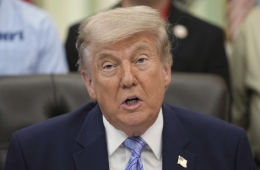
The U.S. Federal Reserve (Fed), which decided on four consecutive giant steps (raising the benchmark interest rate by 0.75 percentage points), has effectively signaled the era of a 5% benchmark interest rate by indicating that the terminal rate will be higher. Jerome Powell, the Fed Chair, drew a line on the possibility of halting rate hikes by saying "there is a long way to go," but left room for easing the pace by emphasizing that "the level and duration of the rate are more important than the speed."
◆ Powell Draws a Line on Halting Rate Hikes, Leaves Room for Pace Adjustment
At a press conference held immediately after the Federal Open Market Committee (FOMC) regular meeting on the afternoon of the 2nd (local time), Chair Powell said, "It is very premature to think or talk about stopping rate hikes," and added, "We have a ways to go."
On the same day, the Fed announced in a statement after the FOMC meeting that it would raise the federal funds rate by 0.75 percentage points from the previous 3.0?3.25% to 3.75?4.0%. This unanimous decision to take an unprecedented four consecutive giant steps came as inflation stubbornly refused to ease despite high-intensity tightening.
Notably, the statement included dovish language such as "considering the cumulative tightening of monetary policy, the lags with which monetary policy affects economic activity and inflation, and economic and financial developments," and "ready to adjust monetary policy appropriately if risks arise," which fueled expectations for future policy adjustments.
However, Chair Powell dismissed these expectations for policy adjustments during the subsequent press conference and confirmed that the tightening stance would continue for the time being. He said, "As rates move into restrictive territory, 'how high' and 'how long' are more important than 'how fast,'" and predicted that "the terminal rate will be higher than previously expected." He also emphasized that "overtightening is easier to correct than undertightening."
He left room for the possibility of slowing the pace of rate hikes. He said, "I have said it would be appropriate to slow the pace of rate hikes, and that time is approaching," adding, "That could be the next meeting (December)." However, he added, "Nothing has been decided yet," noting that it depends on the indicators to be released and the economic impact during the remaining period. While leaving the door open for pace adjustment, he essentially confirmed a data-driven tightening stance similar to previous FOMCs.
He also said, to prevent his remarks from being overly interpreted as dovish in the market and casting doubt on the Fed's commitment to controlling inflation, "People hear 'lags' and think about stopping (rate hikes)," and added, "There is no conversation about stopping rate hikes now. I hope people understand our commitment to price stability."
◆ Attention Drawn to the Forecast of a Higher Terminal Rate
Wall Street is flooded with interpretations weighted toward hawkishness. Mike Feroli, Chief Economist at JP Morgan, summarized the FOMC as "Slower for longer" in an investor memo. The Fed may ease the size of rate hikes as early as next month but raise the terminal rate to a higher level and maintain it for a long period. RBC noted that Powell mentioned the terminal rate before the December Summary of Economic Projections (SEP) was released, evaluating that "the dovish content related to slowing the pace of rate hikes turned into a hawkish meeting due to the mention of a possible upward revision of the terminal rate."
Powell's remark that "the terminal rate could be higher" is expected to be reflected in the dot plot next month. In the dot plot released in September, the terminal rate forecast for next year was 4.5?4.75% (median 4.6%). By clearly indicating it will exceed this, it is widely seen as heralding the era of 5%. Investment bank Citi raised its terminal rate forecast from 5.0?5.25% to 5.25?5.5% on the day. JP Morgan also expects the December dot plot to be revised upward. The interest rate futures market reflects more than a 60% chance that U.S. rates will exceed 5.0% by March next year.
For the last meeting of the year, the December FOMC, the possibility of a big step (0.5 percentage point hike) is gaining traction. According to the Chicago Mercantile Exchange (CME) FedWatch, the probability of a big step in December reflected in the interest rate futures market rose to 56.8% from 44.5% the previous day. However, since inflation remains high and the Fed's hawkish stance continues, the possibility of continuing giant steps until December (43.2%) also exceeds 40%. Morgan Stanley said, "(Powell) did not provide clear guidance on the size of the hike at the next meeting, but the possibility of a 0.5 percentage point hike has increased," adding, "However, this depends on upcoming economic data."
Jack McIntyre, Portfolio Manager at Brandywine Global, said, "Powell's remarks are quite hawkish," and evaluated that the mention in the statement of considering the lagged effects of cumulative tightening suggests flexibility to keep the door open for slowing the pace. He emphasized that going forward, consumer price index (CPI), employment data, and China's zero-COVID policy will have a more sustained impact on the world than signals sent by the Fed.
◆ The Interest Rate Inversion Between Korea and the U.S. Widens... New York Stock Market Also a Roller Coaster
With the Fed's rate hike decision on the day, the interest rate inversion gap between Korea (3.0%) and the U.S. widened to a maximum of 1.0 percentage point. This is the same level as from March 2018 to February 2020, raising concerns about foreign capital outflows and depreciation of the Korean won in the future.
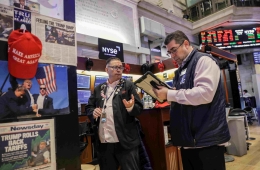
The New York stock market fluctuated. The New York stock market, which started lower awaiting the FOMC regular meeting results, rose after 2 p.m. when the monetary policy statement was released, buoyed by the phrase indicating that policy changes could be made if necessary. The S&P 500 and Nasdaq indices, which had been in a downtrend, both turned upward, and the Dow Jones Industrial Average also slightly expanded its gains.
Hot Picks Today
 "Only Two Per Person" Garbage Bag Crisis Was Just Yesterday... Japan Also Faces Shortage Anxiety
- "Samsung Electronics Employee with 100 Million Won Salary Receiving 600 Million Won Bonus... Estimated Tax Revealed"
- Lived as Family for Over 30 Years... Daughter-in-Law Cast Aside After Husband's Death
- 'Will Demand Finally Decline Due to High Prices?'... "I'll Just Enjoy Nearby Trips" as Japan and China See a Surge
- "Wore It Once, Then This? White Spots All Over 4.15 Million Won Prada Jacket... 'Full Refund Ordered'"
However, immediately after Chair Powell's press conference began and his key remarks were disclosed, the New York stock market sharply turned downward. On the day at the New York Stock Exchange (NYSE), the Dow Jones Industrial Average closed at 32,147.76, down 505.44 points (1.55%) from the previous session. The large-cap S&P 500 index fell 96.41 points (2.50%) to 3,759.69, and the tech-heavy Nasdaq index plunged 366.05 points (3.36%) to 10,524.80.
© The Asia Business Daily(www.asiae.co.kr). All rights reserved.