Mubo "Strengthening Support for the Expansion of Hydrogen Economy Infrastructure"

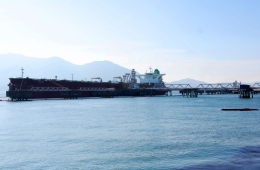
On the 30th, an official is refueling a vehicle with hydrogen at the Incheon International Airport Terminal 2 hydrogen refueling station, the first self-service hydrogen station in Korea. In Korea, hydrogen gas has been regulated under the High-Pressure Gas Safety Control Act, preventing drivers from refueling by themselves. However, the Ministry of Trade, Industry and Energy approved a regulatory sandbox exemption at the 6th Industrial Convergence Regulatory Special Committee in December last year, on the condition of establishing a safety management system for safe demonstration and complying with safety education. A self-service hydrogen refueling demonstration project will be conducted until December 2023. Photo by Moon Honam munonam@
View original image[Asia Economy Sejong=Reporter Dongwoo Lee] The Korea Trade Insurance Corporation shared support programs to strengthen hydrogen infrastructure.
On the 27th, K-Sure held a 'Hydrogen Project Seminar' at its headquarters in Jongno-gu, Seoul, to promote the hydrogen economy.
The seminar was jointly hosted by K-Sure, the Ministry of Trade, Industry and Energy, Cranmore Partners, a financial advisory firm specializing in energy infrastructure, and the multinational law firm Sherman & Sterling.
At the seminar, key issues and response strategies related to hydrogen projects were shared, focusing on excellent project cases to help participating companies enhance their financial and legal response capabilities.
Attorney Anna Jung from Sherman & Sterling conveyed issues to consider in advance when developing hydrogen projects, such as country-specific regulations and technology licenses. She also explained legal differences according to the structure of product sales contracts, considering the industrial characteristic of difficulty in accurate production forecasting.
K-Sure introduced support programs related to hydrogen infrastructure projects, including limit preferences and insurance premium discounts. Until last month, K-Sure provided trade insurance worth 37.3 billion KRW to 11 specialized hydrogen companies.
Seungdal Baek, Vice President of K-Sure, said, "To strengthen the competitiveness of our companies' hydrogen projects, it is necessary to accumulate various know-how, invest, and provide policy support."
Hot Picks Today
 "Stocks Are Not Taxed, but Annual Crypto Gains Over 2.5 Million Won to Be Taxed Next Year... Investors Push Back"
- "Don't Throw Away Coffee Grounds" Transformed into 'High-Grade Fuel' in Just 90 Seconds [Reading Science]
- Signed Without Viewing for 1.6 Billion Won... Jamsil and Seongbuk Jeonse Prices Jump 200 Million Won in a Month [Real Estate AtoZ]
- [Breaking] President Lee: "Sharing operating profit before taxes are deducted?... I don't understand"
- "Even With a 90 Million Won Salary and Bonuses, It Doesn’t Feel Like Much"... A Latecomer Rookie Who Beat 70 to 1 Odds [Scientists Are Disappearing] ③
© The Asia Business Daily(www.asiae.co.kr). All rights reserved.