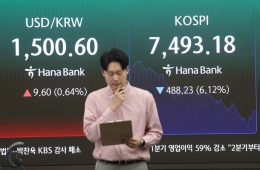
KOSPI Rollercoaster Without a Bottom Yet... Growing Downside Caution Amid Recession Warning Signals

[Asia Economy Reporter Lee Seon-ae] Warning signals for further declines in the KOSPI are growing louder. Variables such as economic recession and tightening monetary policies are expected to continuously exert downward pressure on the stock market. In particular, the increasing possibility of a year-on-year decline in KOSPI operating profits this year is dampening investor sentiment. Despite the shock from the US Consumer Price Index (CPI) last week exceeding expectations, the domestic stock market rebounded and recovered the 2200 level in just one day, influenced by the US stock market. However, on the 17th, it fell back below 2200, showing extreme volatility, leading to growing voices cautioning that further declines should be anticipated rather than a ‘flash rally’ going forward.
On that day, the KOSPI opened at 2187.17, down 1.15% from the previous trading day, once again falling below the 2200 mark. The recovery above 2200 was short-lived. Securities firms unanimously agree that given the significant domestic and international uncertainties surrounding the market, further declines should be anticipated. Regarding the collapse of the KOSPI below 2200, Seo Sang-young, a researcher at Mirae Asset Securities, noted, "The previous day’s US stock market decline was influenced by a combination of factors including lack of confidence in the UK government, rising US expected inflation, and recession concerns due to slowing retail sales, which weighed on the domestic stock market." He added, "The strengthening of the US dollar and the resulting depreciation of the Korean won also contributed to weakening investor sentiment."
This week, Kim Young-hwan, a researcher at NH Investment & Securities, suggested a weekly KOSPI range of 2090 to 2210 and cited the possibility of a realized economic recession as a downward pressure factor. Kim said, "We are currently in the early to mid-phase where actual economic slowdown is being confirmed, so it is not yet a time when the bottom of the economy is clearly visible." He added, "From a macro perspective, it is difficult to expect economic stimulus from the Federal Reserve (Fed) due to high inflation, and from a micro perspective, rising prices and wages are increasing corporate cost burdens, which is troubling both companies and investors."
The expectation that the Fed will maintain a strong tightening stance if high inflation persists is exerting downward pressure on the stock market. Regarding this, Kim Sung-geun, a researcher at Mirae Asset Securities, also said, "Although the stock market has rebounded, it is expected to be limited." He pointed out, "The September CPI results suggest that inflation is likely to decline more slowly than expected, and the Fed’s hawkish stance is likely to continue for a longer period."
Samsung Securities forecasted that as confirmed by the September US CPI, underlying inflationary pressures remain persistent, and if the Fed’s tightening intensifies further, it will be difficult to predict the upper limit of interest rates. Cape Investment & Securities predicted that with the Fed’s high-intensity tightening policy continuing until December, the stock market is likely to remain in a box range until the end of the year. Lee Kyung-min, a researcher at Daishin Securities, emphasized, "The global financial market is still highly sensitive to inflation and monetary policy, which means it has not escaped the main causes of the initial decline. Therefore, caution is needed regarding the possibility of further declines due to fundamental factors such as economic recession and earnings slowdown."
Warnings about a decline in KOSPI operating profits are also increasing, which is expected to weigh on the stock market. According to financial information provider FnGuide, the estimated annual sales for 180 KOSPI-listed companies with earnings forecasts from three or more securities firms is KRW 2,474.2257 trillion, and the estimated operating profit is KRW 205.8487 trillion. This represents a 19.6% increase in sales and a 0.4% increase in operating profit compared to last year. The problem is that the annual operating profit estimates have been continuously lowered. Three months ago, the annual operating profit estimate was KRW 222.5629 trillion, but it sharply dropped to KRW 216.4515 trillion one month ago and to the 205 trillion range this month. If this downward trend continues, it is expected to ultimately result in negative growth.
Jung Myung-ji, head of investment information at Samsung Securities, pointed out, "The downward revision of profit estimates is strong in semiconductors, which account for the largest portion of overall earnings, and oil companies that posted record earnings in the first half are also expected to see profit declines in the second half." He added, "Assuming SK Hynix’s earnings estimates are further lowered, the possibility of year-on-year negative growth in KOSPI operating profits this year is high." Yeom Dong-chan, a researcher at Korea Investment & Securities, also emphasized, "Last year, KOSPI’s annual operating profit exceeded KRW 200 trillion for the first time, reaching KRW 217 trillion, but we need to consider the possibility that annual operating profits may fall below KRW 200 trillion."
Hot Picks Today
 After Topping 8,000 Instead of Hitting 10,000... KOSPI Plunges—When Will It Rebound?
- "Samsung and Hynix Were Once for the Underachievers"... Hyundai Motor Employee's Lament
- [Breaking] Court Rules Against Samsung Electronics Union...1 Billion Won per Day Penalty for Exceeding Strike Scope
- Global Big Tech Joins AI Firms in Full-Scale AI Agent Showdown
- "That? It's Already Stashed" Nightlife Scene Crosses the Line [ChwiYak Nation] ③
© The Asia Business Daily(www.asiae.co.kr). All rights reserved.