National Police Agency Chief Urges Nationwide Command to "Enhance Victim Protection Response System"
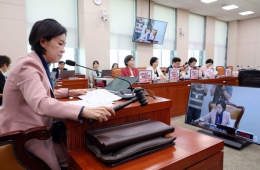
![Police Chief Yoon Hee-geun visited the Jungbu Police Station in Seoul on the afternoon of the 15th to receive a report regarding the murder of a station worker at Sindang Station. Chief Yoon ordered a thorough investigation and the preparation of measures to improve victim protection systems during his visit to the Jungbu Police Station. <br>[Image source=Yonhap News]](http://www.asiae.co.kr/news/img_view.htm?img=2022091609441934562_1663289059.jpg)
Police Chief Yoon Hee-geun visited the Jungbu Police Station in Seoul on the afternoon of the 15th to receive a report regarding the murder of a station worker at Sindang Station. Chief Yoon ordered a thorough investigation and the preparation of measures to improve victim protection systems during his visit to the Jungbu Police Station.
[Image source=Yonhap News]
[Asia Economy Reporter Seongpil Cho] Yoon Hee-geun, Commissioner of the National Police Agency, on the 16th ordered police leadership nationwide to "further enhance the police response system, including victim protection," in relation to the Sindang Station clerk murder case.
At the 'National Police Leadership Workshop' held at the Police Human Resources Development Institute in Asan, Chungnam, Commissioner Yoon urged, "Prepare fundamental improvement measures through cooperation with related agencies." About 650 people attended the workshop, including Commissioner Yoon, chiefs of police agencies from cities and provinces nationwide, and police station chiefs. Kim Kwang-ho, Chief of Seoul Metropolitan Police Agency, Park Jeong-bo, Deputy Chief of Investigation at Seoul Police Agency, and Kim Seong-jong, Head of Investigation Department at Seoul Police Agency, did not attend due to their involvement in the investigation of the Sindang Station clerk murder case.
Attendees reportedly focused on discussing improvements in police response to crimes such as stalking and victim protection related to the clerk murder incident at Sindang Station. Commissioner Yoon emphasized, "Please deeply consider ways to concretize the main proposals discussed at the workshop into policies," and added, "Based on the discussions, police leadership should take the lead in realizing a 'competent and confident police force, a safe community trusted by the public.'"
During his visit to the Seoul Jungbu Police Station, which is investigating the Sindang Station clerk murder case the previous day, Commissioner Yoon also stated, "We will do our best to identify institutional problems and prepare improvement measures related to victim protection." He urged thorough and strict investigations to staff, emphasizing, "It is time for not only the police but also related agencies to put their heads together and pool wisdom to find fundamental solutions for victim protection."
Previously, after the Kim Tae-hyun and Lee Seok-jun cases, where women under personal protection or their families were murdered, the police revised several on-site response systems to protect stalking victims. Numerous improvements were introduced, including registration in the Personal Protection 112 System, emergency response measures, provisional measures, issuance of smartwatches, and linked patrols. Since the Kim Byung-chan case last year, a task force (TF) to strengthen on-site response capabilities has been operating, establishing a response segmentation strategy that classifies victim risk levels into three stages and implements safety measures accordingly.

At the entrance of the women's restroom at Sindang Station on Seoul Subway Line 2, where a female attendant was killed by a coworker who had been stalking her, citizens continue to visit to pay their respects. Photo by Mun Ho-nam munonam@
View original imageHowever, voices suggest that the recent Sindang Station clerk murder case reveals the limitations of these improvement measures. According to the police, the victim in this case was registered in the Personal Protection 112 System for one month starting October 8 last year. This was from the day after the victim filed a police complaint against the perpetrator, A, on October 7 for violating the Act on Special Cases Concerning the Punishment, etc. of Sexual Crimes (illegal filming using a camera, threats using the footage). The police checked the risk level during this period but found no particular issues, and the victim did not wish to extend the registration period, so safety measures were lifted in early November.
The police also did not take additional measures when the victim filed an additional complaint against A in January this year for violating the Stalking Punishment Act. Regarding this, the police stated, "If the victim does not want safety measures, the police cannot enforce them," and "We can only recommend measures if the risk level is high." Ultimately, there was no institutional mechanism to protect the victim for the 10 months until A committed the murder.
Hot Picks Today
 "Now Our Salaries Are 10 Million Won a Month" Record High... Semiconductor Boom Drives Performance Bonuses at Major Electronic Component Firms
- Wallets Open Wide on Big News...300 Trillion Won Heads to the U.S., "Tax Breaks" Fail to Keep Funds at Home
- "Realizing How Fast Money Disappears: Should You Try Only the Essentials for 5,000 Won? [The Basics of Benefits]"
- "Heading for 2 Million Won": The Company the Securities Industry Says Not to Doubt [Weekend Money]
- Experts Already Watching Closely..."Target Price Set at 970,000 Won" Only Upward Momentum Remains [Weekend Money]
Experts point out that while such institutional mechanisms are designed to protect the victim, there are virtually no sanctions that can be imposed on the perpetrator. Professor Kim Do-woo of the Department of Police Science at Gyeongnam National University said, "During the police investigation stage, the principle of presumption of innocence is followed too strictly, so there is a lack of physical sanctions to make potential offenders aware of the seriousness of their actions," adding, "To prevent stalking retaliation crimes in advance, legal and institutional reforms are needed to allow police to actively intervene from a preventive perspective."
© The Asia Business Daily(www.asiae.co.kr). All rights reserved.