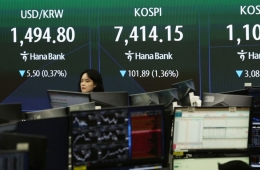
Bank Stocks Fallen Too Far, Showing Signs of Gradual Recovery
A 21% Sharp Decline Over Two Months Since Last June
Government Financial Support and Loan Loss Provision Issues Raise Profit Concerns
Hana Financial Group and Others Show Upward Trend This Month

[Asia Economy Reporter Minji Lee] Investor interest is increasing in bank stocks, which had been sluggish due to government regulations and concerns over rising loan loss provisions.
According to the Korea Exchange on the 26th, from the 1st of this month to the previous day, the KRX Bank Index rose 0.99%, from 622.35 to 628.52. Bank stocks had fallen more than 21% over two months from June to the end of July, showing the largest decline among KRX indices. As the stock price drop became excessive, significantly underperforming the KOSPI (-8%) returns over the past two months, investment sentiment has improved mainly among individual investors.
By stock, Hana Financial Group fell nearly 29%, from 47,600 KRW on June 2 to 33,850 KRW on July 15, but has risen about 6% since the beginning of this month. Industrial Bank of Korea also dropped more than 16% over the past two months but has shown a rise of around 4% this month. KB Financial Group (5%), Woori Financial Group (4.6%), and JB Financial Group (2%) have also maintained an upward trend since the 1st of this month.
The biggest factor suppressing bank stock prices so far has been concerns over a decrease in net interest margin (NIM) due to various government financial support policies. With the emphasis on the public nature of banks, there has been a view that banks might have to bear losses as they did in the past.
However, experts analyze that the impact of government financial support policies on banks will be less severe than expected. For example, the low-interest refinancing loan program (8.5 trillion KRW) offers borrowers refinancing at a low interest rate of 5.5% in the first to second year, compared to over 7% previously. In terms of scale, banks account for 20% and non-banks 80%, so the bank sector's share is relatively small. The New Start Fund (30 trillion KRW) is also different from the National Happiness Fund of 2013-2014, which caused impairment losses for banks, as it is funded by the private sector, and the recovery rate is expected to be higher than before, limiting its impact on NIM.
Although banks are increasing loan loss provisions due to economic slowdown, which limits stock price gains, experts believe that profits will not decline so significantly as to trigger a long-term downtrend in stock prices. Kyunghoe Koo, a researcher at SK Securities, analyzed, "Next year, the bank loan loss provision ratio will rise to a maximum of 0.43%, higher than the recent four-year average of 0.31%, but since no specific industry is hitting a limit, the increase in loan loss provisions will be small."
Hot Picks Today
!["Rather Than Endure a 1.5 Million KRW Stipend, I'd Rather Earn 500 Million in the U.S." Top Talent from SNU and KAIST Are Leaving [Scientists Are Disappearing] ①](https://cwcontent.asiae.co.kr/asiaresize/93/2026051414165763158_1778735817.jpg) "Rather Than Endure a 1.5 Million KRW Stipend, I'd Rather Earn 500 Million in the U.S." Top Talent from SNU and KAIST Are Leaving [Scientists Are Disappearing] ①
"Rather Than Endure a 1.5 Million KRW Stipend, I'd Rather Earn 500 Million in the U.S." Top Talent from SNU and KAIST Are Leaving [Scientists Are Disappearing] ①
- [Breaking] Park Sukeun, Central Labor Relations Commission Chair: "Some Gaps Narrowed Between Samsung Electronics Labor and Management"
- Is This the Peak? As Others Hesitate..."The Answer Is Clear for Surviving the KOSPI 10,000 Era"
- "If That's the Case, Why Not Just Buy Stocks?" ETFs in Name Only, Now 'Semiconductor-Heavy' and a Playground for Short-Term Traders
- "No Cure Available, Spread Accelerates... Already 105 Dead, American Infected"
The investment appeal has also increased due to the sharp drop in stock prices despite solid earnings. The price-to-book ratio (PBR) of bank stocks is at an all-time low of 0.4 times. While net income of major U.S. bank holding companies is expected to decrease by about 40% this year, the combined annual operating profit of eight domestic banks (Woori Financial Group, JB Financial Group, Shinhan Financial Group, BNK Financial Group, Industrial Bank of Korea, KB Financial Group, Hana Financial Group, DGB Financial Group) is estimated at 29.3244 trillion KRW, representing an average growth of 12%.
© The Asia Business Daily(www.asiae.co.kr). All rights reserved.