'US Ultra Step Included'.. What About the Domestic Stock Market?
US Takes Strong Measures to Curb Inflation
Mixed Views on Impact on Domestic Stock Market
![[Image source=Yonhap News]](http://www.asiae.co.kr/news/img_view.htm?img=2022050908271559051_1652052435.jpg)
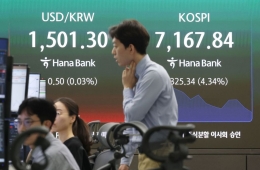
[Asia Economy Reporter Hwang Junho] As the possibility of ultra-high-intensity inflation control measures arises in the United States, fear has increased in the South Korean stock market. This fear stems from the possibility of a 1 percentage point (100bp) increase in the benchmark interest rate, known as an ultra step. While there are concerns that the stock market could further decline due to the interest rate hike, there is also speculation that the speed of market normalization could accelerate as strong measures to curb inflation take effect.
According to the Korea Exchange on the 18th, the KOSPI experienced a significant drop after the Federal Open Market Committee (FOMC), which sets the direction of U.S. monetary policy, held its meetings. This year, four FOMC meetings have been held, resulting in a total benchmark interest rate increase of 1.50 percentage points. Since the FOMC meeting on March 17, when the interest rate was raised, the KOSPI has rapidly frozen. It fell from 2694.51 at that time to 2300.98 on the 15th.
Last month on the 16th, despite concerns about an economic recession, the FOMC implemented a giant step by raising the rate by 0.75 percentage points at once. The June Consumer Price Index (CPI) again hit a record high of 9.1%. Accordingly, there is even talk of an ultra step (a 1 percentage point increase) at the FOMC meeting scheduled for June 26-27. Cha Hyun-gi, a researcher at Cape Securities, predicted, "If an ultra step is implemented, the domestic stock market could experience an additional level down." However, as dovish comments have emerged among Federal Reserve (Fed) officials, the expectation that the interest rate hike will be around a giant step (0.75 percentage points) is gaining traction.
Although the possibility of an ultra step has decreased, it is not a situation to be relieved of concern. Moreover, unless the interest rate hike is below the big step level, there is still concern about downward pressure on the stock market due to the possibility of a Korea-U.S. interest rate inversion. The U.S. benchmark interest rate following the giant step is around 2.25?2.5%, which would exceed South Korea's current benchmark rate of 2.25%.
Funds flow from lower-yielding to higher-yielding markets, and considering risks from economic slowdown, it is safer to channel funds into the U.S. stock market rather than the South Korean market. In particular, foreign investors, who determine the direction of the domestic stock market, are moving according to these conditions. Seo Jeong-hoon, a researcher at Samsung Securities' Investment Information Team, said, "The dollar, which gained upward momentum with the giant step, has additional upward momentum due to the simultaneous weakness of the yen and euro," adding, "In a strong dollar environment, foreign inflows are inevitably limited." He further predicted, "The dollar will lower its head only when inflationary pressures decrease and clearer signals emerge that the Fed is slowing the pace of rate hikes, which will enable foreign inflows and stock market improvement."
Hot Picks Today
 "Samsung and Hynix Were Once for the Underachievers"... Hyundai Motor Employee's Lament
- "Plunged During the War, Now Surging Again"... The Real Reason Behind the 6% One-Day Silver Market Rally [Weekend Money]
- After Losing Her Only Daughter, a Mother in China Gave Birth to Twins at 60... Reinventing Life at 76
- "We Will Return to the EU" ... Brexit Reignited in UK Prime Ministerial Race
- "That? It's Already Stashed" Nightlife Scene Crosses the Line [ChwiYak Nation] ③
However, as strong inflation control continues, there is also a forecast that the vicious cycle among inflation, monetary policy, and the economy could weaken. Lee Kyung-min, a researcher at Daishin Securities, said, "As concerns about an economic recession grow, expectations for monetary policy easing are accelerating," adding, "Looking at the recent consensus on U.S. Fed rate hikes, the forecast for rate cuts in 2023 has been moved forward to the second quarter." His view is that as the vicious cycle among 'inflation - monetary policy - economy' weakens, the market could enter a phase of reaction (technical rebound) following the initial effect (expanded downward pressure).
© The Asia Business Daily(www.asiae.co.kr). All rights reserved.