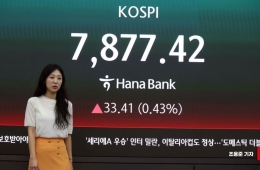
Concerns Over Second Big Step... Stocks 'Pause for Now' Bonds 'Quick Steps'
Bank of Korea's Monetary Policy Committee Makes First Big Step
Base Interest Rate Rises to 2% Range
Big Step Possible Next Month
Stock Experts Advise Response After Checking Key Economic Indicators and FOMC
10-Year Government Bond Yield at 3.2~3.3%
Bond Investors See Opportunity for Bargain Buying

The Monetary Policy Committee (MPC) of the Bank of Korea raised the base interest rate to the 2% range for the first time ever by implementing a big step (a 50 basis point increase). Amid this, market experts are forecasting that the MPC may once again resort to the big step card next month, considering inflationary pressures and the interest rate levels in the United States.
◆BOK's Unprecedented Response... Also in August?
On the morning of the 13th, the Bank of Korea's Monetary Policy Committee held a full meeting and decided to operate monetary policy by raising the base interest rate from 1.75% to 2.25%, an increase of 0.5 percentage points. This marks the first time in history that the base rate was raised by 50 basis points (1bp = 0.01 percentage points) at once, following three consecutive rate hikes in April and May.
The prolonged inflation has caused inflationary pressures to grow uncontrollably, and the aggressive moves by the U.S. Federal Open Market Committee (FOMC) have left no choice but to select the big step. This month, the U.S. FOMC is expected to take a giant step (raising the base rate by 75bp at once), surpassing the big step. If this happens, the U.S. base interest rate will rise to 2.5%, surpassing South Korea's base rate. If the interest rate gap widens, foreign capital outflows from the domestic market could accelerate.
The key question is whether the big step will end with just one occurrence. The market expects that the MPC's big step will not end with this one time. Inflationary pressures and the weak Korean won, which triggered the big step, are not expected to subside easily. Kim Seong-su, a researcher at Hanwha Investment & Securities, said, "Inflation, the most important factor, is at an unprecedentedly high level, making stabilization impossible. Considering that the time for the economy to endure tightening is decreasing, it is highly likely that consecutive big steps will be taken."
◆Watching the FOMC... Stocks ‘On Hold’
As inflation variables increasingly pressure the financial market, stock experts believe it is necessary to respond after confirming key economic indicators and the FOMC results. Although buying sentiment has partially revived for stocks with excessive declines such as secondary batteries, semiconductors, and bio sectors, it is difficult to connect this to a trend of sustained rises.

Among the economic indicators to watch most closely is the U.S. June CPI, released at 9 p.m. Korean time on the same day. The market expects an 8.8% increase compared to the same month last year. Since the May CPI (8.6%), which greatly exceeded expectations earlier last month, dragged down global indices, if this time also shocks the market, further declines in indices are expected. Furthermore, the June CPI results are expected to determine the tightening intensity of the July FOMC (to be announced on the 28th). Moon Nam-jung, a researcher at Daishin Securities, analyzed, "If the Fed confirms a continuous inflation rise, it is expected to take a giant step, which is a factor that will increase stock market volatility."
The U.S. second-quarter GDP growth rate is also important because it can confirm the intensity of the 'recession,' another variable suppressing the stock market. Currently, the Atlanta Fed's GDPNow for the second quarter is at about -1.2% quarter-on-quarter. Although this is an improvement from the early-month forecast (-2.1%), if it records consecutive negative growth following the first quarter GDP growth rate (-1.6%), the recession concerns are expected to intensify.
Expectations for domestic companies' earnings are rapidly fading, making it difficult to sustain earnings momentum in the stock market. Due to rising raw material prices, freight costs, and labor expenses, companies' burdens are increasing, causing third-quarter operating profit estimates to decline sharply. The annual earnings consensus for KOSPI-listed companies is below 250 trillion won, which is 2 trillion won lower than a month ago.
◆Bond ‘Bargain Buying Opportunity’
On the other hand, it is an opportunity for bond investors to buy bonds cheaply. Assuming the MPC raises interest rates by an additional 50bp in August, it would be a chance to buy bonds at a low price. Bond prices and interest rates have an inverse relationship. Early this month, concerns about a recession expanded, causing bond yields to fall, and the 10-year government bond yield, which had surged to 3.7%, has dropped to the 3.2% range. If the big step card is played again in August, market interest rates will inevitably rise.
Kim Ji-na, a researcher at Eugene Investment & Securities, analyzed, "It is advisable to take the opportunity to buy long-term bonds when concerns about the big step increase again. This is because if the tightening phase ends quickly and the possibility of a recession in the second half of the year expands, bond yields are expected to turn downward again."
Hot Picks Today
 "Samsung Electronics Employee with 100 Million Won Salary Receiving 600 Million Won Bonus... Estimated Tax Revealed"
- "Only Two Per Person" Garbage Bag Crisis Was Just Yesterday... Japan Also Faces Shortage Anxiety
- Lived as Family for Over 30 Years... Daughter-in-Law Cast Aside After Husband's Death
- Despite ‘Tank Day’ Controversy, Gwangju Schools Purchased Starbucks Gift Certificates
- "Wore It Once, Then This? White Spots All Over 4.15 Million Won Prada Jacket... 'Full Refund Ordered'"
© The Asia Business Daily(www.asiae.co.kr). All rights reserved.