Accumulating Objections to Next Year's Minimum Wage... Will It Also Be Rejected This Year?
No Objections Accepted in Minimum Wage History
Both Labor and Management Oppose Next Year's Minimum Wage Increase Rate
Last Year's Minister of Employment Said "Respect the Minimum Wage Commission's Decision"
Need to Change Not Only the Calculation Method but Also the Decision-Making Structure
![[Image source=Yonhap News]](http://www.asiae.co.kr/news/img_view.htm?img=2022070220130935251_1656760389.jpg)
Next year's minimum wage has been set at 9,620 won, a 5% increase from this year, sparking objections from both labor and management sectors. As the minimum wage is effectively decided mainly by public interest committee members amid labor-management conflicts, opposition arises every year. However, since objections have never been accepted before, it is expected that this year's protests will also end up as empty cries.
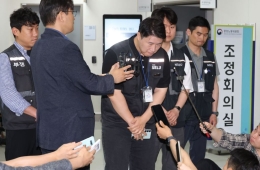
According to labor and management sectors on the 9th, since the Minimum Wage Commission decided on the minimum wage for next year at 9,620 won, 5.0% higher than this year, on the 29th of last month, objections from both sides have been accumulating.
The Korea Federation of Small and Medium Business (Kbiz) announced that it submitted an objection letter regarding the '2023 Minimum Wage Proposal' to the Ministry of Employment and Labor the day before. In the objection letter, Kbiz argued, "It is unreasonable to fully pass on the economic growth rate and inflation rate, which were presented as the basis for deciding next year's minimum wage proposal, to small and micro enterprises and small business owners," adding, "Currently, small and medium enterprises are facing poor business conditions and have not yet recovered their payment capacity."
According to the Minimum Wage Act, representatives of workers or employers can file an objection to the Minister of Employment and Labor within 10 days if they have any objections to the minimum wage proposal. If the Minister recognizes the objection as valid, they must disclose the details and request the Minimum Wage Commission to reconsider, and the minimum wage cannot be decided until the commission submits a re-deliberated and resolved minimum wage proposal.
This year, criticism from labor and management sectors has continued since the minimum wage was decided. The Korean Confederation of Trade Unions (KCTU) already held a press conference at its headquarters in Jung-gu, Seoul, on the 5th and announced that it filed an objection with the Ministry of Employment and Labor. The KCTU criticized the minimum wage, saying, "It was hastily processed without in-depth discussion under the pretext of meeting the legal deadline," and "The level does not even keep up with the inflation rate." Earlier, the labor sector initially demanded 10,890 won for next year's minimum wage and lowered the demand to 10,080 won during negotiations but did not back down from achieving a '10,000 won level.'
![[Image source=Yonhap News]](http://www.asiae.co.kr/news/img_view.htm?img=2022070821410443588_1657284064.jpg)
While the labor sector argues that the minimum wage increase rate is too low, small business owners and self-employed people are opposing it as "too high." The Korea Federation of Micro Enterprise recently stated in a commentary, "A 5% increase rate is absolutely unacceptable when comprehensively considering the payment capacity of small business owners and the current economic situation," and the National Convenience Store Franchise Association strongly opposed by demanding a 'late-night surcharge system' from headquarters. The Korea Employers Federation (KEF) has also expressed its intention to file an objection.
Both labor and management sectors commonly oppose the method of calculating the minimum wage. Public interest committee members, as in the previous year, determined the increase rate by adding the average forecast of economic growth rate (2.7%) and the forecast of consumer price inflation rate (4.5%) and then subtracting the forecast of employment increase rate (2.2%). Both labor and management criticized this formula itself as having no legal basis and being unreasonable.
Amid intense labor-management conflicts, public interest committee members aim to exclude the interests of specific groups, politics, and ideology and derive the increase rate as scientifically as possible. However, there is controversy over why the formula is based on the average forecast of economic growth rate, consumer price inflation rate, and employment increase rate among various factors.
The decision criteria stipulated in the Minimum Wage Act are ▲cost of living ▲labor productivity ▲labor income distribution rate ▲wages of similar workers, which have no special relation to the above formula, and forecasts are not final figures, so there is a possibility of errors. Accordingly, voices from the industry call not only to change the method of calculating the increase rate but also to alter the structure where the minimum wage is decided mainly by public interest committee members.
Hot Picks Today
 "Stocks Are Not Taxed, but Annual Crypto Gains Over 2.5 Million Won to Be Taxed Next Year... Investors Push Back"
- Samsung Electronics' Second Post-Adjustment Negotiation Fails... Central Labor Commission: "Labor Accepted, Management Deferred" (Update)
- "Not Jealous of Winning the Lottery"... Entire Village Stunned as 200 Million Won Jackpot of Wild Ginseng Cluster Discovered at Jirisan
- Bull Market End Signal? Securities Firm Warns: "Sell SK hynix 'At This Moment'"
- "Even With a 90 Million Won Salary and Bonuses, It Doesn’t Feel Like Much"... A Latecomer Rookie Who Beat 70 to 1 Odds [Scientists Are Disappearing] ③
Although labor and management sectors have filed objections, the likelihood of acceptance is low. There has never been a case of reconsideration in the history of the minimum wage system. Last year, although management filed an objection to the minimum wage proposal, the Ministry of Employment and Labor published it in the official gazette as originally decided. At that time, Minister of Employment and Labor An Kyung-duk said, "We respect the fact that the Minimum Wage Commission made a comprehensive decision after doing its best."
© The Asia Business Daily(www.asiae.co.kr). All rights reserved.