Black Friday Shock Hits Hard: "KOSPI and KOSDAQ at Lowest Levels"... Finally, 50,000 Electronics Stocks Collapse
![[Image source=Yonhap News]](http://www.asiae.co.kr/news/img_view.htm?img=2022061710410117059_1655430061.jpg)
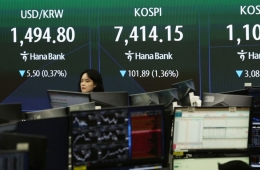
[Asia Economy Reporter Lee Seon-ae] The shock of 'Black Friday' triggered by the overnight plunge in the New York stock market was fully transmitted to the domestic market. Both the KOSPI and KOSDAQ hit new yearly lows. The market was heavily overwhelmed by concerns of an economic recession due to the Federal Reserve's (Fed) aggressive tightening.
As of 10:36 a.m. on the 17th, the KOSPI was down 1.06% at 2,425.51, and the KOSDAQ was down 1.34% at 791.44. On that day, the KOSPI opened at 2,409.72, down 41.69 points (1.70%) from the previous session. It fell below 2,400 shortly after the opening. The intraday break below 2,400 on the KOSPI was the first in 1 year and 7 months since November 5, 2020 (2,370.85). The KOSDAQ started the session below 800, opening at 787.97, down 14.18 points (1.77%). The KOSDAQ falling into the 780s during the session was also the first time in 1 year and 8 months.
The New York stock market was heavily influenced by the collapse following the Fed's large interest rate hike and the end of the 'relief rally' just one day earlier. On the 16th (local time), the Dow Jones Industrial Average closed at 29,927.07, down 741.46 points (2.42%) from the previous session. The Dow falling below the 30,000 mark at the close was the first time in 1 year and 5 months since January last year. The Standard & Poor's (S&P) 500 index dropped sharply by 123.22 points (3.25%) to 3,666.77, and the tech-heavy Nasdaq index plunged 453.06 points (4.08%) to 10,646.10. The Nasdaq index is at its lowest level since September 2020. Despite the 0.75 percentage point rate hike?the largest in 28 years?the day before, investors who had bought stocks due to uncertainty easing and the Fed's strong commitment to price stability seemed burdened by the ongoing prospects of further Fed rate hikes and the resulting possibility of an economic recession. Fed Chair Jerome Powell is expected to raise rates by 0.50 or 0.75 percentage points at the July meeting, indicating that aggressive tightening may continue in the short term. As tightening continues globally, concerns are growing that reduced global liquidity will slow economic growth.
Foreign investors, who had turned to net buying the previous day, resumed net selling in just one day. They have sold about 308.2 billion KRW in the KOSPI market. Meanwhile, individuals and institutions are buying about 58.1 billion KRW and 229.2 billion KRW, respectively.
All of the top market capitalization stocks in the KOSPI are uniformly weak. Samsung Electronics' stock price finally broke below 60,000 KRW. It opened at 59,400 KRW, down 2.46% on the day. Although the early session losses slightly narrowed, it still hovered below 60,000 KRW. The intraday drop below 60,000 KRW for Samsung Electronics was also the first in about 1 year and 7 months. Securities firms are collectively lowering their target prices for Samsung Electronics, citing concerns over earnings deterioration due to tightening. On the 13th, SangSangIn Securities lowered Samsung Electronics' target price to 74,000 KRW and projected a downside support level of 57,000 KRW. Naver and Kakao also showed declines in the mid-to-high 1% range, hitting 52-week lows. The top market capitalization stocks in the KOSDAQ are also mostly falling. While secondary battery stocks such as EcoPro BM and Cheonbo declined slightly, Celltrion Healthcare and Celltrion Pharm dropped more than 1%.
Hot Picks Today
!["Rather Than Endure a 1.5 Million KRW Stipend, I'd Rather Earn 500 Million in the U.S." Top Talent from SNU and KAIST Are Leaving [Scientists Are Disappearing] ①](https://cwcontent.asiae.co.kr/asiaresize/93/2026051414165763158_1778735817.jpg) "Rather Than Endure a 1.5 Million KRW Stipend, I'd Rather Earn 500 Million in the U.S." Top Talent from SNU and KAIST Are Leaving [Scientists Are Disappearing] ①
"Rather Than Endure a 1.5 Million KRW Stipend, I'd Rather Earn 500 Million in the U.S." Top Talent from SNU and KAIST Are Leaving [Scientists Are Disappearing] ①
- [Breaking] Chung Yongjin Apologizes for Starbucks 'Tank Day' Controversy: "I Take Full Responsibility"
- "If That's the Case, Why Not Just Buy Stocks?" ETFs in Name Only, Now 'Semiconductor-Heavy' and a Playground for Short-Term Traders
- "Most Americans Didn't Want This"... Americans Lose 60 Trillion Won to Soaring Fuel Costs
- "No Cure Available, Spread Accelerates... Already 105 Dead, American Infected"
Seo Sang-young, head of the Media Content Division at Mirae Asset Securities, analyzed, "Although the possibility of an immediate economic recession in global countries is limited, it is true that the demand slowdown caused by interest rate hikes by the Fed and other central banks has increased the likelihood of a recession. If global stock markets fall due to recession concerns, it will be a burden on the Korean stock market, which is highly dependent on exports."
© The Asia Business Daily(www.asiae.co.kr). All rights reserved.