Presidential Office and Chief Secretary Hold Meeting at Emergency Economic Situation Room... "Lasting Longer Than Past Crises"
![[Image source=Yonhap News]](http://www.asiae.co.kr/news/img_view.htm?img=2022051611404068130_1652668840.jpg)
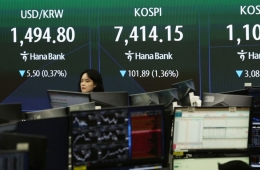
[Asia Economy Reporter Ki-min Lee] The Presidential Office announced that it has shifted to an emergency system by operating the daily morning meeting chaired by the Chief Presidential Secretary as an Emergency Economic Situation Room to respond to the so-called 'three-high (high) crisis' caused by high inflation, high interest rates, and high exchange rates.
A senior official from the Presidential Office said at a briefing held at the Yongsan Presidential Office on the afternoon of the 15th, "The daily morning meeting chaired by (Kim Dae-gi) the Chief Presidential Secretary is already being held every morning, and it is being operated as an Emergency Economic Situation Room." This briefing was held a day before the announcement of the 'Economic Policy Direction,' which contains the economic blueprint for the new government's five years.
The senior official added, "The economic chief secretary's office is the first to report to the President," and said that the economic ministers' meeting chaired by the Deputy Prime Minister will be converted into an Emergency Economic Ministers' Meeting. In addition, Choi Sang-mok, the Senior Secretary for Economic Affairs, will attend the macro-financial ministers' meeting to serve as a bridge between the Presidential Office and the Cabinet.
The reason the Presidential Office and the Cabinet have taken such measures is because they judged that this crisis is the most difficult to resolve among the three economic crises experienced since the 2000s: the IT company-driven economic crisis known as the dot-com bubble in 2001, the global financial crisis in 2008, and this year's supply chain crisis.
The official explained, "In early 2001, it was not a global crisis, but there was a significant shock. In 2008, the global financial crisis occurred. Although it turned into a very large financial crisis in the short term, it was resolved quickly. The phenomena are similar, but the causes are different. The cause of this three-high crisis is a supply-side crisis caused by difficulties in supply. It could be a supply chain shock due to COVID-19, or the rise in resource prices due to the Ukraine war, including increased energy prices."
In the cases of the 2001 and 2008 economic crises, since they were caused by demand-side problems, the government overcame the crisis through structural reforms such as nationalizing financial institutions and securing foreign currency. However, this time, because it is a supply chain crisis, it will take considerable time until the situation is resolved.
The official emphasized, "There are parts where bottlenecks in the production and distribution process of goods need to be temporarily cleared and costs reduced. Since supply and demand difficulties can cause prices to soar in the short term, the government's role is to unblock these bottlenecks."
He also stressed, "Not only the government but also the private market needs system reforms to enhance crisis response capabilities and resilience by improving production capacity and efficiency." This means that due to the supply chain crisis, supply volume has decreased, efficiency has dropped, and costs have risen, so system reforms in the private sector are necessary.
Referring to the resolution of the general strike after negotiations between the Ministry of Land, Infrastructure and Transport and the Cargo Solidarity the day before, he said, "It is truly fortunate that the strike was halted in a situation where it could fundamentally impact the industrial sector."
Hot Picks Today
!["Rather Than Endure a 1.5 Million KRW Stipend, I'd Rather Earn 500 Million in the U.S." Top Talent from SNU and KAIST Are Leaving [Scientists Are Disappearing] ①](https://cwcontent.asiae.co.kr/asiaresize/93/2026051414165763158_1778735817.jpg) "Rather Than Endure a 1.5 Million KRW Stipend, I'd Rather Earn 500 Million in the U.S." Top Talent from SNU and KAIST Are Leaving [Scientists Are Disappearing] ①
"Rather Than Endure a 1.5 Million KRW Stipend, I'd Rather Earn 500 Million in the U.S." Top Talent from SNU and KAIST Are Leaving [Scientists Are Disappearing] ①
- [Breaking] Chung Yongjin Apologizes for Starbucks 'Tank Day' Controversy: "I Take Full Responsibility"
- "If That's the Case, Why Not Just Buy Stocks?" ETFs in Name Only, Now 'Semiconductor-Heavy' and a Playground for Short-Term Traders
- "Most Americans Didn't Want This"... Americans Lose 60 Trillion Won to Soaring Fuel Costs
- "No Cure Available, Spread Accelerates... Already 105 Dead, American Infected"
Regarding concerns that reducing corporate tax might lead to rising prices, he suggested the possibility of tax cuts by saying, "Even if tax systems are reformed or tax burdens are reduced, it is important to design the transmission process so that these efforts help alleviate the burden of inflation."
© The Asia Business Daily(www.asiae.co.kr). All rights reserved.