President-elect Yoon's 'Meritocracy' Appointments... "No Youth or Women, Reinforcing Academic Elitism and Established Interests"
Yoon: "If capable people are chosen, regional, generational, and gender balance will be achieved"
Democratic & Justice Parties criticize "'Seo-O-Nam Transition Team' followed by 'Gyeong-Yuk-Nam Cabinet'"
Experts: "Already biased by education and gender... Will balance naturally occur?"
"Exclusion of youth, women, and disabled will lead to strengthening vested interests"

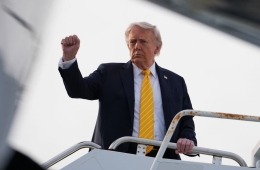
President-elect Yoon Seok-yeol is performing an uppercut ceremony on the afternoon of the 11th at Sangju Central Market in Sangju, Gyeongbuk. Photo by Transition Committee Press Corps
View original image[Asia Economy Reporter Kang Juhee] The key characteristics of the first round of ministerial appointments announced by President-elect Yoon Seok-yeol on the 10th can be summarized as 'Yeongnam region, Seoul National University graduates, in their 60s, male.' President-elect Yoon stated that this was the result of prioritizing expertise and ability without 'quotas' or 'balancing.' Regarding criticism that 'diversity is lacking,' he expressed optimism, saying, "Since talent in the Republic of Korea is not concentrated in one area, I believe that eventually there will be balance in terms of region, generation, and gender." This implies that if talent is selected based on skill and ability, balance will naturally be achieved.
However, criticism continues in political circles that the appointments do not consider national unity and diversity. There are significant concerns that this appointment philosophy excludes voices from various sectors of society and may entrench Korea's deep-rooted academic elitism. The fact that the results of verifying ability led to appointments from specific academic backgrounds and regions is pointed out as being far from the 'balance' that President-elect Yoon mentioned.
Looking at the first cabinet lineup announced by President-elect Yoon, the average age of the eight ministerial candidates is 60.5 years. During his presidential campaign, Yoon had predicted that there could be ministers in their 30s, but this did not materialize. In terms of birthplace, five are from Yeongnam, the largest group, with one each from Seoul, Jeju, and Chungbuk. There were no candidates from Jeonnam, Chungnam, or Gangwon.
Regarding alma maters, three graduated from Seoul National University, two each from Korea University and Kyungpook National University, and one from the Korea Military Academy. Including Prime Minister nominee Han Duck-soo, four are Seoul National University graduates. The only female candidate is Kim Hyun-sook, nominee for Minister of Gender Equality and Family. Previously, the Presidential Transition Committee also included many 'Seoul National University graduates, in their 50s, males,' leading to the so-called term 'Seo-o-nam,' and this trend appears to have continued into the cabinet formation.

President-elect Yoon Suk-yeol is announcing the inaugural cabinet list at the 20th Presidential Transition Committee in Tongui-dong on the afternoon of the 10th. From the left (excluding the sign language interpreter): Won Hee-ryong, Ministry of Land, Infrastructure and Transport; Kim Hyun-sook, Ministry of Gender Equality and Family; Park Bo-gyun, Ministry of Culture, Sports and Tourism; Choo Kyung-ho, Deputy Prime Minister and Minister of Economy and Finance nominee; Han Duck-soo, Prime Minister nominee; President-elect Yoon; Lee Jong-sup, Ministry of National Defense; Lee Chang-yang, Ministry of Trade, Industry and Energy; Jung Ho-young, Ministry of Health and Welfare; Lee Jong-ho, Ministry of Science and ICT nominee. Photo by Yonhap News.
View original imagePresident-elect Yoon did not disclose specific criteria for this appointment. Regarding this, he only stated, "The selection and verification were based on whether the person knows the relevant field best and can lead it for the country and all citizens."
The Democratic Party and the Justice Party criticized, saying, "We don't know the concept behind the cabinet formation," and "There is no sign of unity at all." On the 11th, Democratic Party lawmaker Woo Sang-ho said in an interview with TBS Radio, "Including Prime Minister nominee Han Duck-soo, I don't really understand the concept of the eight people announced this time," and harshly criticized, "Overall, compared to the concept of the first cabinet formation of past administrations, this seems like a regression."
It was also pointed out as a problem that most of the eight ministerial candidates belonged to the transition committee or had past connections with President-elect Yoon. On the same day, Democratic Party Emergency Committee Chairman Yoon Ho-jung strongly criticized at an emergency committee meeting held at the National Assembly, saying, "The cabinet has become a clique for the privileged class, and the people's hopes have been dashed in an instant," and "The promise of President-elect Yoon to form a nationally unifying, ability-centered cabinet is nowhere to be found, and the cabinet list presented to the public is filled with Yoon's core aides, reward appointments, and revolving-door personnel."
The Justice Party also raised its voice of criticism, saying that following the 'Seo-o-nam transition committee,' the cabinet has continued as a 'Gyeong-yuk-nam (men in their 50s from Gyeongsang Province)' cabinet. Justice Party spokesperson Jung Tae-soo pointed out in a written briefing, "President-elect Yoon said that if competent people are appointed by ministry, balance in region, generation, and gender will be achieved, but he did not explain the logical causal relationship between 'appointing competent people' and 'balance in region, generation, and gender.'"
Experts pointed out that appointments based solely on ability without balancing or quotas will entrench academic elitism and vested political interests. Kim Ji-hak, director of the Korea Diversity Research Institute, said, "The 'ability' that the Yoon Seok-yeol government talks about ultimately means being a Seoul National University graduate, a man in his 40s or 50s. In a society centered on these people, those with similar academic backgrounds and origins will naturally be evaluated as 'competent' in the future," adding, "People from various groups such as youth, women, and persons with disabilities will be completely excluded from opportunities to voice their opinions, and vested interests and academic elitism will inevitably be further strengthened."
Hot Picks Today
 "Is Yours Just Gathering Dust at Home? Millenni...
- "Stock Set to Double: This Company Smiles Every Time a Data Center Is Built [Cli...
- "Continuous Groundwater Pumping Causes Mexico City to Sink 24cm Annually... 'Gia...
- "I Take Full Responsibility"... Seongjae Ahn Issues Direct Apology for 'Wine Swi...
- “She Shouted, ‘The Rope Isn’t Tied!’... Chinese Woman Falls from 168m Cliff ...
He continued, "President-elect Yoon said he evaluated and appointed based on ability, but the appointments turned out to be biased toward certain academic backgrounds, regions, and ages. I don't understand how he can predict that balance will be achieved in the future or how he expects the public to believe such claims."
© The Asia Business Daily(www.asiae.co.kr). All rights reserved.