[The Editors' Verdict] Allow Freedom of Imagination
[Asia Economy Reporter Ryu Jeong-min] Freedom of culture and arts and prohibition of discrimination are enshrined in the Constitution of the Republic of Korea.
"No one shall be discriminated against in all areas of cultural life on the basis of sex, religion, or social status." Article 11 of the Constitution explicitly prohibits discrimination in the cultural field. This, together with Article 22 which states "All citizens shall have freedom of artistic expression," symbolizes the fundamental rights of the people.
The reason to pay attention to constitutional rights is closely related to the characteristics of the culture and arts sector. While freedom of imagination must be guaranteed more than in any other field, it is also vulnerable to the influence of power. The emphasis on cultural capacity alongside national economic power as a criterion for classifying advanced countries is related to this. The extent to which the value of freedom is respected can be gauged through cultural policies.

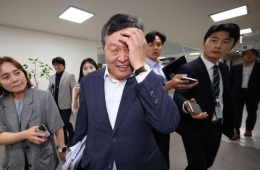
Chairman Oh Seok-geun of the Korea Film Council is apologizing for the implementation of the film industry blacklist at the "Public Apology and Commitment to Innovation in the Film Industry" press conference held on April 4, 2018, at the Korea Federation of Banks Building in Jung-gu, Seoul. Photo by Kang Jin-hyung aymsdream@
View original imageA value highly regarded like a golden rule in advanced cultural countries is the so-called "Arm’s length principle." This principle embodies the idea that while the public sector supports cultural policies, it does not interfere in order to maximize the autonomy of the private sector.
The origin of the Arm’s length principle dates back to the establishment of the Arts Council in the United Kingdom in 1945. The British government provided financial support but did not interfere in the filmmaking process, granting autonomy. As this policy spread to major countries, it was established as a fundamental principle guaranteeing freedom in culture and arts.
Like other major advanced countries, Korea has also adopted the Arm’s length principle. Since the inauguration of the People's Government in February 1998, successive governments have at least outwardly respected this principle.
The problem is that in the culture and arts sector, the value of freedom is easily threatened because it can be exploited for the power’s "image politics." Attempts to use culture and arts as tools for regime propaganda and promotion tailored to the tastes of those in power can be seen in many countries. Cultural and artistic figures who might hinder regime ideology promotion are disciplined or have their support withdrawn.
In this regard, Korea also has a dark history. The "Blacklist" incident that broke out in October 2016 during the Park Geun-hye administration shocked the cultural and artistic community. The rumor of a blacklist of 10,000 people was exposed with a concrete list. It revealed that the government attempted "political censorship" in artistic support.
![[Image source=Yonhap News]](http://www.asiae.co.kr/news/img_view.htm?img=2018041015265547784_1523341614.jpg)
Cultural and artistic figures expressed deep regret that the nightmare of the military dictatorship era had resurfaced. Although efforts to prevent recurrence, such as the enactment of the "Artists' Rights Protection Act," followed this incident, can we say that the shockwave of the blacklist has completely disappeared from this land?
The period of power transition when a new government takes office is the most tense time for cultural and artistic figures. Given the reality of Korea living in an era of ideological excess, it is difficult to dismiss such concerns as groundless.
If cultural and artistic figures who declared support for a particular candidate in the presidential election have to worry about making a living, can this be considered normal? It is now the new government’s responsibility to dispel these suspicions.
As President-elect Yoon Seok-yeol stated in his campaign pledge, it is important to firmly uphold the grand principle of "providing support but not interfering." If the cultural ecosystem is protected so that the "mushroom of self-censorship" cannot even appear, K-Culture will shine even brighter under the new government.
If a president is recorded in history as having rooted the status of a cultural powerhouse in the world, that alone would be considered a successful government. To realize this, you only need to remember nine words: "Allow freedom of imagination."
Hot Picks Today
!["Rather Than Endure a 1.5 Million KRW Stipend, I'd Rather Earn 500 Million in the U.S." Top Talent from SNU and KAIST Are Leaving [Scientists Are Disappearing] ①](https://cwcontent.asiae.co.kr/asiaresize/93/2026051914165468840_1779167814.png) "Rather Than Endure a 1.5 Million KRW Stipend, I'd Rather Earn 500 Million in the U.S." Top Talent from SNU and KAIST Are Leaving [Scientists Are Disappearing] ①
"Rather Than Endure a 1.5 Million KRW Stipend, I'd Rather Earn 500 Million in the U.S." Top Talent from SNU and KAIST Are Leaving [Scientists Are Disappearing] ①
- Given Grants, Then Says "No Launch" ... Innovative Korean Technology Ultimately Forced Overseas
- [Breaking] Chairman Park Sookeun: "Possibility of Agreement Instead of Samsung Electronics Labor-Management Mediation Proposal"
- "If That's the Case, Why Not Just Buy Stocks?" ETFs in Name Only, Now 'Semiconductor-Heavy' and a Playground for Short-Term Traders
- "No Cure Available, Spread Accelerates... Already 105 Dead, American Infected"
© The Asia Business Daily(www.asiae.co.kr). All rights reserved.
![Cheaper Than Candy, Yet Impossible to Find... Fears of a 'Pediatric Medical Crisis' as Pharmaceutical Companies Halt Production [Why&Next]](https://cwcontent.asiae.co.kr/asiaresize/307/2026051910065268365_1779152813.jpg)