Gyeongsang National University AI Convergence Talent Education and Research Group Hosts International AI Convergence Academic Workshop

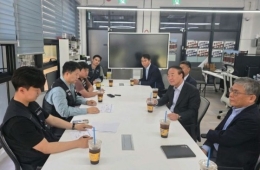
[Asia Economy Yeongnam Reporting Headquarters Reporter Choi Soon-kyung] Gyeongsang National University announced on the 28th that the AI Convergence Talent Education and Research Group held an AI Convergence International Academic Workshop.
This workshop was conducted to directly hear and communicate the latest research results and trends related to AI convergence engineering from overseas experts. About 30 participants attended the workshop, including professors and students from the AI Convergence Engineering Department and other interested university professors and students.
Lectures were given by distinguished scholars and experts in AI convergence engineering from home and abroad, including Professor Inseop Lee of the University of Pennsylvania, Professor Bongho Kim of Nokia Bell Labs and UPenn, Professor Shing-Chi Cheung of the Hong Kong University of Science and Technology (HKUST), Executive Director Yongnyeo Shin of Microsoft Korea, and Dr. Jeongho Lee of the Korea Institute of Nuclear Nonproliferation and Control.
Professor Inseop Lee is a professor in the Department of Computer and Information Science at the University of Pennsylvania and director of the PRECISE Center. His main research areas include the Internet of Medical Things, cyber-physical system security, and safe autonomy. Professor Lee delivered a lecture titled “Assuring Confidence in AI-Based Autonomous Cyber-Physical Systems,” covering the development process and future challenges of AI-based autonomous CPS development.
Professor Bongho Kim is a senior research engineer in the Software Architecture and Technology Group of Nokia Bell Labs Core Research RAN. He has received numerous awards, including Nokia’s Business Excellence Award and the WiMAX Forum Individual Contribution Award, and holds 19 patents and patent applications in wireless networks and algorithm design. His main research area is next-generation broadband wireless. His lecture topic was “The Future Network Enabling a New Digital Era: 5G-Advanced and 6G,” presenting the current state of 5G networks and the development direction of future 6G networks.
Professor Shing-Chi Cheung of the Department of Computer Science and Technology at HKUST is a distinguished scientist of the ACM in software analysis and testing. His main research areas include testing and program analysis, software analysis, and mining software repositories. In his lecture titled “Detecting Numerical Bugs in Neural Network Architectures,” he introduced the DEBAR technique, which detects bugs in neural networks used in deep learning through static methods by performing tensor abstraction and analyzing relationships between tensors, achieving a high accuracy of 93%.
Executive Director Yongnyeo Shin is the Chief Technology Officer at Microsoft Korea, researching artificial intelligence and sustainability. In her lecture titled “Responsible AI for Sustainability at Microsoft,” she discussed the role of AI in addressing carbon issues as part of Microsoft’s efforts to solve climate change problems.
Dr. Jeongho Lee is the head of cybersecurity at the Korea Institute of Nuclear Nonproliferation and Control and an expert responsible for cybersecurity regulations for Korean nuclear facilities. In his lecture titled “Security in Mind as Software Engineer,” he shared new security concepts and measures in cyberspace.
The AI Convergence Talent Education and Research Group, conducting the 4th phase BK21 project, develops and operates curricula in four AI specialized fields: autonomous aerial flight, medical artificial intelligence, smart home networks, and intelligent software engineering. It also conducts workshops and seminars in AI-related convergence research, education, and industry-academia cooperation.
Hot Picks Today
 There Is a Distinct Age When Physical Abilities Decline Rapidly... From What Age Do Strength and Endurance Drop?
- "After Vowing to Become No. 1 Globally, Sudden Policy Brake Puts Companies’ Massive Investments at Risk"
- [Breaking] Trump: "I Don't Think There Is a Conflict in Taiwan... Made No Promises"
- Cerebras Soars 70% on IPO Debut: Is Nvidia's Reign Ending as a New AI Semiconductor Power Emerges?
- On Teacher's Day, a Student's Gifted Cake Had to Be Cut into 32 Pieces... Why?
© The Asia Business Daily(www.asiae.co.kr). All rights reserved.