"No Support Staff for Home Treatment" ... 120,000 People in a Month, 200,000 in March
Short-term Prediction of Bangdaebon COVID-19 Cases Reflects Omicron Transmission Rate Tripled
Concerns Over Hundreds of Thousands in Home Care... The Only Measure Is 'Treatment at Local Clinics'

The number of new COVID-19 cases has surged to over 13,000 per day, raising concerns that the number of confirmed cases could reach up to 120,000 next month. In this scenario, the number of patients under home treatment is expected to reach hundreds of thousands, putting emergency management measures in place for them. There are calls to prepare for an expanded shortage of public service personnel such as health center staff and to conduct more detailed inspections of the confirmed case management system in hospitals and clinics. Although the severity and fatality rates caused by the rapidly spreading Omicron variant are not high, the speed of its spread is so fast that it is difficult to let down one's guard.
"120,000 by the end of February" "200,000 by March"
There are even pessimistic forecasts that if the recent spread continues, daily confirmed cases could exceed 120,000 by the end of next month. According to the 'Short-term COVID-19 Case Prediction Results' submitted by the Central Disease Control Headquarters to the office of National Assembly member Seo Jeong-sook of the People Power Party, if the transmission rate of Omicron is three times higher than that of Delta, the number of confirmed cases is expected to be 8,700 to 10,000 by the end of this month, 27,000 to 36,800 by mid-next month, and 79,500 to 122,000 by the end of next month.
Considering that the number of confirmed cases already exceeded the maximum predicted figure of 10,000 for this month with 13,012 cases reported on this day, the increase in confirmed cases by the end of next month could surpass 120,000. Professor Lee Jae-gap of the Department of Infectious Diseases at Hallym University Kangnam Sacred Heart Hospital predicted, "If the current level of social distancing and diagnostic systems are maintained, the number could rise to 200,000 by March."
However, the authorities' perception is rather optimistic. Prime Minister Kim Boo-kyum said the day before, "Our country has a very high third-dose vaccination rate among high-risk groups," adding, "The figures of 100,000 to 200,000 are views held by very pessimistic people, but those working with the government say the peak will be around 30,000." This means that the Disease Control Agency's prediction is close to the worst-case scenario. As of midnight on this day, the third-dose vaccination rate for COVID-19 was 50.3% overall. In particular, 85.1% of the high-risk elderly population aged 60 and over have completed their third dose. Son Young-rae, head of the Social Strategy Division at the Central Disaster and Safety Countermeasures Headquarters, also stated, "It is important to pass through the changes gradually and smoothly," adding, "It depends on how we adapt going forward."
Experts unanimously agreed that despite the high level of immunity in the country due to widespread vaccination, absolute vigilance is necessary. Professor Baek Soon-young, emeritus professor at the Catholic University College of Medicine, said, "Given the high vaccination rate domestically, even if the epidemic period is prolonged, the peak will be lower," but also predicted, "The maximum peak will exceed 100,000."

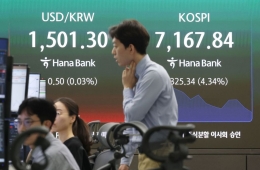
On the 26th, when 13,012 new COVID-19 cases were reported, an increase of 4,400 cases in just one day, the COVID-19 situation room monitor at Songpa District Office in Seoul displayed the number of confirmed cases. Photo by Jinhyung Kang aymsdream@
View original imageIs Home Treatment Management Feasible?
One of the core elements of the government's Omicron response system is diagnosing and treating COVID-19 patients at local clinics and hospitals, but on the ground, there is confusion due to a lack of personnel and the absence of government guidelines to refer to. So far, only some clinic-level medical institutions in the Seoul area have agreed to participate in managing patients under home treatment.
Above all, clinic-level hospitals are small in scale, making it physically impossible to separate the movement paths of general patients or citizens from those of COVID-19 patients, and they face difficulties responding to emergencies such as nighttime situations. For example, a large otolaryngology clinic in Seoul, which is a home treatment management medical institution, opened a home treatment center in November last year and has hired six dedicated doctors and twelve nurses separately from its existing outpatient services to currently manage about 300 confirmed cases. However, it is difficult for clinic-level hospitals to secure additional medical personnel or to accept general patients simultaneously.
Professor Lee said, "To respond to the spread of Omicron, the number of institutions performing home treatment must be greatly increased, but it is not easy for clinics because they have only a few medical staff," adding, "Under the current circumstances, it is inevitable to focus on hospital-level medical institutions." He further suggested, "Even if clinics manage patients during the day, hospital-level medical institutions could share on-call duties at night by only taking calls, and such complementary participation by clinics is necessary."
Hot Picks Today
 "Samsung and Hynix Were Once for the Underachievers"... Hyundai Motor Employee's Lament
- "Plunged During the War, Now Surging Again"... The Real Reason Behind the 6% One-Day Silver Market Rally [Weekend Money]
- "They Said It's Impossible to Get—Already Selling for Triple the Price: Crowds Worldwide Line Up for $600 Luxury Watch"
- "Does Frequent Checking Lower Your Score?" The Worst Habit in Credit Management Is 'This'
- "That? It's Already Stashed" Nightlife Scene Crosses the Line [ChwiYak Nation] ③
Hyun Ji-hyun, policy director of the Medical Solidarity Headquarters, said, "Even if home treatment is greatly expanded due to Omicron, the number of hospitalized patients will inevitably increase as well," adding, "Since the large-scale outbreak after the phased return to normal life (With COVID), we have continuously talked about the shortage of support personnel, but the situation has only worsened without improvement." Professor Baek advised, "Since the number of household members under home treatment and self-quarantine will also surge along with confirmed cases, it is important to organize the medical system," and added, "Especially since pediatric care for children who have not been vaccinated will increase sharply, a system must be urgently established to allow COVID-19 confirmed patients and those in quarantine to receive treatment in other departments as well."
© The Asia Business Daily(www.asiae.co.kr). All rights reserved.