Faster US Tightening Clock... KOSPI Closes Lower

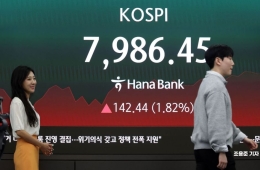
On the 19th, dealers were working in the dealing room of Hana Bank in Euljiro, Seoul. On that day, the KOSPI index opened at 2,840.34, down 23.90 points (0.83%) from the previous session. The won-dollar exchange rate started at 1,195.0 won, up 4.9 won. Photo by Moon Honam munonam@
View original image[Asia Economy Reporter Hwang Junho] On the 19th, the stock market closed lower. As the US tightening clock accelerated, US Treasury bonds and the dollar strengthened, exerting downward pressure on the stock market. Although there was a surprising rise early in the session, concerns about a further rise in oil prices and prolonged inflation worries led to a decline at the close.
On the 19th, the KOSPI closed at 2,842.28, down 21.96 points (0.77%) from the previous session. Foreign investors continued net buying worth 27.4 billion KRW, while individuals and institutions sold net amounts of 29.5 billion KRW and 4.7 billion KRW respectively, causing the index to fall.
Among all stocks, only 230 stocks maintained an upward trend. Among the top market capitalization stocks, only Samsung Biologics (1.24%), which attracted buying from foreign and institutional investors, maintained gains.
Samsung Electronics, the unchanging market leader, recorded 76,300 KRW, down 0.91% from the previous session. Although foreign and institutional investors engaged in joint net selling, individuals bought shares, resulting in a slight decline at the close. SK Hynix (000660), in the semiconductor sector like Samsung Electronics, closed at 127,000 KRW, up 0.40%.
Among the top market capitalization stocks, LG Chem experienced the largest decline, closing at 653,000 KRW, down 5.91%. Korea Investment & Securities lowered its target price from 1.06 million KRW to 970,000 KRW citing poor earnings, and due to the impact of LG Energy Solution's listing, foreign investors engaged in net selling, causing the stock price to slump.
By sector, only pharmaceuticals (0.98%), distribution (0.40%), construction (0.10%), and electric & gas (0.09%) showed gains. In pharmaceuticals, stocks such as Celltrion (4.70%) and JW Pharmaceutical (2.20%) rose, supporting the overall sector's upward trend.
On this day, Celltrion's stock price rose after the Financial Services Commission's Securities and Futures Commission postponed discussions on accounting fraud allegations against the three Celltrion companies. Considering that the Securities and Futures Commission's regular meetings are usually held biweekly on Wednesdays, the audit discussion on Celltrion is expected to begin around the 9th of next month at the earliest.
Lee Kyung-min, a researcher at Daishin Securities, analyzed, "Ahead of the January FOMC next week, concerns over the acceleration of the Fed's tightening clock continued with a sharp rise in US Treasury yields, dollar strength, and the won/dollar exchange rate attempting to rise further to the mid-1190 KRW range, all negatively affecting foreign demand and investor sentiment." He added, "Additionally, the expansion of geopolitical risks increased the burden of rising oil and energy prices, leading to prolonged inflation concerns, which also contributed to the weakening of investor sentiment."
The KOSDAQ closed at 933.90, down 10.04 points (1.06%). Although individuals net bought 43.9 billion KRW, foreign and institutional investors net sold 15.8 billion KRW and 26.2 billion KRW respectively, causing the index to fall.
Among all stocks, 357 stocks rose while 1,026 stocks fell. With the postponement of discussions on Celltrion's accounting fraud allegations, Celltrion Healthcare (3.41%, 66,800 KRW) closed higher, regaining the top spot in KOSDAQ market capitalization. Celltrion Pharm also rose 4.22% to 88,900 KRW.
Hot Picks Today
 No Bacteria Detected in Arisu After 24 Hours of Repeated Drinking from a Tumbler
- "Available Only in Korea": Pokémon Card Prices Surge 2,532% Due to Rarity, Becoming Investment Assets
- Staring at Stock Charts Causes 'Hwabyeong'... "What Have I Even Been Doing?" FOMO Spreads Amid Soaring KOSPI
- President Lee: "NongHyup's Opaque Structure Must Be Corrected... Accelerate Reforms for Direct Elections of Cooperative Members"
- "Egg Prices Are Strange" Proven True... Collusive Margin Hike of 46% Without Basis Leads to 594 Million Won Fine
Kim Seok-hwan, a researcher at Mirae Asset Securities, analyzed, "Although there was a rebound buying inflow into the KOSPI during the session, news of an explosion at the Iraq-Turkey oil pipeline increased pressure on oil prices." He added, "As on the previous day, concerns about inflation due to rising oil prices, the US 10-year Treasury yield reaching around 1.89%, and supply-demand instability following LG Energy Solution's listing acted as downward pressure."
© The Asia Business Daily(www.asiae.co.kr). All rights reserved.