[Interest Rate Hike] Accelerating 'Interest Rate Normalization' Likely in Q3... Expected to Reach 1.75% This Year (Comprehensive Report 2)
Consumer Price Inflation Likely to Stay in the 3% Range
Additional Increase Expected in Q3
![[Interest Rate Hike] Accelerating 'Interest Rate Normalization' Likely in Q3... Expected to Reach 1.75% This Year (Comprehensive Report 2)](http://www.asiae.co.kr/news/img_view.htm?img=2022011411070699895_1642126027.jpg)
[Asia Economy Reporter Jang Sehee] The Bank of Korea has raised the base interest rate for the first time this year, with forecasts suggesting it could increase to 1.50?1.75% by the end of the year. Experts believe that after the replacement of the Bank of Korea governor and reviewing the timing of the U.S. interest rate hikes, an additional rate increase in the third quarter is highly likely. If the pace of rate hikes accelerates in line with the economic recovery and normalization of major countries' monetary policies, the repayment burden, especially for vulnerable borrowers, is expected to grow further.
◆ Inflation and Fed Tightening Lead to ‘Two Consecutive Rate Hikes’ = On the 14th, the Bank of Korea’s Monetary Policy Committee raised the base interest rate from 1.00% to 1.25%. The reasons for this hike include soaring inflation and the early tightening by the U.S. Federal Reserve (Fed). It is also interpreted as a commitment to continue the slowing trend in household debt growth.
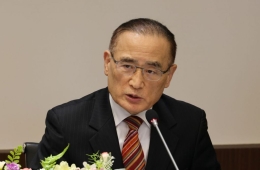
Governor Lee Ju-yeol stated at a briefing that "the consumer price inflation rate is expected to remain in the 3% range for a considerable period and is anticipated to exceed the mid-2% range annually," adding, "We will operate monetary policy with attention to financial stability to ensure that inflation stabilizes at the target level over the medium term."
Expectations that the Fed might start raising its base interest rate as early as March also influenced the decision. If the interest rate gap between Korea and the U.S. widens, capital outflows and upward pressure on the exchange rate could increase. Another purpose is to maintain the slowing trend in household debt growth. In December last year, household loans increased by 200 billion KRW compared to the previous month, a significant reduction from the 5.9 trillion KRW increase in the prior month. Although the monthly growth has slowed, the total amount (1,844.9 trillion KRW in Q3) remains at a risky level. Additionally, the decision to raise the base rate was influenced by the ongoing economic recovery despite the persistence of COVID-19.
Professor Kim Sang-bong of Hansung University’s Department of Economics analyzed, "Due to the ultra-low interest rate policy during COVID-19, asset prices have risen excessively. Considering exports and employment conditions, a 1.25% rate hike is quite feasible."
◆ Household Interest Burden Increases by 3.2 Trillion KRW... About ‘160,000 KRW’ Per Person = The Bank of Korea analyzed that if the base interest rate hike is fully reflected and loan interest rates rise by 0.25 percentage points, the annual interest burden on households will increase by 3.2 trillion KRW. The per capita interest burden will rise from 2,896,000 KRW to 3,058,000 KRW annually, an increase of 161,000 KRW. If one more rate hike is implemented, the household interest burden will increase to 6.4 trillion KRW, and the average interest burden per borrower will rise to 322,000 KRW.
As the base interest rate normalizes, borrowers’ interest burdens are expected to grow further. Experts predict that the base rate could be raised two to three more times, reaching 1.5?1.75% by the end of the year. This forecast gains credibility when looking back at the November 2018 hike (from 1.50% to 1.75%). Governor Lee commented, "Although the rate is raised slightly, it remains at a accommodative level, so it will not cause significant damage to the real economy," adding, "It is a level that our economy can somewhat endure."
The timing for additional hikes is expected to be the ‘third quarter.’ This is based on the plan to observe the effects of the rate hike while monitoring inflation and major countries’ monetary policy adjustments. Furthermore, it is considered difficult to raise rates around the times of the governor’s replacement (April) and the presidential inauguration (May). Professor Kim Tae-gi of Dankook University’s Department of Economics said, "Given the high economic uncertainty, a direction will be indicated in the second quarter, with an additional hike in the third quarter," adding, "It could reach 1.75% by the end of this year." Yoon Yeo-sam, a researcher at Meritz Securities, said, "If volatility in risky assets expands during the U.S. liquidity absorption process, it may be difficult to raise rates in the second half of the year," and "The additional rate hike is expected in August, with the upper limit for this year forecasted at 1.50%."
Hot Picks Today
 "Now Our Salaries Are 10 Million Won a Month" Record High... Semiconductor Boom Drives Performance Bonuses at Major Electronic Component Firms
- Living the Homebody Dream? "I Was Shocked by My Spending" How to Cut Costs to 5,000 Won for Essentials [The Principles of Benefits]
- Is It Really Like an Illness? "I Can't Wait to Go Again"—Over 1 Million Visited in Q1, Now 'Busanbyeong' Takes Hold [K-Holic]
- "Heading for 2 Million Won": The Company the Securities Industry Says Not to Doubt [Weekend Money]
- Experts Already Watching Closely..."Target Price Set at 970,000 Won" Only Upward Momentum Remains [Weekend Money]
© The Asia Business Daily(www.asiae.co.kr). All rights reserved.