[Good Morning Stock Market] Fed-Originated Negative News 'Investor Sentiment Frozen'... Entering a Phase of Increased Volatility
![[Image source=Yonhap News]](http://www.asiae.co.kr/news/img_view.htm?img=2022011008055793018_1641769556.jpg)
[Asia Economy Reporter Lee Seon-ae] The hawkish moves by the U.S. Federal Reserve (Fed) officials are expected to freeze investor sentiment in the domestic stock market. Concerns over rising long-term U.S. Treasury yields and liquidity tightening due to the spread of COVID-19 are dominating financial market sentiment, limiting the upside of the stock market and likely ushering in a phase of increased volatility.
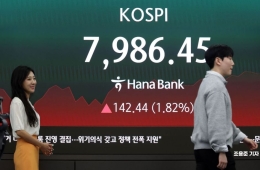
On the 10th, the securities industry suggested a KOSPI band of 2850 to 3020 for this week. Factors supporting an increase include the possibility of rising memory semiconductor prices and the potential end of selling by financial investors. On the downside, concerns over rising U.S. long-term Treasury yields, the spread of COVID-19 in the U.S. and Europe, and the dispersion of individual investor demand ahead of large initial public offerings (IPOs) were cited.
Yumi Kim, a researcher at Kiwoom Securities, said, "This week, the financial market will focus on U.S. inflation and the Fed’s monetary policy moves," adding, "Since the release of the December Federal Open Market Committee (FOMC) minutes confirmed the Fed’s intention to normalize monetary policy more quickly, sensitivity to inflation indicators and Fed officials’ remarks may increase in the financial market." However, she added, "Expectations remain for real economy and export indicators such as U.S. retail sales in December and South Korea’s exports (~10th), which should support the downside of the domestic stock market."
Byunghyun Cho, a researcher at Yuanta Securities, emphasized, "With the release of the December FOMC minutes, concerns over a more radical monetary policy and a tightening stance beyond normalization have intensified," adding, "At least at this point, the policy direction is confirmed, but uncertainty about its intensity and speed has significantly expanded, and until the path becomes clearer, it may act as a factor causing volatility."
Jaeseon Lee, a researcher at Hana Financial Investment, also explained, "The upside of the domestic stock market is likely to be somewhat limited," noting, "As the market becomes more sensitive to U.S. liquidity tightening, employment and inflation indicators are likely to support the Fed’s rate hikes."
Yongtaek Jung, chief researcher at IBK Investment & Securities, pointed out, "Concerns about COVID-19, inflation, and U.S. rate hikes are likely to pressure the market throughout the first half of the year and induce a decline in real economy indicators, so caution is needed."
The internal supply and demand strength of the domestic stock market has also weakened. Amid large-scale selling by institutions, individual trading has also slowed. In particular, with the LG Energy Solution IPO approaching, general investors’ subscription for public offering shares is scheduled for the 18th and 19th, and it is analyzed that individuals have limited buying power.
Meanwhile, this week (10th?14th), the New York stock market is expected to show volatility due to events such as the release of core inflation indicators including the Consumer Price Index (CPI) and the confirmation hearings for Jerome Powell.
First, the confirmation hearings for Fed Chair Jerome Powell and Vice Chair nominee Lael Brainard are scheduled for the 11th and 13th, respectively. The market is paying close attention to whether additional explanations will be provided regarding the Fed’s stance on faster tightening. On the 13th, the confirmation hearing for Lael Brainard is also expected to be a time to gauge how strong the Fed’s commitment to tightening is.
Key indicators to be released include the CPI on the 12th and retail sales on the 14th. These are the most significant variables for the Fed’s tightening. According to the Wall Street Journal, economists expect the December CPI to rise 7.1% year-on-year, surpassing the 6.8% recorded in November. The December core CPI is also expected to have reached 5.4%, exceeding November’s 4.9%. If inflationary pressures continue to strengthen like this, the timing of the Fed’s rate hikes could accelerate.
Hot Picks Today
 No Bacteria Detected in Arisu After 24 Hours of Repeated Drinking from a Tumbler
- "Available Only in Korea": Pokémon Card Prices Surge 2,532% Due to Rarity, Becoming Investment Assets
- Staring at Stock Charts Causes 'Hwabyeong'... "What Have I Even Been Doing?" FOMO Spreads Amid Soaring KOSPI
- Trump and Xi: "No Nuclear Weapons for Iran"... Consensus on Keeping Hormuz Open (Update) [U.S.-China Summit]
- "Egg Prices Are Strange" Proven True... Collusive Margin Hike of 46% Without Basis Leads to 594 Million Won Fine
On the 7th (local time), the New York stock market closed lower across the board amid rate hike pressures and declines in tech stocks. At the New York Stock Exchange (NYSE), the Dow Jones Industrial Average fell 4.81 points (0.01%) to close at 36,231.66. The Standard & Poor’s (S&P) 500 index closed down 19.02 points (0.41%) at 4,770.3. The tech-heavy Nasdaq index ended the day down 144.96 points (0.96%) at 14,933.90.
© The Asia Business Daily(www.asiae.co.kr). All rights reserved.