Recognized for Autonomous Driving Research... Pukyong National University Undergraduate Team Wins Best Paper Awards at Two Conferences

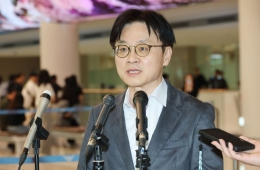
Award-winning students (from left, Kim Hyun-yeol, Lee Do-yoon, Kim Ye-rin, Lee In-hwan, Kim Joon-soo) are taking a commemorative photo.
View original image[Asia Economy Yeongnam Reporting Headquarters Reporter Hwang Du-yeol] A team of undergraduate students from the Department of Information and Communication Engineering at Pukyong National University received outstanding paper awards from two academic societies, the Korean Institute of Electronics Engineers and the Korean Institute of Communications Sciences, in recognition of their autonomous driving research achievements.
The Pukyong National University team, consisting of senior students Inhwan Lee, Junsu Kim, Hyunyeol Kim, and junior students Doyun Lee and Yerin Kim from the Department of Information and Communication Engineering, won the excellence award at the undergraduate paper competition hosted by the Korean Institute of Electronics Engineers with their paper titled "Implementation of Road Tracking Autonomous Driving Technology through Multi-task Learning."
The paper proposed a multi-task learning technique to train functions used for autonomous driving, including road tracking, collision avoidance, and obstacle detection.
The Pukyong National University team conducted training based on the deep learning model ResNet18 and implemented the trained multi-task neural network on an embedded board.
The team built an autonomous driving system and confirmed through simulations that the road tracking and collision avoidance functions operated well.
The same team members Inhwan Lee, Junsu Kim, and Hyunyeol Kim received an outstanding paper award at the academic conference of the Korean Institute of Communications Sciences for their paper on swarm autonomous driving titled "Implementation of a Deep Learning-Based Swarm Autonomous Driving System."
The Pukyong National University students proposed a convolutional neural network-based technology in their paper, which was recognized for its research achievements.
The technology effectively performs functions where the autonomous vehicle recognizes the shape of the road and drives autonomously, and controls its actions by recognizing the distance to the preceding autonomous vehicle.
Hot Picks Today
 No Bacteria Detected in Arisu After 24 Hours of Repeated Drinking from a Tumbler
- "We Can't Just Let Them Be Damaged Inside"... Samsung Electronics Removes 360,000 Wafers in Preparation for Strike
- "Up to 100 Trillion Won in Losses Feared, It's Not About Second Place but Catastrophe"... Industry Minister: 'Emergency Mediation Unavoidable If Samsung Strike Occurs'
- Wife in $6.7 Million Debt Took Out $3 Million in Husband's Life Insurance, Poisoned Him... US Court: "She Can Never Be Released"
- "He's Handsome, It's Such a Pity?"... Lawyer Responds to Bizarre 'Appearance Evaluation' of High School Girl Murder Suspect
Through simulations, the students implemented functions that estimate the pixel position of the point where the autonomous vehicle should drive in real-time captured video and control the speed of the following vehicle by recognizing the size of the preceding vehicle.
© The Asia Business Daily(www.asiae.co.kr). All rights reserved.