Hong Nam-ki: "Advance Payment of Loss Compensation to be Executed Before Lunar New Year Holiday... 40 Trillion Won in New Funds Supplied" (Update)
The 52nd Emergency Economic Central Countermeasures Headquarters Meeting
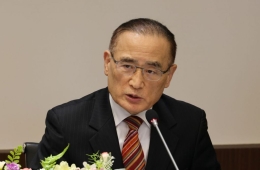
![Hong Nam-ki, Deputy Prime Minister and Minister of Economy and Finance, is speaking while presiding over the "52nd Emergency Economic Central Countermeasures Headquarters Meeting" held at the Government Seoul Office Building on the 6th. 2022.1.6 [Photo by Yonhap News]](http://www.asiae.co.kr/news/img_view.htm?img=2022010607595189163_1641423591.jpg)
Hong Nam-ki, Deputy Prime Minister and Minister of Economy and Finance, is speaking while presiding over the "52nd Emergency Economic Central Countermeasures Headquarters Meeting" held at the Government Seoul Office Building on the 6th. 2022.1.6 [Photo by Yonhap News]
View original image[Sejong=Asia Economy Reporter Son Seon-hee] Hong Nam-ki, Deputy Prime Minister and Minister of Economy and Finance, announced on the 6th, "We will expedite the execution of the 'Three Major Support Packages for Small Business Owners' totaling 6.5 trillion KRW as quickly as possible, and also push to execute most of the 'Loss Compensation Advance Payment Program' for applicants before the Lunar New Year holiday." Accordingly, small business owners and self-employed individuals struggling due to recently strengthened quarantine measures are expected to receive 5 million KRW in loss compensation and 1 million KRW in quarantine support funds before the Lunar New Year holiday.
On the morning of the same day, Deputy Prime Minister Hong held an emergency economic central countermeasure meeting at the Government Complex Seoul and announced the 'Lunar New Year Livelihood Stabilization Measures' containing these details. He also added, "We will supply approximately 40 trillion KRW in new funds to small and medium-sized enterprises and promote support for purchasing seasonal goods up to 10 million KRW for traditional market merchants." This 40 trillion KRW in new funds is separate from the 35.8 trillion KRW in low-interest loan support, such as the Hope Loan Plus, which is provided year-round to small business owners.
Regarding living costs for ordinary citizens ahead of the holiday season, Deputy Prime Minister Hong stated, "We will supply 204,000 tons of 16 major seasonal products, the highest ever, starting three weeks earlier than last year's Lunar New Year (January 10?28), an increase of 31% compared to the previous year, and expand tax and financial support for raw materials subject to tariff quotas and price surges."
He also said, "To revitalize the regional economy, from the 8th for 30 days, we will double the gift value limit under the Anti-Graft Act for agricultural, livestock, and fishery products from 100,000 KRW to 200,000 KRW, and increase the support limits for discount coupons (20?30%) for agricultural, livestock, and fishery products as well as the January purchase limit for Onnuri gift certificates."
The government plans to focus its policy capabilities on four areas: ▲ concentrated support for affected groups such as small business owners ▲ livelihood stabilization measures including price stabilization for Lunar New Year ▲ real estate market stabilization ▲ and promotion of domestic consumption and export policies amid quarantine measures. Deputy Prime Minister Hong said, "Based on perfect COVID-19 control this year, economic ministries will work as one team to make every effort until the end for 'complete economic recovery + leap to a leading economy.'"
The government will accelerate fiscal execution this year as it did last year. Deputy Prime Minister Hong said, "Central government finances will execute 63% (about 126 trillion KRW) of the approximately 200 trillion KRW in projects subject to execution management in the first half of the year, and local governments and local education finances will also execute more than 60% early in the first half accordingly." He emphasized, "We will specially encourage the execution speed of six core project groups (about 107 trillion KRW) directly linked to the recovery of the livelihood economy and the establishment of a leading economy."
Deputy Prime Minister Hong also said, "Public institution investments will focus on social overhead capital (SOC) and energy sectors, with a record-high investment of 67 trillion KRW, an increase of 2.3 trillion KRW compared to last year, and the investment execution rate in the first half will be adjusted to over 53%."
Hot Picks Today
 "Now Our Salaries Are 10 Million Won a Month" Record High... Semiconductor Boom Drives Performance Bonuses at Major Electronic Component Firms
- Living the Homebody Dream? "I Was Shocked by My Spending" How to Cut Costs to 5,000 Won for Essentials [The Principles of Benefits]
- Is It Really Like an Illness? "I Can't Wait to Go Again"—Over 1 Million Visited in Q1, Now 'Busanbyeong' Takes Hold [K-Holic]
- "Heading for 2 Million Won": The Company the Securities Industry Says Not to Doubt [Weekend Money]
- Experts Already Watching Closely..."Target Price Set at 970,000 Won" Only Upward Momentum Remains [Weekend Money]
This year, the total policy finance is planned to be supplied at 495 trillion KRW, similar to last year. Financial programs dedicated to small business owners and small to medium-sized enterprises will supply 311 trillion KRW, about 9 trillion KRW more than last year's 302 trillion KRW. Additionally, to strengthen industrial competitiveness, a policy finance package totaling 118 trillion KRW will be prepared and supported for the DNA (Data, Network, Artificial Intelligence) industry, Big 3 industries (semiconductors, future cars, bio), the Korean New Deal, materials, parts and equipment industries, and low-carbon facility investments.
© The Asia Business Daily(www.asiae.co.kr). All rights reserved.