Will I Survive This Mine Today...
'Japanese Sado Mine' Promoting World Heritage Listing While Concealing Traces of Forced Korean Labor
Originally a Bank and Mint in Edo Period, Taken Over by Mitsubishi in 1896 with Korean Forced Labor
Report Reveals Minimum of 1,140 Koreans, Over Half in Their 20s
Wages, Savings, and Insurance Withheld, Korean Miners Forced to Work Unaware
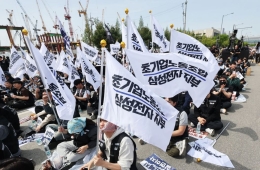
Japan Limits Listing Application to Edo Period... No Apology, Only Concealment of Shameful History
![[Image source=Yonhap News]](http://www.asiae.co.kr/news/img_view.htm?img=2022010601384788984_1641400727.jpg)
There is a mine on Sado Island in Niigata Prefecture, Japan. Gold mining began there in 1601. It was designated as a directly managed site by the Edo Shogunate, serving as both a bank and a mint. All smelting processes were done manually. Although flooding was frequent, operations continued by introducing drainage devices and creating water channels. From 1615 to 1634, the annual gold production was about 400 kg. Approximately 40 tons of silver were also mined annually. The Cultural Affairs Council of the Japanese Agency for Cultural Affairs judged it to have outstanding universal value and selected it last month as a candidate for UNESCO World Cultural Heritage registration. However, it is said that Niigata Prefecture and Sado City limited the application period to the Edo period (1603?1867). This is because Mitsubishi took over in 1896 and many Korean laborers were forcibly mobilized.
Excluding the Meiji and Showa periods diminishes the value of the Sado Mine. This is because Edo period relics are limited to the magistrate’s office (Bugy?sho) at Oma Port and some shafts. Most of the remains such as the Toyu Shaft, water shaft, machinery factory, smelting plant, and ore dressing plant were built from the late 19th century. At that time, Japan improved mining efficiency by using dynamite for blasting and rock drills to penetrate bedrock. The ore dressing (sorting useful ore) and smelting processes were mechanized to increase productivity. The flotation ore dressing plant established in 1938 symbolizes the advanced technology. Flotation ore dressing is a method that uses a flotation agent to raise small gold and silver particles that are difficult to recover. Originally used in copper smelting, it was successfully applied at the Sado Mine. Omitting this world-first technology during the World Heritage registration process can only be seen as an attempt to hide the history of forced mobilization of Korean laborers. In fact, Niigata Prefecture and Sado City never revealed the existence of Korean miners in promotional brochures covering up to the mine’s closure in 1989.
![[Image source=Yonhap News]](http://www.asiae.co.kr/news/img_view.htm?img=2022010601383688982_1641400716.jpg)
The history of forced mobilization of Koreans was identified by Jeong Hye-gyeong, a senior researcher at the Argo Institute for Humanities and Social Sciences, in 2019 through a report titled “The Actual Conditions of Forced Mobilization of Koreans in Japanese Regional Coal Mines and Mines ? Focusing on Mitsubishi Mining’s Sado Mine.” This was confirmed from the Korean tobacco distribution ledger and the designated age group roster. The tobacco distribution ledger was created by the company when distributing cigarettes to miners. Although workers were not given meals, cigarettes were always provided. The ledger recorded 463 Koreans. About half included names, birthdates, movement information, and the date of record. The average age of 353 individuals with recorded ages was 28.8 years (as of 1944). Those in their 20s accounted for 53% (187 people). The designated age group roster listed 100 names, birthdates (1901?1923), and registered domiciles (Hamnam and Gyeongbuk).
The traces of these individuals also appear in the “Report on the Investigation of Korean Assets in Japan ? Investigation Results on Unpaid Wages and Debts for Returning Koreans” and the “Economic Cooperation Korea·105·Unpaid Wage Debt Investigation for Koreans” held at the National Archives of Japan. In her report, researcher Jeong explained, “These two deposit records mean two things.” She elaborated: “One is that at least 1,140 Koreans were forcibly mobilized. The other is that their wages, savings, and insurance money were not given to them but were deposited.”
In April 1943, the average monthly income of Korean miners at the Sado Mine was 83 yen 88 sen. Deductions were made for the cost of tools needed for labor, so the actual amount received was only a portion. Forced savings were also applied. This was a method used by the Japanese government to suppress inflation, cover war expenses, and prevent escape. The Sado Mine deposit records do not contain individual information. Essentially, the wages for labor were diverted elsewhere. Korean miners, unaware of this, shed blood and sweat daily inside the shafts. Ten Koreans died during work. Separately, in December 1942, two miners died when rocks fell from a rock face while they were installing ladders, fracturing their skulls. Even if they avoided accidents, most suffered from pneumoconiosis and did not live long.
![[Image source=Yonhap News]](http://www.asiae.co.kr/news/img_view.htm?img=2022010601384288983_1641400722.jpg)
There is a record of an oral testimony describing a hellish life. The protagonist is Mr. Im Tae-ho, who was mobilized to the Sado Mine in November 1940. He only realized it was forced labor after arriving on Sado Island. He trembled with fear every time he walked 1 hour and 30 minutes from the lodging to the mine. “I lived anxiously thinking, ‘Will I be able to leave this underground alive today?’ There was no human treatment or even condolences for the deceased. (…) I narrowly escaped death when a foothold fell underground. When I regained consciousness, it was not in a hospital but in my lodging bed. I had been lying down for about ten days because my waist was severely injured and I couldn’t get up. When I barely could stand, they told me to return to work. Even if you got sick, you couldn’t rest for more than two days, but since I hadn’t worked for ten days, they no longer allowed any rest.”
Mr. Im succeeded in escaping to Hiroshima. At the end of his testimony, he said, “I hope that as long as even one person who was at the Sado Mine is alive, we receive a sincere and genuine apology. More than half a century has passed since the war, but even today, I have never heard a sincere word from the Japanese government. I think the deceased colleagues have not attained peace even now.”
Hot Picks Today
 No Bacteria Detected in Arisu After 24 Hours of Repeated Drinking from a Tumbler
- "I Feel Uncomfortable Being Filmed"... Cheerleaders Distressed by Commercial Fan Cam Practices
- "What Have I Been Doing All This Time?" Even Celebrities Can't Escape 'FOMO' Amid KOSPI Rally
- "3% in Sight": Semiconductors Drive Growth Rate Up, but Potential Growth Rate Warning Remains
- Police Officer Cycling on Day Off Rescues Woman Attempting to Jump from Hangju Bridge
Mr. Im died in May 1997. Twenty-five years have passed since then, but neither the Japanese government nor Mitsubishi has apologized. Rather, there are signs they are pushing for World Heritage registration while hiding this shameful history. The Japanese government has never ignored the candidate recommended by the Cultural Affairs Council. The UNESCO submission deadline is February 1 next year. Our government has firmly stated it will respond decisively. A Foreign Ministry official who summoned Kazuo Chujo, Director of the Public Affairs and Cultural Center at the Embassy of Japan in Korea, to the Foreign Ministry building last month said, “We will not stop at raising issues with Japan or demanding cancellation.” He added, “We will actively explain to UNESCO and expert bodies the reasons for unsuitability and the need for historical interpretation including forced labor by analyzing the World Heritage application contents,” and “We will also conduct comprehensive diplomatic negotiations targeting World Heritage Committee member countries.”
© The Asia Business Daily(www.asiae.co.kr). All rights reserved.