[Next Year's Real Estate Outlook] 75% of Experts Say "Government Should Focus on Expanding Private Supply"
"Seoul Private Housing Supply Expected at 40,000 Units, Currently 8,000 Units... Supply Must Increase Next Year"
85% Fail Rate for Moon Administration's 5-Year Real Estate Policy... No 'Well Done'
65% Say Urgent Policy Improvement Needed on "Acquisition and Transfer Taxes" Transaction Tax System
![[Next Year's Real Estate Outlook] 75% of Experts Say "Government Should Focus on Expanding Private Supply"](http://www.asiae.co.kr/news/img_view.htm?img=2021120310523847448_1638496358.jpg)
[Asia Economy Reporters Kim Hyemin, Ryu Taemin, Jo Gangwook] According to a survey conducted by Asia Economy on the 3rd, 75% of real estate experts pointed out that the government should focus on ‘expanding private supply’ to stabilize housing prices next year. The current administration’s real estate policy received failing marks, with no experts rating it as ‘well done.’
In the survey, 15 out of 20 respondents identified ‘expanding private supply’ as the major framework for real estate policy that the government should emphasize. This was followed by expanding public supply at 15% (3 respondents). In total, 18 out of 20 experts believed that government policy should focus on ‘supply.’
Kim Hakryeol, head of the SmartTube Real Estate Research Institute, said, "The reason housing prices have not stabilized this year is ultimately due to the perception of insufficient supply. In the case of Seoul’s city center, where large-scale development is impossible, the speed of redevelopment and reconstruction projects is crucial, but this has been neglected for a long time." Lim Byungcheol, senior researcher at Real Estate R114, pointed out that among private supply, the number of new apartment sales was particularly low this year. He said, "At the beginning of the year, 40,000 private units were expected to be sold in Seoul, but currently, it is at the level of 8,000 units. This needs to be improved next year."
There were also calls to show results in ongoing public supply projects such as the 3rd phase new towns in the metropolitan area. Ham Youngjin, head of Zigbang Big Data Lab, said, "In situations where large-scale land development is required through land acquisition, there is a need to proceed with public interest, and adding public interest can also speed up the process. Since the 3rd phase new towns are actively progressing, it is necessary to show results."
On the other hand, no respondents said that regulations on transactions or prices should be strengthened. Other opinions included ‘strengthening jeonse loans to suppress jeonse price increases’ and ‘abolishing the price ceiling system to increase the probability of unsold units.’
Regarding the Moon Jae-in administration’s five years of real estate policy, 65% (13 respondents) evaluated it as ‘very poor.’ Including those who said ‘poor’ (4 respondents, 20%), 17 out of 20 experts evaluated the Moon administration’s real estate policy negatively. Not a single expert rated it as ‘well done.’ The response ‘average’ accounted for 15% (3 respondents).
Kim said, "Supply was needed, but it was reduced; rental properties were needed, but the Lease Protection Act was implemented; and in a situation with no new housing supply, transactions of existing buildings were made difficult. The government is supposed to be for ordinary people, but it made things harder for them, so it is difficult to receive a good evaluation." Senior researcher Lim said, "Efforts were made. There was a positive aspect in targeting demand in specific areas to stabilize prices and sharing development profits. However, the supply policy was largely missed. If aggressive supply policies had been implemented from the beginning of the administration, housing price instability would not have worsened as it has now."
Regarding urgent improvements needed in government real estate policy, 13 out of 20 respondents chose ‘improvement of transaction tax systems such as acquisition and capital gains tax.’ Three respondents each selected improvements in supply policy and deregulation of redevelopment and reconstruction projects. This was followed by ▲improvement of price regulations such as the price ceiling system (1 respondent) ▲improvement of subscription system (1 respondent) ▲improvement of holding tax systems such as comprehensive real estate tax (1 respondent).
Han Mundo, professor of Finance and Real Estate at Yonsei University Graduate School of Economics and Political Science, said, "The heavy capital gains tax was a bad move considering normal market conditions and supply-demand situations. As holding taxes rise, there should be an exit strategy, but the ruling party missed the timing."
Hot Picks Today
 "Now Our Salaries Are 10 Million Won a Month" Record High... Semiconductor Boom Drives Performance Bonuses at Major Electronic Component Firms
- Wallets Open Wide on Big News...300 Trillion Won Heads to the U.S., "Tax Breaks" Fail to Keep Funds at Home
- "Hope You Enjoy the 'Welfare' for Bereavement of Children"... Ridicule of Strike Non-Participants Intensifies Union Conflict at Samsung Electronics
- "Heading for 2 Million Won": The Company the Securities Industry Says Not to Doubt [Weekend Money]
- Experts Already Watching Closely..."Target Price Set at 970,000 Won" Only Upward Momentum Remains [Weekend Money]
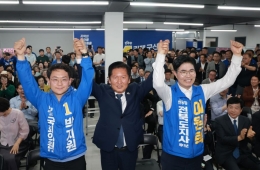
Regarding Lee Jae-myung, the Democratic Party’s presidential candidate’s pledge to introduce a land holding tax, 90% (18 respondents) opposed it. Regarding Yoon Seok-youl, the People Power Party’s presidential candidate’s pledge to abolish the comprehensive real estate tax, 70% (14 respondents) supported it. Lee Hyuncheol, head of the Real Estate Cycle Research Institute, said, "It is difficult to find an appropriate range where the comprehensive real estate tax can lower market prices, and if excessive, it can create innocent victims. However, rather than abolishing it, it needs to be eased. Regarding the introduction of the land holding tax, there are many other policy options, and there is no need to apply a policy that could cause side effects."
© The Asia Business Daily(www.asiae.co.kr). All rights reserved.