Six Countries Including US and China Cooperate on Strategic Oil Release... But Oil Prices Rise
Biden: "High Oil Prices Are a Global Issue"
US, China, South Korea, UK, India Unite
First Strategic Oil Release in 10 Years
Release Size Seen Having Minimal Impact on Oil Prices
WTI Closes Up 2%
Concerns Over Strong Response from Oil-Producing Countries

[Asia Economy New York=Correspondent Baek Jong-min, Beijing=Correspondent Jo Young-shin, Reporter Kwon Hae-young] U.S. President Joe Biden has decided to release strategic petroleum reserves to lower oil prices. President Biden formed a coalition to reduce oil prices, including allies such as South Korea and even China, but international oil prices instead rose. This is because the announced release volume was smaller than expected, and there are concerns that it might provoke oil-producing countries, leading the Organization of the Petroleum Exporting Countries Plus (OPEC+) to take a tough stance.
◇ First joint response by the U.S. and China to soaring oil prices = On the 23rd (local time), President Biden announced the release of 50 million barrels of strategic reserves together with India, Japan, South Korea, the United Kingdom, and China. President Biden explained, "I spoke with other world leaders facing challenges due to rising oil prices to find ways to lower oil prices." He diagnosed that high oil prices are a problem not only for the U.S. but for the entire world.
President Biden stated, "India, Japan, South Korea, the United Kingdom, and China have also agreed to participate in the largest-ever release of strategic reserves to support supply," adding, "This cooperation will support our efforts to address supply shortages."
President Biden claimed, "A big part of why Americans face high oil prices is that oil-producing countries and large corporations have not worked to lower prices."
President Biden's remarks imply that the release of strategic reserves is intended to pressure oil-producing countries such as those in the Middle East and Russia, which have not responded to calls for increased oil production. He said, "Oil prices will not drop overnight, but there will be a clear difference."
![U.S. President Joe Biden is delivering a speech on energy at the South Court Auditorium on the White House grounds in Washington, D.C., on the 23rd (local time). President Biden announced that he has ordered the release of 50 million barrels of oil from reserves to lower oil prices, and that countries including South Korea, China, Japan, India, and the United Kingdom will also participate. [Photo by Yonhap News]](http://www.asiae.co.kr/news/img_view.htm?img=2021112411312934167_1637721088.jpg)
U.S. President Joe Biden is delivering a speech on energy at the South Court Auditorium on the White House grounds in Washington, D.C., on the 23rd (local time). President Biden announced that he has ordered the release of 50 million barrels of oil from reserves to lower oil prices, and that countries including South Korea, China, Japan, India, and the United Kingdom will also participate. [Photo by Yonhap News]
View original imageThis is the first time in 10 years since the 2011 Libyan civil war that the international community has cooperated to decide on releasing strategic reserves. It is also the first time that the U.S. and China have simultaneously released strategic reserves.
The U.S. plans to release 50 million barrels, the U.K. 1.5 million barrels, India 5 million barrels, and Japan 4.2 million barrels of strategic reserves. South Korea and China have not yet disclosed specific volumes. South Korea's release volume is expected to be around 5 million barrels, about 4-5% of its reserves.
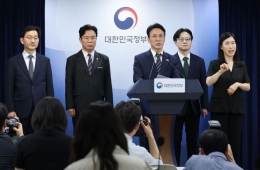
The Ministry of Trade, Industry and Energy and the Ministry of Foreign Affairs stated, "Considering the recent sharp rise in international oil prices, the need for international cooperation, the importance of the South Korea-U.S. alliance, and the participation of major countries, we have decided to join the U.S. proposal for releasing strategic reserves," adding, "Specific details such as the volume, timing, and method of release will be finalized later."
South Korea has released strategic reserves three times so far, with release volumes amounting to 4-5% of its reserves. During the 2011 Libyan crisis, about 3.467 million barrels, approximately 4% of reserves, were released. The current reserve volume is 97 million barrels (as of the end of October), enough for about 106 days of use.
China has not officially announced its release of strategic reserves, but local media have argued that the Chinese government should participate conditionally in response to the U.S. government's request to join the release. Since the release of strategic reserves is a desperate measure by the Biden administration to curb soaring U.S. inflation, the U.S. side must show sincerity to improve China-U.S. relations.
According to the state-run Global Times, Hai Dong, director of the International Relations Research Institute at the China Foreign Affairs University, said, "The oil price issue cannot be solved by the U.S. alone," diagnosing that "the U.S. is caught in a dilemma where it has no choice but to cooperate with China."
◇ OPEC+ retaliation feared... oil prices rise instead = Despite President Biden's determination to lower oil prices, on the same day, the January West Texas Intermediate (WTI) crude oil price on the New York Mercantile Exchange closed at $78.50 per barrel, up $1.75 (2.3%). The January Brent crude oil price on the London Futures Exchange also rose 3.3% to $82.31 per barrel. The daily price increase for Brent crude was the highest since August.
The Wall Street Journal evaluated that even if oil prices fall due to the release of strategic reserves, the effect may be short-term as global economic recovery continues and demand is expected to keep rising next year. RBC Capital Markets estimated the total release volume from the six countries to be about 65 to 70 million barrels, which is just slightly more than half of the world's daily oil consumption (about 100 million barrels).
Bjorn Tonhaugen, head of oil market research at Rystad Energy, explained, "The effect of the strategic reserve release will occur with a significant time lag and may not occur at all." This means that unless OPEC+ increases oil production, the supply shortage cannot be fully resolved.
Hot Picks Today
 "Now Our Salaries Are 10 Million Won a Month" Record High... Semiconductor Boom Drives Performance Bonuses at Major Electronic Component Firms
- Living the Homebody Dream? "I Was Shocked by My Spending" How to Cut Costs to 5,000 Won for Essentials [The Principles of Benefits]
- Is It Really Like an Illness? "I Can't Wait to Go Again"—Over 1 Million Visited in Q1, Now 'Busanbyeong' Takes Hold [K-Holic]
- "Heading for 2 Million Won": The Company the Securities Industry Says Not to Doubt [Weekend Money]
- Experts Already Watching Closely..."Target Price Set at 970,000 Won" Only Upward Momentum Remains [Weekend Money]
How OPEC+ will respond to pressure from the Biden administration is uncertain. The New York Times predicted that OPEC+ might decide to increase production at next week's meeting but could also take a tougher stance. Julian Lee, an oil strategist at Bloomberg News, warned, "OPEC+ could respond by delaying the timing of additional production increases by about two months."
© The Asia Business Daily(www.asiae.co.kr). All rights reserved.