Biden-Xi Jinping Agree to Pursue Nuclear Arms Control Talks... Establishing Negotiation Framework
Sullivan Aide "Agreement to Begin Discussions on Strategic Stability"
Mutual Journalist Expulsion Measures Also Eased..."Extension of Visa Deadlines for Chinese Journalists"
![[Image source=Reuters Yonhap News]](http://www.asiae.co.kr/news/img_view.htm?img=2021111711041024349_1637114650.jpg)
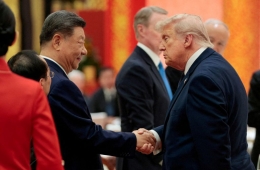
[Asia Economy Reporter Hyunwoo Lee] It has been reported that U.S. President Joe Biden and Chinese President Xi Jinping agreed to pursue negotiations on nuclear arms control during their first virtual summit. This move is interpreted as an effort to ease the intense arms race between the two countries amid growing concerns in the U.S. over China's expanding nuclear capabilities. The two countries also reportedly agreed to ease the expulsion measures against journalists, which had been imposed last year as reciprocal diplomatic retaliations. This development is seen as laying the groundwork for dialogue and negotiation in the previously escalating confrontational relationship between the two nations.
According to AFP on the 16th (local time), Jake Sullivan, U.S. National Security Advisor, attending a virtual seminar hosted by the Brookings Institution, stated, "During yesterday’s U.S.-China summit, the two leaders agreed to begin discussions on ‘strategic stability.’ Although it may not reach the level of dialogue we have had with Russia, with whom we have conducted arms control negotiations for decades, we will consider the most productive ways to advance this plan moving forward."
Strategic stability is a term that broadly refers to arms control negotiations concerning strategic weapons such as nuclear forces, primarily pursued between the U.S. and Russia. Sullivan’s remarks are interpreted as the U.S. signaling its intention to formally start nuclear arms control negotiations with China, which had previously been conducted only with Russia.
Previously, since the Trump administration in 2019, the U.S. has pressured China to be included as a participant in the ‘New Strategic Arms Reduction Treaty (New START)’ negotiations, which had been conducted with Russia, arguing that China should be part of nuclear arms control talks. The Chinese government, however, has rejected this, stating that China’s nuclear arsenal is at a minimal level, less than one-tenth of that of the U.S. or Russia, and therefore does not need to be included in such negotiations. Officially, China’s declared nuclear warhead count is 250, which is about 6.7% of the U.S.’s official count of 3,750 warheads.
However, following a recent report by the U.S. Department of Defense revealing that China could increase its nuclear warheads more than fourfold from current levels, voices have grown not only in the U.S. but also internationally, calling for China to be included in nuclear arms control negotiations. Earlier, on the 3rd, the U.S. Department of Defense submitted a military security report to Congress projecting that China’s nuclear warhead count will exceed 700 by 2027 and 1,000 by 2030.
AFP reported that if negotiations between the two countries proceed in earnest, discussions will likely cover not only the number of nuclear warheads but also efforts to ease the arms race concerning the development of hypersonic missiles. China announced in 2019 that it had deployed the Dongfeng (DF)-17, a hypersonic missile capable of carrying nuclear warheads, and it is known to have successfully conducted two hypersonic missile tests in July and August of this year.
Alongside the agreement on nuclear arms control negotiations, the two countries reportedly agreed to ease the expulsion measures against each other’s journalists that had been implemented during the Trump administration. According to China’s state-run China Daily, the U.S. government will issue multiple-entry visas valid for one year to Chinese journalists, and the Chinese government has promised to treat U.S. journalists equally with its own journalists if the U.S. policy is implemented.
Last year, the U.S. government designated nine Chinese state media journalists, including those from the People’s Daily, as members of a ‘foreign mission’ under Chinese government control, limiting their stay to 90 days with the possibility of extension. China protested this as political repression and retaliated by revoking press credentials and expelling journalists from U.S. media outlets such as The New York Times (NYT), The Washington Post (WP), and The Wall Street Journal (WSJ) stationed in China.
Hot Picks Today
 Cerebras Soars 70% on IPO Debut: Is Nvidia's Reign Ending as a New AI Semiconductor Power Emerges?
- "He's Handsome, It's Such a Pity?"... Lawyer Responds to Bizarre 'Appearance Evaluation' of High School Girl Murder Suspect
- "After Vowing to Become No. 1 Globally, Sudden Policy Brake Puts Companies’ Massive Investments at Risk"
- "Mom, Isn't It Comfortable Living With Me?"... 'Unexpected Result' Shows Increased Drinking Out of Frustration
- "Nothing Has Changed": Union Rejects Samsung's Proposal... Further Talks Fail as Strike Proceeds
© The Asia Business Daily(www.asiae.co.kr). All rights reserved.