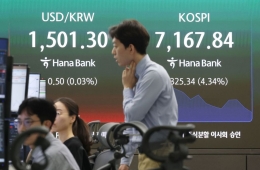
[Good Morning Stock Market] Nasdaq Rises Amid Inflation Concerns... "Focus on Steel, Semiconductors, and 2nd Battery"
US Stock Market Rises Amid Inflation Concerns
Semiconductor Stocks Rebound... Philadelphia Semiconductor Index Up 1.9%
Inflation Pressure Expected to Ease If Supply Chain Issues Improve in First Half of Next Year
![[Image source=Reuters Yonhap News]](http://www.asiae.co.kr/news/img_view.htm?img=2021111206434117882_1636667021.jpg)
[Asia Economy Reporter Minji Lee] Despite concerns about inflation, the U.S. stock market showed gains centered on technology stocks, leading to forecasts that the domestic stock market could rebound. Inflationary pressures, largely driven by supply chain disruptions and rising raw material prices, are expected to ease by the first half of next year.
Sangyoung Seo, Researcher at Mirae Asset Securities: “Focus on steel, semiconductors, secondary batteries, and solar energy sectors”
The U.S. stock market showed gains centered on technology stocks as a rebound buying followed the previous day’s decline, with the Nasdaq leading the rise. On that day, the Nasdaq index closed up 0.52%, while the Dow Jones index fell about 0.44% due to Disney’s (-7%) decline.
The Nasdaq’s rise could have a positive impact on the domestic stock market. By sector, it is predicted that attention could be expanded to steel, semiconductors, secondary batteries, and solar energy. This is because ArcelorMittal reported solid earnings and claimed that global steel demand excluding China would increase by 12-13%, leading to strength in the steel sector, and the semiconductor sector, which had been sluggish recently, saw rebound buying with the Philadelphia Semiconductor Index rising 1.94%. Additionally, the joint climate change declaration between the U.S. and China is expected to support the solar energy, secondary battery, and electric vehicle sectors.
Considering this, the domestic stock market is expected to continue its upward trend with strength in the top market capitalization stocks. Furthermore, as economic indicators from the U.S. and China and statements from Federal Reserve (Fed) officials may be released, cautious sentiment could persist, which should also be taken into account.
Gyuyun Jeon, Researcher at Hana Financial Investment: “Inflationary pressures will ease in the first half of next year”
![[Good Morning Stock Market] Nasdaq Rises Amid Inflation Concerns... "Focus on Steel, Semiconductors, and 2nd Battery"](http://www.asiae.co.kr/news/img_view.htm?img=2021111207580118000_1636671481.png)
When prices rise excessively, household purchasing power decreases and private investment weakens. The U.S. consumer price index (CPI) for October rose 6.2% year-on-year, marking the highest level since November 1990. This was largely due to a sharp increase in volatile international oil prices and major energy costs.
Inflationary pressures are expected to ease in the first half of next year. Wage pressures in the U.S. are increasing due to labor shortages, and housing cost burdens are high, so intrinsic inflationary pressures are expected to rise further for the time being. However, the current excessive inflationary pressure is more influenced by supply-side factors such as global supply chain disruptions and sharp rises in raw material prices.
If transportation costs ease after peaking and supply chain disruptions gradually resolve from the first half of next year, supply-side price pressures are expected to weaken. International oil prices are also expected to balance supply and demand based on gradual production increases by oil-producing countries. Although a higher price level than in the past is inevitable, the Fed is not expected to raise interest rates until tapering ends, so there is time to monitor inflation trends until mid-next year. If the rate of price increases gradually slows from the first half of next year, the Fed’s burden of early rate hikes is expected to decrease.
Hanjin Kim, Researcher at KTB Investment & Securities: “Volatility in the Nasdaq and domestic stock markets is inevitable when liquidity effects disappear”
With the Fed’s gradual tapering of asset purchases scheduled, market attention is focused on how long the liquidity effect that has dominated asset markets will continue. Numerically, just before the COVID-19 pandemic in 2019, the U.S. total money supply (M2)/GDP ratio was 70.6%, but this ratio reached an all-time high of 94.4% in August last year. During the 2008 financial crisis, the ratio increased only 7 percentage points from 51% in early 2008 to 58% at the end of 2009.
![[Good Morning Stock Market] Nasdaq Rises Amid Inflation Concerns... "Focus on Steel, Semiconductors, and 2nd Battery"](http://www.asiae.co.kr/news/img_view.htm?img=2021111207574417997_1636671465.png)
Due to the Fed’s tightening stance, the potential for further gains in risk assets reliant on liquidity is expected to be limited. The valuation of the Nasdaq market considering money supply (market capitalization/M2 ratio) is very close to the dot-com bubble level of 2000. For the Nasdaq to rise further, real economic factors are more important than liquidity. If real economic factors do not support it, volatility is expected to increase first in the stock market, which benefited greatly from low interest rates and liquidity.
Especially, the assets that benefited most from liquidity during the COVID-19 era are the Nasdaq, copper, and crude oil. Looking at the situation over the past two years, both the technology-focused Nasdaq and major commodity markets have already fully reflected the liquidity injected into the market, so their valuation appeal is not high.
Hot Picks Today
 "Samsung and Hynix Were Once for the Underachievers"... Hyundai Motor Employee's Lament
- "Plunged During the War, Now Surging Again"... The Real Reason Behind the 6% One-Day Silver Market Rally [Weekend Money]
- "They Said It's Impossible to Get—Already Selling for Triple the Price: Crowds Worldwide Line Up for $600 Luxury Watch"
- Korea and ASEAN to Strengthen Supply Chain Cooperation... FTA Digital Rules to Be Revised
- "That? It's Already Stashed" Nightlife Scene Crosses the Line [ChwiYak Nation] ③
From this perspective, the KOSPI is also expected to respond sensitively to changes in liquidity. Since early last year until recently, the KOSPI has well reflected the increase in U.S. liquidity. Although the domestic stock market’s liquidity benefits during the COVID-19 spread period were less than those of the Nasdaq, they were by no means lower than the overall U.S. stock market. The domestic stock market has been influenced much more by the increase in U.S. money supply than by domestic money supply since the COVID-19 pandemic, so volatility due to changes in global financial conditions is expected to be inevitable going forward.
© The Asia Business Daily(www.asiae.co.kr). All rights reserved.