"Stable Supply of Battery Materials" POSCO and Australian Mine Joint Venture to Start Factory Operations in Two Years

[Asia Economy Reporter Choi Dae-yeol] POSCO and Australian lithium mining company Pilbara Minerals have signed a joint venture agreement and established a full-scale domestic production system. Lithium, a key material for electric vehicle batteries, will now be stably supplied through this agreement.
According to POSCO on the 28th, the two companies recently signed a joint venture agreement for POSCO Lithium Solution. Earlier in April, POSCO established a production corporation for lithium production, and under this agreement, Pilbara can hold up to a 30% stake in POSCO Lithium Solution. Additionally, according to the contract, POSCO will receive an annual supply of 315,000 tons of lithium ore necessary for lithium hydroxide extraction from Pilbara.
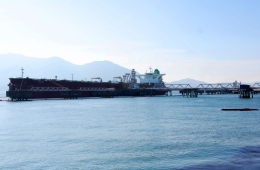
POSCO Lithium Solution began construction of a lithium hydroxide plant in May on a 196,000㎡ site within the Gwangyang Yulchon Industrial Complex, investing a total of 760 billion KRW. The plant will produce 43,000 tons of lithium hydroxide annually, enough for batteries for one million electric vehicles. The plant is scheduled to be completed in the second half of 2023. If production proceeds as planned, POSCO Chemical, a battery material subsidiary producing cathode materials, will be able to fully supply the lithium hydroxide needed. This completes one axis of the secondary battery material value chain that POSCO aims to establish.
POSCO is known to have acquired shares in Pilbara in 2018 and cooperated in lithium-related businesses. With the successful joint venture of POSCO Lithium Solution with Pilbara, POSCO is expected to accelerate preparations for domestic lithium production, which had previously relied 100% on imports.
Lithium used as a raw material for secondary battery cathode materials is divided into lithium carbonate and lithium hydroxide. Lithium hydroxide produced by POSCO Lithium Solution is known to be advantageous for increasing battery capacity and lifespan compared to lithium carbonate. The raw materials for lithium hydroxide are broadly divided into brine dissolved in water and ore forms, and POSCO Lithium Solution has adopted a process using ore lithium. The company explains that the ore-type lithium production process has a competitive edge by simplifying the process, as it produces lithium hydroxide directly from lithium sulfate without generating intermediate products.
Hot Picks Today
 "Stocks Are Not Taxed, but Annual Crypto Gains Over 2.5 Million Won to Be Taxed Next Year... Investors Push Back"
- "Don't Throw Away Coffee Grounds" Transformed into 'High-Grade Fuel' in Just 90 Seconds [Reading Science]
- Signed Without Viewing for 1.6 Billion Won... Jamsil and Seongbuk Jeonse Prices Jump 200 Million Won in a Month [Real Estate AtoZ]
- [Breaking] Lee Targets Samsung Electronics Union: "Collective Bargaining Should Not Be Abused... There Is an Appropriate Limit"
- "Even With a 90 Million Won Salary and Bonuses, It Doesn’t Feel Like Much"... A Latecomer Rookie Who Beat 70 to 1 Odds [Scientists Are Disappearing] ③
Meanwhile, POSCO is actively continuing its secondary battery material business through joint ventures with global companies besides Pilbara. In May, POSCO established 'POSCO HY Clean Metal' in partnership with China’s Huayou Cobalt and began construction last month of a secondary battery recycling plant in the Jeonnam Yulchon Industrial Complex. POSCO plans to invest in ore and brine lithium extraction businesses to establish an annual production system of 220,000 tons by 2030.
© The Asia Business Daily(www.asiae.co.kr). All rights reserved.