Integrated Union "Why Is the Korea Customs Service Stingy with Part-Time Public Officials?"
Integrated Union Issues Press Release on the 14th, Submits Change of Organization Application Twice, Requests Four Meetings with the Commissioner of Customs, but Receives No Response...Criticism of Customs Service for Not Providing Work Opportunities to Temporary Officials Despite Labor Shortage
[Asia Economy Reporter Park Jong-il] The 'time-selective recruitment public officials' system was first introduced in 2013 during the Park Geun-hye administration. It was established to provide employment opportunities to those who find it difficult to work full-time due to childcare, studies, etc., and to share quality jobs without discrimination. These are general public officials hired to work shorter hours of 15 to 25 hours per week, and currently, 109 such officials are working at the Korea Customs Service.
On June 18, 2019, the law was amended to allow work up to 35 hours per week to guarantee a living wage and improve equity with full-time public officials. As of two years and four months after implementation, 39 out of 40 central administrative agencies (97.4%) have adopted the system, but the Korea Customs Service is the only agency without even an expansion plan.
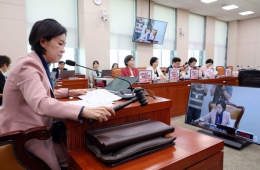
At the Korea Customs Service audit on the 12th, Kim Du-gwan, a member of the Democratic Party of Korea, pointed out, “You should understand the status of implementation in other central administrative agencies and, since time-selective recruitment public officials have repeatedly requested meetings with the Commissioner of the Korea Customs Service, hold discussions with the parties involved to listen to their difficulties and propose measures so that the Korea Customs Service can also implement the system.”
Yong Hye-in, a member of the Basic Income Party, also stated, “The same issue was pointed out during the 2020 Korea Customs Service audit, but it has not yet been corrected, which is regrettable.”
In response, Lim Jae-hyun, Commissioner of the Korea Customs Service, replied, “The total quota for time-selective Grade 9 positions is overstaffed, so if time-selective recruitment public officials increase their working hours, it would be difficult for full-time Grade 8 officials to be promoted, which could cause conflicts between full-time and time-selective public officials. Also, I have never been informed that time-selective public officials requested meetings.”
The Integrated Public Officials Union stated in relation to this, “This has incited conflicts between full-time public officials and time-selective recruitment public officials within the Korea Customs Service.”
According to the law, time-selective recruitment public officials affiliated with the Korea Customs Service submitted 'time expansion change applications' once in 2020 and twice in 2021.
They also requested four times to arrange meetings with the Commissioner to discuss their grievances, but it was revealed during this audit that Lim Jae-hyun, appointed in March, was not informed of this. The union claims that the Korea Customs Service personnel in charge of human resources did not properly report the issues concerning time-selective recruitment public officials to the Commissioner.
In particular, agencies with similar situations such as the National Police Agency and the Ministry of Employment and Labor have flexibly responded by promoting full-time Grade 9 officials to Grade 8 at local offices, using the resulting Grade 9 vacancies to expand working hours, or prioritizing offices with Grade 9 vacancies, thereby implementing the legislative intent.
According to data obtained by Representative Yang Hyang-ja of the Democratic Party of Korea in the first half of 2021 from the Korea Customs Service titled '2020 and 2021 regional and grade-wise quotas and actual numbers of time-selective public officials,' it was confirmed that all time-selective recruitment public officials are working at Grade 9 due to no promotions, and that the Grade 8 quota required for full-time officials to be promoted from Grade 9 is unrelated to time-selective recruitment public officials.
Furthermore, Commissioner Lim Jae-hyun stated, “It is difficult to expand working hours because Grade 9 is overstaffed,” but after disclosing the quotas and actual numbers of full-time and time-selective recruitment public officials by customs offices, it was confirmed that there are shortages in the job series where time-selective recruitment public officials are working.
The Korea Customs Service human resources staff provided incorrect information to Commissioner Lim Jae-hyun, shifting the responsibility for personnel and organizational quota management failures onto time-selective recruitment public officials, thereby causing labor-to-labor conflicts.
The union emphasized that the Korea Customs Service ultimately regards 'time-selective recruitment public officials' not as colleagues but as 'competitors to full-time public officials,' and due to discriminatory perceptions and operations contrary to the purpose of the law amendment, they suffer double hardships while receiving wages below the minimum wage.
Jung Sung-hye, head of the Time-Selective Division of the National Integrated Public Officials Labor Union, said in an interview, “After the law passed, some central administrative agencies initially had difficulties with quotas and work assignments for time expansion, but they actively found solutions such as expanding working hours for time-selective public officials and transferring them to departments with labor shortages, completing implementation in 2020 and showing positive effects in personnel management.”
Hot Picks Today
 "Now Our Salaries Are 10 Million Won a Month" Record High... Semiconductor Boom Drives Performance Bonuses at Major Electronic Component Firms
- Wallets Open Wide on Big News...300 Trillion Won Heads to the U.S., "Tax Breaks" Fail to Keep Funds at Home
- "Hope You Enjoy the 'Welfare' for Bereavement of Children"... Ridicule of Strike Non-Participants Intensifies Union Conflict at Samsung Electronics
- "Realizing How Fast Money Disappears: Should You Try Only the Essentials for 5,000 Won? [The Basics of Benefits]"
- Experts Already Watching Closely..."Target Price Set at 970,000 Won" Only Upward Momentum Remains [Weekend Money]
She added, “The Ministry of Economy and Finance and the Public Procurement Service, which fall under the Planning and Finance Committee, are representative agencies that have already implemented the system. However, the Korea Customs Service remains immovable. Since June 2019, the Time-Selective Division has requested through various channels (the 2020 audit, four requests for meetings with the Commissioner, demands for proactive administration via the People’s Petition system, and information disclosure to understand quota and vacancy status) that time-selective recruitment public officials be allowed to increase working hours and contribute to the Korea Customs Service. However, due to four changes in the head of the human resources department, these efforts have fizzled out. After the personnel officer Choi Moon-gi of the Korea Customs Service contacted us by phone saying, ‘After completing the demand survey in the first half of 2021, we will schedule a meeting and strive to implement it in 2022,’ there has been no news to date.”
© The Asia Business Daily(www.asiae.co.kr). All rights reserved.