[Good Morning Stock Market] FOMC Tapering Signal Burden... Continued Sector Differentiation Expected in Han Stock Market
US Fed's Tapering Signal Poses Pressure on Domestic and Global Stock Markets
Limited Decline in Domestic Stocks...Semiconductor Industry Uncertainty Eases Phase
![[Image source=Yonhap News]](http://www.asiae.co.kr/news/img_view.htm?img=2021081908230682826_1629328986.jpg)
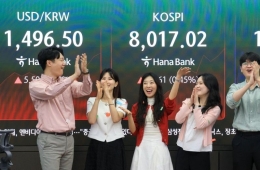
[Asia Economy Reporter Minwoo Lee] The U.S. stock market closed lower amid concerns after the Federal Reserve (Fed) hinted at announcing tapering (asset purchase reduction) next month. The domestic stock market is also expected to continue a sector-differentiated trend as the possibility of foreign selling dominance increases amid tapering concerns.
On the 18th (local time) at the New York Stock Exchange (NYSE), the Dow Jones Industrial Average closed at 34,960.69, down 1.08% from the previous session. The S&P 500 also fell 1.07% to 4,400.27, and the tech-heavy Nasdaq dropped 0.89% to 14,525.91. All three major indices closed lower for two consecutive days. Until the previous day, the Dow and S&P 500 had set record highs for five consecutive trading days.
◆ Sangyoung Seo, Researcher at Mirae Asset Securities = The Fed hinted at implementing tapering this year through the Federal Open Market Committee (FOMC) announcement. It is expected to announce the implementation schedule either at the Jackson Hole Conference starting on the 26th or at the FOMC meeting on the 22nd of next month.
Along with this, there is a forecast that the possibility of raising interest rates within at least one year after tapering is low. The Chicago Mercantile Exchange (CME) FedWatch tool lowered the probability of a rate hike in November 2022 from 47.4% to 44.3% the previous day. The December possibility was also revised down from 69.5% to 63.7%. Nevertheless, as the likelihood of announcing tapering at next month’s FOMC and starting it in October increased, the market sold off, deepening the decline.
James Bullard, President of the Federal Reserve Bank of St. Louis, and others mentioned that tapering should be expedited and interest rates should be raised in the fourth quarter of next year. However, unlike the period without vaccines, they argued that COVID-19 is now preventable and will not have a significant impact on the economy. Considering this, contrary to market claims, the Fed appears to be focusing more on employment and inflation despite COVID-19 uncertainties. This is why the Personal Consumption Expenditures (PCE) deflator data released on the 27th and the employment report on the 3rd of next month are particularly important. Following these announcements, the U.S. stock market saw selling pressure and declined.
The domestic stock market fell early in the session due to active foreign selling. This seems to be because concerns about economic slowdown still persist in investor sentiment. However, anxiety caused by recent declines has improved somewhat, as the market at one point rose more than 1%. Amid this, the Fed’s hint at tapering announcement in September is a burden. Although the Fed still expressed caution regarding interest rate hikes, it could weigh on the liquidity-driven market.
However, it is important to note that although the U.S. stock market declined after the FOMC minutes release, sector differentiation was observed, with electric vehicles and lithium-related sectors, including Tesla, soaring. Considering this, the domestic market is expected to see foreign net selling dominance due to tapering visibility effects, leading to weakness, while a sector-differentiated market trend is likely to continue.
◆ Jiyoung Han, Researcher at Kiwoom Securities = The domestic stock market is expected to face downward pressure due to renewed tapering uncertainties following the release of the July FOMC minutes, but the extent of the decline is expected to be limited. Attention should be paid to the fact that excessive concerns about the semiconductor industry, which led last week’s sharp market drop, are easing, as inferred from this week’s stock performance of Samsung Electronics and SK Hynix. Considering that the U.S. dollar showed only limited strength after the July FOMC minutes release in the U.S. financial market the previous day, the upper limit of the domestic won-dollar exchange rate is also expected to be capped, which could weaken the intensity of foreign net selling.
Hot Picks Today
 Cerebras Soars 70% on IPO Debut: Is Nvidia's Reign Ending as a New AI Semiconductor Power Emerges?
- Democratic and Progressive Parties Agree to Unify Ulsan Mayoral Race... "Kim Sangwook and Kim Jonghun to Compete in Poll-Based Primary"
- "After Vowing to Become No. 1 Globally, Sudden Policy Brake Puts Companies’ Massive Investments at Risk"
- "Mom, Isn't It Comfortable Living With Me?"... 'Unexpected Result' Shows Increased Drinking Out of Frustration
- "Nothing Has Changed": Union Rejects Samsung's Proposal... Further Talks Fail as Strike Proceeds
However, with the Q2 earnings season over and earnings momentum entering a lull phase, a macro-driven market is expected for the time being. It is necessary to prepare for increased macro influence from upcoming major economic indicators in the U.S. and other countries, as well as remarks from Fed officials.
© The Asia Business Daily(www.asiae.co.kr). All rights reserved.