Jung Seong-hye, Head of Time-Selective Workers' Union, Demands Improvement of Time-Selective Public Official System to Candidate Lee Nak-yeon
Since 2014, the Park Geun-hye administration hired general public officials with guaranteed retirement working 20 hours per week to raise the employment rate to 70% by expanding short-term jobs, but currently no longer hires them, and personnel officers in local governments and central administrative agencies are demanding improvements to allow converted public officials to work up to 40 hours per week.

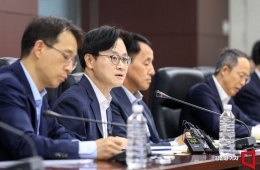
[Asia Economy Reporter Jongil Park] At 10:30 a.m. on the 9th, during a meeting of Lee Nak-yeon, a preliminary candidate of the Democratic Party of Korea, held in the large conference room on the 6th floor of the Korean Federation of Trade Unions, Jeong Seong-hye, head of the Part-Time Public Officials Division of the National Integrated Public Officials Labor Union, demanded the "improvement of the part-time public official (conversion, recruitment) system."
Since 2014, a total of about 6,500 part-time recruited public officials have been hired, and as of December 31, 2020, about 3,800 remain (1,585 national officials, 2,224 local officials), resulting in a resignation rate of 42%. Resignations continue to occur, clearly revealing that the system has failed after seven years since its introduction.
Jeong Seong-hye, head of the Part-Time Public Officials Division of the National Integrated Public Officials Labor Union, stated, “The Park Geun-hye administration hired part-time general public officials working 20 hours a week with guaranteed retirement from 2014, aiming to raise the employment rate to 70% by expanding short-time jobs. However, currently, no new hires are being made, and personnel officers in local governments and central administrative agencies are demanding improvements to allow converted public officials to work up to 40 hours per week, the same as full-time employees.”
Kim Ju-young, a member of the Democratic Party of Korea who attended the meeting, said, “For those who can increase their working hours due to resolved reasons such as childcare or nursing, the system should be improved to allow them to work up to 40 hours.”
In response, preliminary candidate Lee Nak-yeon expressed a proactive intention, saying, “Regarding increasing working hours up to 40 hours per week, internal discussions are needed, and it is necessary to consider various methods to ensure that the procedures or stages for conversion are conducted fairly.”
In an interview, Head Jeong emphasized, “Although the guarantee of living wages and excessive overtime led to the revision of the Public Officials Appointment Decree in June 2019, allowing work up to 35 hours per week, converted part-time public officials are granted the right to choose their working hours, making it easy to expand or reduce working hours. However, part-time recruited public officials do not have the right to choose their working hours, causing discrimination among part-time public officials. Even if they request an increase or decrease in hours based on their circumstances, some are allowed while others are not, and the system operates solely under the authority of the institution (appointing authority) without consistent standards. Therefore, legal amendments are necessary to reflect the opinions of the parties involved.”
Hot Picks Today
 Cerebras Soars 70% on IPO Debut: Is Nvidia's Reign Ending as a New AI Semiconductor Power Emerges?
- "After Vowing to Become No. 1 Globally, Sudden Policy Brake Puts Companies’ Massive Investments at Risk"
- "Saudi Arabia Discusses Mutual Non-Aggression Pact with Iran with Allies After End of War"
- "Mom, Isn't It Comfortable Living With Me?"... 'Unexpected Result' Shows Increased Drinking Out of Frustration
- "He's Handsome, It's Such a Pity?"... Lawyer Responds to Bizarre 'Appearance Evaluation' of High School Girl Murder Suspect
She also revealed that, unlike converted part-time public officials who are recorded as one person on the official public official quota table, part-time recruited public officials are recorded in decimals such as 0.5 or 0.875 according to their working hours. She has repeatedly expressed to the Ministry of the Interior and Safety that this practice raises issues of human dignity and equity as stipulated in the Constitution, and announced plans to hold a video forum to improve this matter.
© The Asia Business Daily(www.asiae.co.kr). All rights reserved.