Jung Se-kyun on Mention of Unification with Lee Nak-yeon: "Presumptuous Talk, No Such Thought at All"

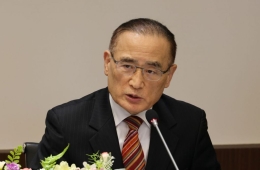
Jeong Se-gyun, a presidential primary candidate of the Democratic Party of Korea, is holding a policy meeting for bus transport workers at the National Federation of Automobile Workers' Unions on Nonhyeon-ro, Seocho-gu, Seoul, on the 29th. Photo by the National Assembly Press Photographers Group
View original image[Asia Economy Reporter Jeon Jinyoung] Jeong Se-gyun, a presidential candidate from the ruling party and former Prime Minister, clearly stated on the 30th that he has no intention of unifying with former Democratic Party leader Lee Nak-yeon, calling the possibility raised by some “presumptuous talk.”
In an interview with KBS Radio’s ‘Choi Kyung-young’s Strong Current Affairs’ on the morning of the same day, Jeong responded to Rep. Yang Ki-dae’s visit to the Jeonbuk Provincial Assembly on the 27th, where Yang said, “I look forward to the moment when Lee Nak-yeon and Jeong Se-gyun join forces in the primary,” by saying, “I think that was presumptuous,” and “I have no thoughts of unification at all.”
He then launched an offensive against his rivals, Gyeonggi Province Governor Lee Jae-myung and former leader Lee Nak-yeon. Jeong said to Lee Jae-myung, “In the TV debate, I asked what regional expansion meant in relation to regionalism remarks, but there was no response on that part,” and toward Lee Nak-yeon, he pointed out, “Regarding the impeachment controversy, he recently stated opposition to impeachment. I asked why he changed his stance, among other questions, but the answers were insufficient.”
Regarding the real estate issue, he criticized, “I will supply 2.8 million housing units over five years,” and said, “Lee’s basic housing plan and Lee’s three laws on the public concept of land cannot solve the real estate problem.”
Hot Picks Today
 "Now Our Salaries Are 10 Million Won a Month" Record High... Semiconductor Boom Drives Performance Bonuses at Major Electronic Component Firms
- Living the Homebody Dream? "I Was Shocked by My Spending" How to Cut Costs to 5,000 Won for Essentials [The Principles of Benefits]
- Is It Really Like an Illness? "I Can't Wait to Go Again"—Over 1 Million Visited in Q1, Now 'Busanbyeong' Takes Hold [K-Holic]
- "Heading for 2 Million Won": The Company the Securities Industry Says Not to Doubt [Weekend Money]
- Experts Already Watching Closely..."Target Price Set at 970,000 Won" Only Upward Momentum Remains [Weekend Money]
He said, “The basic housing plan risks reducing rental housing that should be supplied to low-income groups. It is inappropriate because excessive competition could harm low-income people,” and added, “The public concept of land could potentially raise housing supply prices.”
© The Asia Business Daily(www.asiae.co.kr). All rights reserved.