Cannot Guarantee Excess Tax Revenue in the Second Half of the Year
National Tax Revenue Increased by 43.6 Trillion Won from January to May This Year
Impact of Corporate and Income Tax Growth
Government Notes Stabilization Trend in Real Estate and Securities Transactions
"Cannot Guarantee Excess Tax Revenue in the Second Half"

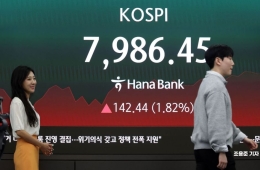
On the 9th, as the spread of COVID-19 intensifies, the KOSPI index is displayed in the Hana Bank dealing room in Euljiro, Seoul. On that day, the KOSPI started at 3,245.52, down 7.16 points (0.22%) from the previous session, showing a downward trend. Photo by Moon Honam munonam@
View original image[Asia Economy Reporter Jang Sehee] With the real estate and stock markets booming, national tax revenue from January to May this year increased by as much as 43.6 trillion KRW compared to last year. However, due to the stabilization trend in real estate and stock transactions, this tax revenue expansion is not expected to continue in the second half of the year.
According to the Ministry of Economy and Finance’s July issue of the "Monthly Fiscal Trend" published on the 8th, national tax revenue through May this year reached 161.8 trillion KRW, an increase of 43.6 trillion KRW compared to the same period last year. The progress rate was 57.2%, 15.8 percentage points ahead of one year ago.
The increase in tax revenue was prominent in corporate tax and value-added tax categories. Due to a faster-than-expected recovery since the second half of last year, corporate performance improved, resulting in an additional 11.8 trillion KRW collected in corporate tax, totaling 37.9 trillion KRW, and an additional 4.3 trillion KRW in value-added tax, totaling 33.6 trillion KRW. Capital gains tax revenue increased by 5.9 trillion KRW due to the heated real estate market, and securities transaction tax revenue rose by 2.2 trillion KRW amid the stock market boom. Inheritance tax also increased by 2 trillion KRW.
Government: Excluding 11 Trillion KRW Base Effect, Excess Tax Revenue is 32.5 Trillion KRW
However, the government analyzes that it is more accurate to exclude the 11.1 trillion KRW generated by the base effect of tax support. A Ministry of Economy and Finance official stated, "If we subtract the 11.1 trillion KRW base effect from last year’s tax support, the increase compared to the previous year is 32.5 trillion KRW." He added, "If the base effect is not considered, there is a risk of significantly overestimating tax revenue."
Furthermore, the current economic recovery trend is not immediately reflected in tax revenue for the second half of the year. The official explained, "In the case of corporate tax, most of the income earned this year is reported and paid in March next year, and comprehensive income tax is reported and paid in May next year. If private consumption recovers toward the second half, tax revenue related to activities in October and November will come in next year, so there is a time lag in tax revenue from economic recovery in the second half of this year, and it is not immediately reflected."
Hot Picks Today
 In the End, Fearing a Strike, Samsung Electronics Removes Wafer Pods... Enters 'Emergency Mode'
- No Bacteria Detected in Arisu After 24 Hours of Repeated Drinking from a Tumbler
- "Available Only in Korea": Pokémon Card Prices Surge 2,532% Due to Rarity, Becoming Investment Assets
- Kumho Tire Invests 59.6 Billion Won in Polish Subsidiary
- Pulling Out His Phone for a '360-Degree Selfie' and Giving a Thumbs Up at the Ceiling... "China Is Fascinating" [US-China Summit]
The variable of the fourth wave of COVID-19 also remains. Professor Park Kibaek of the Department of Economics at University of Seoul said, "There may be a decrease in revenue due to the fourth wave," but analyzed, "However, since face-to-face service industries such as food and lodging do not constitute a large portion of total tax revenue, the decrease will not be significant." He also predicted, "The export impact of key companies and domestic sales may rather affect corporate tax." The Ministry of Economy and Finance also analyzed that if the fourth wave occurs, it will partially affect tax revenue.
© The Asia Business Daily(www.asiae.co.kr). All rights reserved.