Ruling Party and Government Agree to Provide Disaster Relief Funds to Bottom 80% Income Earners
20% Cashback Based on Additional Credit Card Spending
3-Item Package Supplementary Budget Expected to Cost 15 to 16 Trillion Won

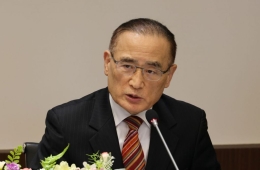
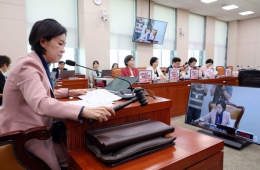
Yoon Ho-jung, floor leader of the Democratic Party of Korea, is delivering opening remarks at the '2021 2nd Supplementary Budget Party-Government Consultation' held at the National Assembly Members' Office Building on the 29th. Photo by Yoon Dong-ju doso7@
View original image[Asia Economy Reporter Jeon Jinyoung] The Democratic Party of Korea and the government agreed on the 29th to provide emergency disaster relief funds to the bottom 80% of income earners. While the Democratic Party had advocated for universal payments citing economic stimulus and fairness issues, the government emphasized selective payments considering fiscal conditions.
Park Wanju, the Policy Committee Chair of the Democratic Party, stated at a briefing on the second supplementary budget (supplementary budget) party-government consultation held at the National Assembly on the morning of the same day, "After in-depth discussions, it was agreed to support households in the bottom 80% of income, broadly encompassing the middle class, with the COVID-19 coexistence national support fund." Instead, the remaining 20% will receive cashback equivalent to the increase in their credit card spending. An additional fixed amount will be provided to 3 million low-income individuals, including basic livelihood security recipients, near-poverty groups, and single-parent families. This three-part COVID-19 damage support package, including a 1 trillion won cashback budget, is expected to cost a total of 15 to 16 trillion won.
The scale of this supplementary budget is about 36 trillion won, which includes the 33 trillion won supplementary budget and 3 trillion won of existing budget. Apart from the COVID-19 package, the party and government decided to allocate 4 to 5 trillion won for vaccine and quarantine reinforcement, 2 to 3 trillion won for employment and livelihood stabilization budgets, and 12 to 13 trillion won to revitalize the regional economy.
Regarding the decision to support 80% despite the Democratic Party’s advocacy for universal payments, Policy Committee Chair Park explained, "During the practical discussions, the party requested universal payments, but through high-level party-government consultations, it was decided to exclude the top 20%, i.e., the top quintile. The 20% will be compensated with cashback, and the government’s proposal to provide stronger support to about 3 million vulnerable groups was accepted."
Hot Picks Today
 "Now Our Salaries Are 10 Million Won a Month" Record High... Semiconductor Boom Drives Performance Bonuses at Major Electronic Component Firms
- Experts Already Watching Closely..."Target Price Set at 970,000 Won" Only Upward Momentum Remains [Weekend Money]
- "Heading for 2 Million Won": The Company the Securities Industry Says Not to Doubt [Weekend Money]
- Living the Homebody Dream? "I Was Shocked by My Spending" How to Cut Costs to 5,000 Won for Essentials [The Principles of Benefits]
- "Chanel Open Run? I Get a Free Pass"... The World of the Top 0.1% That Money Alone Can't Enter [Luxury World]
Additionally, the party and government will work on creating new jobs, strengthening vocational training and workforce development in software and shipbuilding sectors, and supplementing the employment safety net. Regarding youth issues, temporary support for certification acquisition costs will be provided for vocational high school and junior college students facing employment difficulties due to COVID-19. Furthermore, the abolition of the support obligation criteria for livelihood benefits, originally scheduled for January 2022, will be advanced to October, allowing about 50,000 households to receive early benefits. The government plans to submit the supplementary budget bill to the National Assembly on the 2nd of next month, reflecting the results of this party-government consultation.
© The Asia Business Daily(www.asiae.co.kr). All rights reserved.