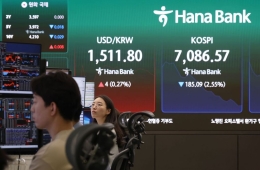
[Good Morning Stock Market] Global Stock Markets Heading Toward Economic Recovery
Rising Expectations for US Stock Market Infrastructure Investment Bill Passage
ExxonMobil Up 3% on OPEC+ Demand Forecast Upgrade
"Domestic Stock Market Likely to Continue Rally Led by Cyclical Stocks"
![[Image source=Yonhap News]](http://www.asiae.co.kr/news/img_view.htm?img=2021050113214517269_1619842905.jpg)
[Asia Economy Reporter Minji Lee] As expectations for the passage of the infrastructure investment bill rise, cyclical stocks centered on industrials showed strength in the U.S. stock market. While growth stocks underwent a correction, the S&P 500 and Nasdaq indices fell by 0.05% and 0.09% respectively, the Dow Jones Industrial Average closed up 0.13%. Accordingly, on the 2nd, differentiated movements in sectors related to economic recovery are expected to unfold in the domestic stock market.
◆ Sangyoung Seo, Researcher at Mirae Asset Securities = A notable point in the U.S. stock market is that cyclical stocks, including industrials, showed strength as the possibility of compromise between the Republican Party and the Biden administration regarding the infrastructure investment bill increased.
The Biden administration plans to hold negotiations with Republican senators on the infrastructure investment bill on the 2nd (local time). Currently, the Biden administration has proposed a scale of $1.7 trillion, while the Republicans have specifically proposed $928 billion. However, due to the Democrats' active efforts, Republican lawmakers are creating a bipartisan-supported infrastructure bill and continuing positive talks with President Biden, raising expectations for the passage of the infrastructure investment bill.
As expectations for an agreement increased, infrastructure-related stocks showed strength. In particular, with international oil prices reaching their highest level since late 2018 and OPEC+ (the Organization of the Petroleum Exporting Countries (OPEC) and major oil-producing countries including Russia) revising demand forecasts upward due to economic normalization, ExxonMobil (3.6%) and Chevron (2.7%) continued their gains.
Accordingly, strength in sectors related to economic normalization is expected in the domestic stock market as well. The domestic stock market continued its strength the previous day, buoyed by solid export-import statistics and China's manufacturing index, reflecting confidence in the economy. On this day, influenced by the strength of cyclical sectors such as energy and finance in the U.S. stock market, preference for sectors related to economic normalization and cyclical stocks is expected to increase.
![[Good Morning Stock Market] Global Stock Markets Heading Toward Economic Recovery](http://www.asiae.co.kr/news/img_view.htm?img=2021060207482960996_1622587709.png)
◆ Kyungsoo Lee, Researcher at Hana Financial Investment = As domestic companies recorded strong earnings surprises in the first quarter, corporate earnings estimates have been revised upward. Earnings revisions were mainly seen in sectors such as shipping, refining, steel, finance, and construction, which is analyzed as reflecting increased expectations for economic recovery after COVID-19.
To build a promising portfolio, attention should be paid to sectors where the speed of earnings recovery to pre-COVID-19 levels is slower compared to other sectors. This means finding targets whose consensus estimates for the second or third quarter have not yet risen sufficiently. These are sectors that did not show earnings surprises in the first quarter or had no triggers for consensus increases due to insufficient contact recovery after vaccination.
For example, the airline sector is still experiencing a deficit trend this year. Its earnings recovery potential is also estimated to be low. However, in the second and third quarters of this year, it is expected to record a deficit of 220 billion KRW, which is an improvement compared to the combined operating deficit of 440 billion KRW in the second and third quarters of 2019, just before COVID-19. The hotel and leisure sector is predicted to generate about 10 billion KRW in operating profit during the same period this year, compared to a combined operating profit of 586 billion KRW in the second and third quarters of 2019 before COVID-19. Currently, its earnings recovery rate is around 2%, and it is expected to show the steepest upward trend when society returns to contact-based activities.
Hot Picks Today
 "Stocks Are Not Taxed, but Annual Crypto Gains Over 2.5 Million Won to Be Taxed Next Year... Investors Push Back"
- "Not Jealous of Winning the Lottery"... Entire Village Stunned as 200 Million Won Jackpot of Wild Ginseng Cluster Discovered at Jirisan
- Bull Market End Signal? Securities Firm Warns: "Sell SK hynix 'At This Moment'"
- KOSPI Drops to 7,000 in Early Trading Amid Foreign Sell-Off
- "Even With a 90 Million Won Salary and Bonuses, It Doesn’t Feel Like Much"... A Latecomer Rookie Who Beat 70 to 1 Odds [Scientists Are Disappearing] ③
Earnings estimates for the cosmetics packaging sector also show that while the cosmetics sector’s earnings recovery rate (117%) has surpassed previous levels, it still shows a low earnings recovery rate of 18%. Additionally, earnings recovery rates for utilities (46%), food and beverage (77%), machinery (79%), and auto parts (84%) have yet to fully recover to previous levels.
© The Asia Business Daily(www.asiae.co.kr). All rights reserved.