[Inside Chodong] Myanmar Through the Memories of Gwangju

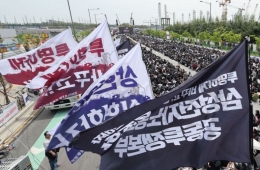
Myanmar residents in Korea are protesting against the Myanmar military coup in front of Hannam Elementary School in Yongsan-gu, Seoul. Photo by Hyunmin Kim kimhyun81@
View original imageOne of the most shocking memories from my childhood is about the ‘5·18 Democratic Movement.’ When I was in elementary school, I visited a friend’s house, and he showed me a scary video, which was about the 5·18 Democratic Movement. I only realized as an adult that it was what is commonly called the ‘Gwangju video.’ To be more precise, I can only speculate that what I saw as a child was the Gwangju video. There is no way to verify it exactly with my fragmented memories.
The feelings I had after watching the video my friend showed me were twofold. First, fear. The screen was covered in blood, with atrocities and corpses everywhere, which was enough to shock a young child. What was even scarier was the fact that this situation happened in our country, and not long before the time I watched the video.
The other feeling was gratitude. It was only after becoming an adult that I learned the footage was filmed by foreigners. Not only that video, but foreigners from all over the world came to Gwangju to raise awareness of the atrocities. I was grateful not only for their courage to enter a dangerous place but also for the fact that they cared about a democratization movement happening in a distant foreign country. They did not forget Gwangju, which was isolated by the military regime.
Recently, I came across news that Hana Bank is temporarily waiving remittance fees for Myanmar workers residing in Korea, and it suddenly reminded me of Gwangju.
Myanmar is currently in complete chaos. Recently, cash has become scarce. Citizens, who cannot trust the system, are trying to hold as much cash as possible. Although the military regime has limited daily withdrawal amounts since February, citizens still line up in front of bank ATMs from early morning to withdraw money. There are reports that ATM withdrawal fees, which were only 2.5%, have surged to 15%. The fee for ‘cash conversion’?exchanging bank transfer amounts into cash?is said to exceed 13%. If you send 10,000 won from your bank account to a dealer, you only receive 8,700 won in cash.
The military punishes those who possess cash above a certain amount, but this is insufficient to overcome the situation. In the past, the military was worried about inflation because they printed money recklessly whenever cash was short, but the situation is different now. Since the end of March, foreign companies supplying raw materials and parts for cash production to the Myanmar Mint have stopped transactions in protest against the military’s harsh crackdown on civilian protesters. Additionally, bank employees are participating in a large-scale Civil Disobedience Movement (CDM) and are on strike, making banking operations difficult.
It is unclear how much Hana Bank’s policy of waiving remittance fees will help the Myanmar democratization movement. However, it will certainly help Myanmar people struggling with huge fees to obtain cash. And Myanmar people sending money from Korea or receiving money locally, along with their families and relatives, will surely remember that even after this crisis ends, at least one Korean bank did not forget them. Just as I remember the Gwangju video and the courageous foreigners.
Hot Picks Today
 "Samsung and Hynix Were Once for the Underachievers"... Hyundai Motor Employee's Lament
- "Plunged During the War, Now Surging Again"... The Real Reason Behind the 6% One-Day Silver Market Rally [Weekend Money]
- After Losing Her Only Daughter, a Mother in China Gave Birth to Twins at 60... Reinventing Life at 76
- KOSPI Drops Over 3% Intraday, Falls Below 7,300 Mark
- "That? It's Already Stashed" Nightlife Scene Crosses the Line [ChwiYak Nation] ③
Kiho Sung, Deputy Head of Finance Department
© The Asia Business Daily(www.asiae.co.kr). All rights reserved.