Samsung Electronics Accelerates 'System Semiconductor 2030 Strategy'
1Q System LSI Business Exceeds Sales Target
Remarkable Growth in Non-Memory Sector
Continued Supply Shortage of System Semiconductors like Mobile AP and DDI
System LSI Business Sales Expected to Achieve Double-Digit Annual Growth
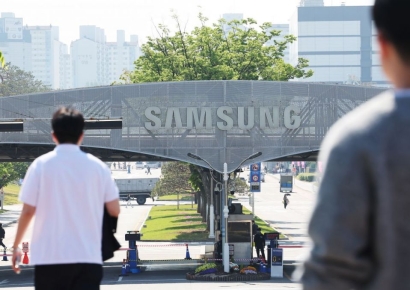
[Asia Economy reporters Suyeon Woo and Hyunjin Jeong] Samsung Electronics' System LSI division has exceeded its sales target for the first quarter, accelerating Samsung's ‘System Semiconductor 2030 Strategy.’ Recently, Samsung has shown remarkable growth in various system semiconductor fields such as mobile application processors (AP), image sensors (CMOS), display driver ICs (DDI), and power management ICs (PMIC).
The non-memory segment accounts for about 25% of Samsung Electronics' semiconductor sales. Considering that Samsung's semiconductor sales were 19 trillion KRW in the first quarter, it is estimated that the non-memory division (System LSI + Foundry) recorded sales of approximately 4.5 trillion KRW.

Taking into account the strong foundry demand this year and price increases due to some system semiconductor shortages, the profit contribution is expected to be higher than this. In the Q4 earnings IR last year, Samsung Electronics mentioned a double-digit sales growth target for the System LSI business this year, and considering the recent tight supply situation, this annual target is expected to be easily achievable.
Although the overall sales proportion of the System LSI business is still minimal, it is a market that cannot be overlooked given its growth potential. System semiconductors represent a massive market accounting for about 70% of the global semiconductor market. While Korean companies hold about 70% market share in memory, their system semiconductor market share has stagnated at around 3% for several years.
To address this, Samsung Electronics announced the ‘System Semiconductor 2030’ strategy, aiming to invest 171 trillion KRW in system semiconductors by 2030 to become the global number one. Samsung is already showing prominence in some areas such as foundry, DDI, mobile AP, and CMOS, and has recently expanded its market base with new product launches like PMIC. According to Omdia, Samsung secured the global number one position in DDI market share last year with 26.3%, and is closely chasing Sony, the industry leader, in the CMOS market as the second largest shareholder.
Meanwhile, fueled by growth in the non-memory segment and rising memory prices, there are forecasts that Samsung Electronics will reclaim the title of ‘world’s top semiconductor sales’ in the second quarter of this year, surpassing Intel. IC Insights predicts Samsung’s semiconductor sales in Q2 this year will reach $18.5 billion (approximately 20.8 trillion KRW), exceeding Intel’s $17.9 billion.
Hot Picks Today
 "Now Our Salaries Are 10 Million Won a Month" Record High... Semiconductor Boom Drives Performance Bonuses at Major Electronic Component Firms
- 'Still Hesitant? If You're Wondering Whether KOSPI Will Rise, This Is the Number You Must Watch [Weekend Money]'
- "Heading for 2 Million Won": The Company the Securities Industry Says Not to Doubt [Weekend Money]
- Fire Breaks Out on 29th Floor of Tower Palace in Seoul; About 40 Residents Evacuated, No Injuries Reported
- Is It Really Like an Illness? "I Can't Wait to Go Again"—Over 1 Million Visited in Q1, Now 'Busanbyeong' Takes Hold [K-Holic]
As signs of a supercycle spread centered on the DRAM market and Intel continues to struggle with poor performance, it is expected that Samsung Electronics will regain the ‘world number one’ title it held in 2017-2018 before losing it to Intel. Due to expanding semiconductor demand, the combined sales of the world’s top 15 semiconductor companies in Q1 totaled $101.863 billion, a 21% increase compared to the previous year.
© The Asia Business Daily(www.asiae.co.kr). All rights reserved.