Jeong Eui-yong Reconfirms "Won't Oppose If Japan Meets Conditions"... Opposition Parties Intensify Criticism

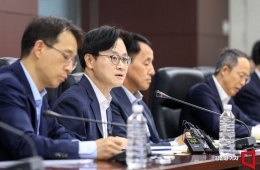
Foreign Minister Chung Eui-yong attended an emergency briefing at the National Assembly on the 20th regarding the discharge of contaminated water from Fukushima and responded to questions from lawmakers. Photo by Yoon Dong-ju doso7@
View original image[Asia Economy Reporters Inho Yoo and Jieun Lee] Foreign Minister Chung Eui-yong stated on the 20th regarding Japan's decision to discharge contaminated water from the Fukushima nuclear power plant, "If conditions such as scientific evidence and transparency according to the International Atomic Energy Agency (IAEA) are met, we do not necessarily oppose it."
Minister Chung reaffirmed his previous stance during the National Assembly Foreign Affairs and Unification Committee plenary session held that morning, following his statement in the government questioning session the day before that "If appropriate procedures according to IAEA standards are followed, there is no need to oppose it."
This is interpreted as the government stepping back from its previously firm position of "unacceptable," which was maintained by President Moon Jae-in the day after Japan's decision was announced on the 13th, even mentioning the possibility of filing a case with the International Tribunal for the Law of the Sea. Observers suggest that with the upcoming South Korea-US summit next month and the US supporting Japan's decision, the government may feel burdened by being at odds with the US.
In line with this interpretation, members of both ruling and opposition parties raised concentrated concerns during the Foreign Affairs and Unification Committee session. Minister Chung explained, "The reason I said 'there is no need to necessarily oppose' is because some criticized our government for 'opposing for the sake of opposition.'" Lee Sang-min, a member of the Democratic Party of Korea, questioned Minister Chung's remark, asking, "Shouldn't our demands have been clearly stated as well?"
Minister Chung emphasized that the government's position on Japan's contaminated water discharge decision has not changed. He said, "If Japan's transparent information disclosure or sufficient consultation with us is inadequate, we are prepared to follow the UN Law of the Sea procedures," adding, "There has been no sudden review or announcement from us that 'it is difficult to prove damage or file a case.'"
The government's shift from a high-key to a low-key stance on this issue appears to be decisively influenced by the US refusal to intervene. Accordingly, the government has decided to focus its efforts on multilateral diplomacy through international organizations rather than pursuing the less feasible option of filing a case with the International Tribunal for the Law of the Sea. The Ministry of Foreign Affairs stated in the "Status Report on the Decision to Discharge Fukushima Nuclear Power Plant Contaminated Water" submitted to the Foreign Affairs and Unification Committee that it will actively utilize multilateral diplomatic opportunities such as the IAEA, the UN, and the World Health Organization (WHO) to publicize the problems with Japan's decision.
Furthermore, it is known that after review centered on the Ministry of Foreign Affairs and related ministries, the option of filing a case was judged to be unrealistic. To win, clear damage caused by Japan's discharge of contaminated water must be proven, but the discharge is not expected to begin for about two years. Although there is a proposal to request a "provisional measure" to prevent Japan from discharging if there is significant concern about damage, this too is likely to fail.
Hot Picks Today
 "After Vowing to Become No. 1 Globally, Sudden Policy Brake Puts Companies’ Massive Investments at Risk"
- "Mom, Isn't It Comfortable Living With Me?"... 'Unexpected Result' Shows Increased Drinking Out of Frustration
- "Available Only in Korea": Pokémon Card Prices Surge 2,532% Due to Rarity, Becoming Investment Assets
- Tenant Steals 80 Million Won from Landlord's Bedroom... "Used for Debt Repayment, Burned 70 Million?"
- Even the Wealthy Ask, "Is It Okay to Enter Now?"... Flocking In With Cash Bundles [Wealth Investment Strategies] ⑨
Some criticize that President Moon's early mention of the filing option narrowed South Korea's diplomatic position in the diplomatic battle over Japan's contaminated water, as the US refused South Korea's request for intervention. Professor Kim Hyun-wook of the Korea National Diplomatic Academy said, "Since the contaminated water discharge issue is intertwined with Korea-Japan relations, it should have been resolved through diplomatic means via the US, but a hardline stance was revealed too early," adding, "The US overlooked the fact that it cannot directly intervene in this issue."
© The Asia Business Daily(www.asiae.co.kr). All rights reserved.