Seoul's First 'Brain Lesion Disability Vision Center' Opens on the 15th... Expanding to 8 Centers in 2023
Comprehensive Support for Education, Care, and Health Management at Mapo-gu 'Brain Lesion Disability Vision Center'... Two Additional Centers Created Annually
Simultaneous Use by 15 People... Barrier-Free Spaces, Special Facilities Including Exchange Beds for Incontinence Products

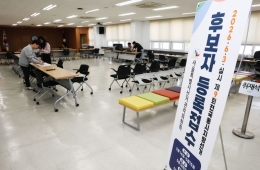
[Asia Economy Reporter Lim Cheol-young] Seoul City’s first ‘Vision Center for Adults with Brain Lesion Disabilities,’ established in Mapo-gu, officially opened on the 15th and has begun full-scale operations. It is the nation’s first dedicated comprehensive support facility for adult brain lesion disability patients who require rehabilitation and treatment throughout their lives.
Fifteen adults with brain lesion disabilities, selected through a public recruitment process, attend the center every weekday from Monday to Friday, receiving comprehensive support including care from 10 a.m. to 4 p.m., systematic social adaptation training, vocational skill enhancement education, and health management services.
Currently, among the registered disabled persons in Seoul (394,190 people), 10.3% (40,905 people), or one in ten, have brain lesion disabilities. Despite the existence of care- and education-focused facilities, there has been no dedicated facility providing systematic comprehensive services including independence training, daily living education, and health management.
The first center is located on the second floor of the Woori Mapo Welfare Center (10 Sinchon-ro 26-gil) in Mapo-gu. It has secured a space of 508.99㎡, about 27% larger than the standard area (over 400㎡) required to accommodate more than 15 users simultaneously, allowing brain lesion disability patients to use the facility comfortably.
A nurse is stationed full-time at the center to carefully manage the health status of users daily. A doctor visits every two weeks to check their health and provide consultations. Since brain lesion disability patients often have multiple disabilities and chronic diseases, requiring lifelong rehabilitation and treatment, the center aims to prevent physical health deterioration and maintain health.
Seoul City selected 11 users through recruitment in February for the center’s opening. After a two-week adaptation period, the final users will be confirmed. Additional users will be recruited through a public announcement in the last week of March. Anyone aged 18 to under 65 with brain lesion disabilities residing in Seoul can apply.
Once admitted, users can utilize the facility for five years. Basic livelihood security recipients use the service free of charge, low-income groups pay 140,000 KRW per month, and general users pay 280,000 KRW per month.
Seoul City plans to establish two Vision Centers annually, expanding to a total of eight centers by 2023. Following the Mapo center, two additional Vision Centers will be created this year through public recruitment in the first and second halves of the year. A budget of 1.05 billion KRW will be invested to designate and operate two centers this year. Each center will receive 300 million KRW for facility costs and 225 million KRW for six months of operating expenses, with an annual operating budget of 450 million KRW to be supported going forward.
Hot Picks Today
 "Suspicious Timing?"...Trump Traded Stocks After Praising Wartime Capabilities
- "I Went to 10 Convenience Stores and Still Couldn't Buy It": The Bread Sensation That Sold 100 Million Units Already [The Way We Shop Now]
- Trump Pressures Taiwan to Relocate Semiconductor Industry to U.S., Says "Taiwan Took Away America's Semiconductor Industry"
- There Is a Distinct Age When Physical Abilities Decline Rapidly... From What Age Do Strength and Endurance Drop?
- "Contact Me First If Houses Are Built": Wealthy Clients Eyeing... Will Ultra-High-End Residences Worth 20 Billion Won Be Developed? [Real Estate AtoZ]
Kim Seon-soon, Director of Seoul City Welfare Policy Office, said, “The Vision Center for Adults with Brain Lesion Disabilities is a specialized dedicated facility for adults who require lifelong rehabilitation and treatment. We expect it to contribute not only to strengthening the independence of people with disabilities but also to alleviating the caregiving burden on their families.”
© The Asia Business Daily(www.asiae.co.kr). All rights reserved.