"A Country That Turns Entrepreneurs into Criminals"... The Anger of SMEs
"Do We Have to Lay Off Employees to Meet the 3-Year Grace Period for Workplaces with Fewer Than 50 Employees?" Outrage
One Accident Could Lead to Bankruptcy... National Assembly Criticized for 'Lack of Expertise and Irresponsibility' Ignoring Reality

[Asia Economy Reporters Jonghwa Kim, Heeyoon Kim] "There is no interest in prevention, only punishment; the law’s sole purpose is punishment itself. Are we, small and medium-sized enterprises, supposed to sacrifice (lay off) 6 out of 55 employees to meet the under-50 employee threshold just to get a grace period and avoid the risk of closure?"
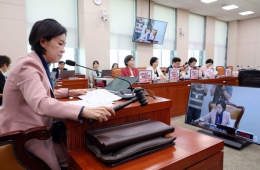
Small and medium-sized business owners could not hide their anger on the 7th at the National Assembly’s Legislation and Judiciary Committee after the ruling and opposition parties agreed on the Serious Accidents Punishment Act. They especially exploded in frustration over the three-year grace period granted to workplaces with fewer than 50 employees, saying, "The National Assembly is completely out of touch with reality."
The Three-Year Grace Period Is Merely a Formality
Yoon Cheol-kyun, a 58-year-old pseudonymous CEO of a construction materials company in the Seoul metropolitan area, said, "If a serious accident occurs while the prime contractor uses subcontractors with fewer than 50 employees, the three-year grace period is practically meaningless. The subcontractors also have to prepare within a year." This points out that since 81% of all workplaces have fewer than 50 employees, the grace period is just a formality.
Starting next year, if a serious accident occurs after the law’s enforcement, the business owner or management responsible will face imprisonment for more than one year or a fine of up to 1 billion KRW, and the corporation will be fined up to 5 billion KRW. If multiple people are seriously injured, the management responsible faces imprisonment of up to seven years or a fine of up to 100 million KRW, and the corporation faces a fine of up to 1 billion KRW. When the business owner or corporation causing the serious accident compensates for damages, they must pay "five times the amount of the damages."
Regardless of the reason, a single accident could force a small business to close, and the founder may never be able to restart, forcing them to operate under fear. Kim Tae-geun, a 54-year-old pseudonymous CEO of an auto parts manufacturing company in Anseong, Gyeonggi Province, said, "If a serious accident occurs on site, rather than investigating the details, the CEO will be arrested and held responsible for fines and damages. Small businesses cannot bear the enormous fines, punitive damages, and legal fees. Ultimately, they will go bankrupt," he expressed concern.
A CEO of an auto parts company in Siheung, Gyeonggi Province, lamented, "If an accident happens due to a worker’s mistake or equipment problem, in plain words, I’m the one who ‘goes to jail.’ If that happens, both I and the company are finished." Jung Young-sik, a 61-year-old pseudonymous CEO of a shipbuilding subcontractor in Ulsan, said, "Did they even listen to the voices from the field when making this law? It’s like telling us not to do business in Korea."
Ignored SMEs, Irresponsible National Assembly
Economic organizations pleaded, "If the law is enforced as is, small and medium-sized enterprises at the frontline of the subcontracting structure could immediately become lawbreakers," but they were coldly ignored. Kim Ki-moon, chairman of the Korea Federation of SMEs, made a final appeal to "at least change the punishment provisions for business owners," but the National Assembly turned a deaf ear.
The Serious Accidents Punishment Act, scheduled to pass the plenary session on the 8th, was modeled after the UK’s Corporate Manslaughter and Corporate Homicide Act. The reason for its introduction was that the number of industrial accident deaths decreased after the UK enacted the law in 2007. The number of industrial accident deaths in the UK dropped from 180 in 2007?2008 to 147 in 2018?2019. However, it is judged that the decrease in industrial accident deaths in the UK was not due to the Corporate Manslaughter Act.
According to the January 2020 issue of the Korea Occupational Safety and Health Agency’s "International Safety and Health Trends," the number of industrial accident deaths in the UK in 2018?2019 decreased by about 18% compared to 2007?2008, but the number of deaths from industrial accidents has shown a long-term decreasing trend with little change in recent years.
Hot Picks Today
 "Now Our Salaries Are 10 Million Won a Month" Record High... Semiconductor Boom Drives Performance Bonuses at Major Electronic Component Firms
- Wallets Open Wide on Big News...300 Trillion Won Heads to the U.S., "Tax Breaks" Fail to Keep Funds at Home
- "Realizing How Fast Money Disappears: Should You Try Only the Essentials for 5,000 Won? [The Basics of Benefits]"
- "Heading for 2 Million Won": The Company the Securities Industry Says Not to Doubt [Weekend Money]
- Experts Already Watching Closely..."Target Price Set at 970,000 Won" Only Upward Momentum Remains [Weekend Money]
Professor Jung Jin-woo of the Department of Safety Engineering at Seoul National University of Science and Technology criticized, "In the UK, the Corporate Manslaughter Act is evaluated as having little effect. The law has become different from the UK’s Corporate Manslaughter Act. We need to create a law that aligns with the legal system and safety theory, but instead, a law solely focused on punishment was made. The lack of expertise and irresponsibility are much bigger problems."
© The Asia Business Daily(www.asiae.co.kr). All rights reserved.