[The Editors' Verdict] Preparing for the Era of a Weak Dollar: Managing Volatility is Key

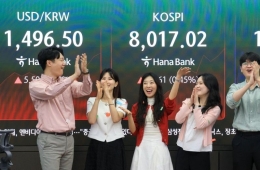
[Asia Economy] As the won-dollar exchange rate sharply fell below 1,100 won, concerns about the won's appreciation are growing, especially among export companies. If the won's strength persists long-term, it could not only reduce the price competitiveness of export products but also negatively impact competitiveness due to delayed investments caused by profitability deterioration from exchange losses. In a recent survey titled 'Impact of Exchange Rate Fluctuations on Exporting Small and Medium Enterprises' conducted by the Korea Federation of SMEs, companies responded that their breakeven exchange rate was around 1,118 won per dollar. The current exchange rate has already fallen short of the breakeven point for export companies.
The appreciation of the won is not entirely negative. A strong won increases its purchasing power and lowers import prices, thereby curbing domestic inflation. It also benefits export companies with a high proportion of raw materials or parts imported from abroad, as well as companies engaged in foreign direct investment. The won's strength also indicates that the fundamentals of the Korean economy, including external payment capacity, are being positively evaluated.
The issue lies in volatility. Since the U.S. presidential election, the won's value has risen much faster compared to competing export countries. Following Joe Biden's inauguration, expectations of eased U.S.-China trade tensions, reduced global uncertainty, global economic recovery due to vaccine distribution, over $900 billion in U.S. stimulus packages, and the Federal Reserve's maintenance of zero interest rates have led to forecasts of continued dollar weakness next year. Amid an overall trend of dollar depreciation, the recent pronounced appreciation of the won can be attributed to relatively favorable growth rates, current account surpluses, and high synchronization with the Chinese yuan.
The Organisation for Economic Co-operation and Development (OECD) recently projected a 4.2% contraction in the global economy this year, but expects South Korea to experience the mildest contraction among OECD members at 1.1%. As expectations for economic recovery grow, global investors have begun increasing their allocations to risk assets and emerging markets rather than safe assets like the dollar or gold. Investment in South Korea, which has relatively sound fiscal health, foreign exchange reserves, and moderate growth slowdown, has surged. In November alone, foreigners net purchased over 6 trillion won in the domestic stock market.
However, the OECD forecasts that while global economic growth will show a clear recovery of 4.2% next year due to vaccine distribution, South Korea's growth rate will be only 2.8%, showing the slowest recovery pace alongside Japan and Brazil. The relatively small share of the service industry helped reduce damage this year, but in the recovery phase, the service sector's low competitiveness is expected to act as a bottleneck. Structural issues including low birth rates and aging population, along with strengthened corporate regulations, are likely to hinder consumption and investment, reducing recovery resilience. Particularly, if COVID-19 vaccination is delayed and economic activities halt again, the exchange rate could experience a sharp swing in the opposite direction from the current trend.
While it is true that preparations for a weak-dollar era are necessary at this point, the possibility that the U.S. economy recovers faster than expected due to vaccine commercialization and that the Federal Reserve may normalize monetary policy earlier cannot be completely ruled out. Regardless of the direction, rapid and extreme swings in the exchange rate over a short period are undesirable. The key is to reduce sharp exchange rate volatility. The government needs to reduce volatility through 'smoothing operations' (fine adjustments). In cases like the recent pronounced short-term won appreciation, some degree of fine-tuning is likely to be tolerated, thus requiring more precise and proactive measures.
Hot Picks Today
 Cerebras Soars 70% on IPO Debut: Is Nvidia's Reign Ending as a New AI Semiconductor Power Emerges?
- [Breaking] Trump: "Achieved a Fantastic Trade Deal with China"
- Flight Cancellations End With "We Refunded You"... Consumers Left to Bear Hotel and Rental Car Losses
- "Mom, Isn't It Comfortable Living With Me?"... 'Unexpected Result' Shows Increased Drinking Out of Frustration
- "After Vowing to Become No. 1 Globally, Sudden Policy Brake Puts Companies’ Massive Investments at Risk"
Kang In-su, Professor, Department of Economics, Sookmyung Women's University
© The Asia Business Daily(www.asiae.co.kr). All rights reserved.