"Labor Union Law Surpasses Critical Point of Labor-Management Balance... Companies Devastated"
Passage of Three Corporate Regulation Laws and Three Labor Union Laws in National Assembly... 3-Person Roundtable Discussion on Current Status and Response Measures
[Asia Economy Reporters Suyeon Woo, Kiho Sung, Dongwoo Lee] As the National Assembly swiftly passed the three corporate regulation laws (amendments to the Commercial Act and the Fair Trade Act, and the enactment of the Financial Group Supervision Act) along with the three labor union laws (Labor Union Act, Public Officials Union Act, and Teachers Union Act), the corporate sector has fallen into a state of panic. Amid worsening business conditions due to the novel coronavirus disease (COVID-19) and continuous exchange rate declines signaling red alerts for export companies' profitability, the ruling party and government pushed through these contentious bills almost by force, disregarding the situation.
The government and ruling party attempted to 'appease companies' by partially reflecting the business community's stance?such as relaxing the 3% voting rights rule for major shareholders when electing audit committee members separately and maintaining exclusive prosecution rights?claiming the legislation was more lenient than the original draft. However, companies expressed anger, dismissing these as mere token gestures. Asia Economy organized an emergency roundtable to assess the reality faced by Korean companies due to the mass passage of corporate regulation bills in the National Assembly and to explore countermeasures. Considering the COVID-19 situation, the roundtable was held remotely (untact) with participants including Jeong Manki, Chairman of the Korea Industrial Alliance Forum (KIAF); Woo Taehee, Executive Vice President of the Korea Chamber of Commerce and Industry; and Kim Heeseong, Professor at Kangwon National University Law School.

- Laws that increase difficulties in business activities, such as the three corporate regulation laws and the three labor union laws, have finally passed the National Assembly. What is the reaction on the corporate front?
▲Jeong Manki= It is literally panic. While countries worldwide are rolling out various support policies to restore corporate profitability after COVID-19, our government is moving in the opposite direction. Once the recovery phase after COVID-19 begins, Europe, the United States, and China?the strongest competitor to our export companies?will restart their engines. Recently, the exchange rate has also declined, raising concerns about the competitiveness of export industries. With rising housing prices reducing disposable income, the domestic market is also challenging. Despite these circumstances, the government's mass passage of regulatory bills that weaken corporate power is hard to understand.
▲Woo Taehee= The mass passage of bills such as the Commercial Act, Fair Trade Act, and Labor Law, which seriously affect corporate management, has caused unprecedented anxiety among companies. It is simply bewildering that economic bills are handled so politically. Especially regarding the Commercial Act and Fair Trade Act, although the business community proposed various alternatives to anticipated problems, the government’s bill was hardly changed. The labor law also reflected only the labor side’s demands, such as allowing dismissed workers to join unions and removing the ban on paying salaries to full-time union officials.
- Among the bills passed this time, which part is most concerning?
▲Jeong Manki= The amendment to the Commercial Act that mandates separate election of audit committee members and restricts major shareholders’ voting rights. Entrusting the appointment of audit committee members?who can access all internal information and trade secrets?to external forces is fatal. Although the government and ruling party partially relaxed the '3% rule' by applying the individual 3% threshold when electing outside director audit committee members, they were too fixated on this intangible ideology and missed the essence. It is regrettable that this resulted in a superficial, ineffective modification.
▲Woo Taehee= The separate election of audit committee members under the Commercial Act undermines the foundation of shareholder capitalism. It impairs the board of directors’ function and weakens companies’ means to defend management rights. There is also the risk that persons recommended by activist funds could enter the board and interfere in management unrelated to corporate development or maliciously access and misuse important corporate information. In a situation where urgent strategic responses are needed, companies may lose competitiveness as they focus resources on securing friendly shares.
Some argue that raising concerns about management threats from electing even one audit committee member separately is an exaggeration. However, even one member elected separately triggers the 3% rule, making the threat of audit committee members recommended by activist funds a reality. There is also significant risk as activist funds could split shares or form alliances to threaten management, leaving companies with insufficient defense mechanisms.
- Since the bills have already passed, are there no countermeasures for companies? There have been talks, mainly from economic organizations, about postponing enforcement and setting a minimum stock holding period (one year) for voting rights when electing audit committee members.
▲Woo Taehee= Since the bills have just passed, companies are likely deliberating on countermeasures. Apart from persuading domestic institutional investors or minority shareholders to secure as many friendly shares as possible and increasing communication with activist funds launching attacks, there are few other options.
▲Jeong Manki= To block attacks from foreign activist capital, it would have been better to mandate that candidates recommended by domestic minority shareholders must be nominated as audit committee candidates. There are already reports that foreign funds are splitting shares of domestic companies. The voting rights of domestic institutions like the National Pension Service, which hold the largest shareholder stakes, are restricted, while foreign funds can act as major shareholders with only 5-8% stakes.
- Let’s also discuss the other laws passed together. What is the reaction on the labor law front?
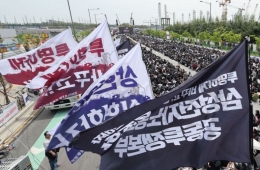
▲Kim Heeseong= From a labor law specialist’s perspective, the recently passed Labor Union Act is the most concerning. This bill regressed the most from the government’s original draft due to labor’s influence, making the problem serious. The current government’s 'labor respect' policy has effectively become 'union respect.'
The biggest concern for companies is the restriction on workplace access. The government’s original draft included provisions banning facility occupation and restricting access to workplaces by non-employees (dismissed or unemployed persons), but these were deleted in the final bill. This means people unrelated to the company can enter workplaces without restrictions. This is a matter of corporate order and discipline and could undermine corporate collective order. If third parties unrelated to labor and management intervene in strikes or disputes, the problem worsens.
▲Woo Taehee= Exactly. Due to the characteristics of company-specific unions, companies are most concerned about dismissed workers’ access to workplaces. We requested strict workplace access controls, but these were not reflected. Although allowing dismissed workers to join unions includes some safeguards like restrictions on union officer qualifications, these are insufficient to prevent side effects. Our society has passed the stage where unions should be unilaterally protected and supported. Companies also need sufficient defensive rights to prevent excessive interference in business activities by union actions. Advanced defensive rights such as a complete ban on workplace occupation and allowing replacement workers during strikes are necessary.
Hot Picks Today
 "Samsung and Hynix Were Once for the Underachievers"... Hyundai Motor Employee's Lament
- "Plunged During the War, Now Surging Again"... The Real Reason Behind the 6% One-Day Silver Market Rally [Weekend Money]
- After Losing Her Only Daughter, a Mother in China Gave Birth to Twins at 60... Reinventing Life at 76
- KOSPI Drops Over 3% Intraday, Falls Below 7,300 Mark
- "That? It's Already Stashed" Nightlife Scene Crosses the Line [ChwiYak Nation] ③
▲Kim Heeseong= If the bill had passed at the level of the government’s original draft, companies would not feel as devastated. Even the original draft’s provisions on workplace access restrictions and facility occupation bans had issues, but the final bill passed is even more heavily tilted toward labor. I believe the balance between labor and management has crossed a critical threshold.
© The Asia Business Daily(www.asiae.co.kr). All rights reserved.