Police Divided into Three, But Report to 112 Anyway
Close-contact community duties handled by Autonomous Police
Specialized investigations managed by National Investigation Headquarters
Organizations remain intact despite separation
General public unlikely to notice changes
Civil society criticizes as "half-hearted reform"

[Asia Economy Reporter Lee Gwan-joo] The South Korean police force is about to undergo the biggest change in its 100-year history. The massive single organization of the police will be divided into three command systems starting next year: the National Police, the Autonomous Police, and the National Investigation Headquarters (Guksubon). Although the organization (headquarters) will remain intact, police operations are expected to change significantly as duties, personnel, and budget authority will be separated.
'Three Families Under One Roof' Coexist... Autonomous Police Handle Community-Centric Tasks
The autonomous police system has been promoted with the aim of decentralizing the expanding police powers following the adjustment of investigative authority between the prosecution and police, and the transfer of counterintelligence investigation authority from the National Intelligence Service to the police. The fully revised Police Act, passed by the National Assembly plenary session on the 9th, centers on separating the duties of the National Police and Autonomous Police, and establishing a separate National Investigation Headquarters to oversee investigations.

Members of the ruling and opposition parties belonging to the National Assembly's Public Administration and Security Committee held a press conference on the Police Act's complete revision bill at the National Assembly on the 2nd. The ruling and opposition parties agreed and resolved on alternatives to the complete revision bills of the Police Act and the Police Officers Act concerning the introduction of autonomous police, the establishment of the National Investigation Headquarters, and the reform of intelligence police. Photo by Yoon Dong-ju doso7@
View original imageThe police organization will be divided into the National Police, which follows the instructions of the Commissioner General of the National Police Agency; the Autonomous Police, managed by the city/provincial autonomous police committees; and the investigative police under the command and supervision of the head of the National Investigation Headquarters. The Autonomous Police can investigate certain cases closely related to daily life, such as community safety, security, traffic duties, as well as domestic and school violence within their jurisdiction. Other investigations will be exclusively handled by the National Investigation Headquarters, so the National Police’s duties will be limited to intelligence, foreign affairs, and security.
However, since all these units will work within the same police station, the organization will not be separately divided, and the 112 emergency call reception and processing will operate as before. Also, general civil complaints will continue to be handled at police stations as usual, so it will be difficult for the public to perceive the changes. The autonomous police system will undergo a pilot operation period until June 30 next year, after which it will be fully implemented.
Open Appointment for National Investigation Headquarters Chief... Commissioner General’s Investigation Command Principally Prohibited
The establishment of the National Investigation Headquarters, promoted alongside the autonomous police, focuses on separating general police duties from investigative duties. This aims to secure the independence and professionalism of investigations in line with the strengthening of police investigative authority. To this end, the head of the National Investigation Headquarters will be appointed as an open position with a single two-year term. Qualifications for the position have been broadened to include not only senior police officers of rank Superintendent General or higher but also legal professionals and experts in law or police studies with certain experience.
In particular, since the head exercises specific command authority over individual cases, the existing detailed investigative command authority of the Commissioner General of the National Police Agency will be abolished in principle. Given the strong investigative powers, external control mechanisms have been established, including making the head of the National Investigation Headquarters subject to parliamentary impeachment. However, investigative command by the Commissioner General is exceptionally allowed only when integrated on-site response requiring large-scale mobilization of police resources is necessary. The Commissioner General’s command is to be exercised through the head of the National Investigation Headquarters, similar to the command relationship between the Minister of Justice and the Prosecutor General.
Hot Picks Today
 "Now Our Salaries Are 10 Million Won a Month" Record High... Semiconductor Boom Drives Performance Bonuses at Major Electronic Component Firms
- Experts Already Watching Closely..."Target Price Set at 970,000 Won" Only Upward Momentum Remains [Weekend Money]
- "Heading for 2 Million Won": The Company the Securities Industry Says Not to Doubt [Weekend Money]
- 'Strait of Hormuz Blockade' Prompts 57 Countries to Intervene in Markets... Oil Price Caps and Fuel Tax Cuts in Full Force
- Is It Really Like an Illness? "I Can't Wait to Go Again"—Over 1 Million Visited in Q1, Now 'Busanbyeong' Takes Hold [K-Holic]

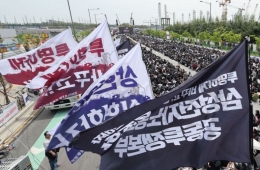
The Emergency Measures Committee of the Police Workplace Council, the National Public Officials Union Police Agency Branch, and the Police Agency Clerks Union are holding a press conference in front of the Police Agency headquarters in Seodaemun-gu, Seoul, demanding the repeal and reconsideration of the "Autonomous Police Bill" proposed by Kim Young-bae, a member of the Democratic Party of Korea. Photo by Moon Ho-nam munonam@
View original image"Half-Baked Police Reform" Criticism Floods In
Controversy is also intense. First, external control mechanisms that had been discussed, such as the actualization of the Police Commission, were not included. Justice Party lawmaker Lee Eun-joo criticized during the National Assembly plenary session debate, calling it a "half-baked autonomous police system that only separates police duties," and warned that "the rebirth of a giant organization with overwhelming power is imminent." The 'Police Reform Network,' composed of civic groups including People’s Solidarity for Participatory Democracy and the Citizens’ Coalition for Economic Justice (CCEJ), also condemned it as "a legislative collusion by the two major parties that regresses and stalls police reform."
© The Asia Business Daily(www.asiae.co.kr). All rights reserved.