"OTT Music Royalties, Why Based on Netflix...Lack of Justification"

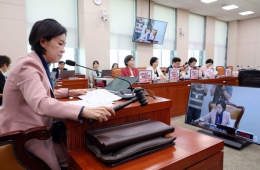
Professor Kim Kyung-sook of the Department of Copyright Protection at Sangmyung University is presenting her research findings as a speaker at the "Appropriate Royalty Rates for Music Copyrights of OTT Operators" forum, jointly hosted by Startup Alliance, the office of Assemblyman Hong Jung-min of the Democratic Party, and the OTT Forum, held on the 9th at the Federation of Korean Industries building in Yeouido.
View original image[Asia Economy Reporter Kim Heung-soon] The Korea Music Copyright Association (KOMCA) demanded that domestic online video service (OTT) providers pay music copyright fees based on the same standards as those in its contract with Netflix. However, the government, academia, and related industries have raised concerns about the lack of grounds for this demand and called for clear standards.
Professor Kim Kyung-sook of the Department of Copyright Protection at Sangmyung University, speaking as a presenter at the 'Appropriate Music Copyright Rates for OTT Providers' forum jointly hosted on the 9th at the Federation of Korean Industries building in Yeouido by Startup Alliance, Assemblyman Hong Jung-min of the Democratic Party, and the OTT Forum, stated, "The collection of music copyright fees should be based on sufficient agreement among the parties involved to establish standards," and argued, "Copyright fees should be calculated based on the usage form rather than the technology providing the service."
"Direct Contracts Between Creators and Users Must Be Recognized"
Introducing the findings of his recent study, 'Research on Appropriate Music Copyright Rates for OTT Video Services,' he said, "Although collection methods and standards vary by country in overseas cases, a common point is that contracts are centered between video producers and music creators, whether for original compositions or existing songs." He also argued that direct contracts between music creators and video producers should be recognized instead of relying on the trust management organization KOMCA.
Professor Kim stated, "Just as the use behavior does not change when technology advances from LPs to CDs, copyright usage fee standards should be determined by the usage behavior of the work, not by the technical differences of the platform." According to Professor Kim's research, countries such as the United States, the United Kingdom, and Japan classify works into original compositions and existing songs and implement direct copyright fee contracts between creators and users. Additionally, to prevent double charging, music works whose rights have already been cleared before video production are stipulated not to incur usage fees.
Professor Kim Yong-hee of Soongsil University's Department of Business Administration pointed out, "The monopoly right of KOMCA to unilaterally set rates is problematic," and questioned, "Is it really appropriate for the trust organization KOMCA to dominate the media content market?"

Hwang Kyung-il, Chairman of the OTT Music Copyright Countermeasures Council, is presenting his opinion at the 'Appropriate Music Copyright Rates for OTT Operators' forum jointly hosted by Startup Alliance, the office of Hong Jung-min of the Democratic Party, and the OTT Forum at the Federation of Korean Industries building in Yeouido on the 9th.
View original imageEarly Stage of Domestic OTT Business
Need for Segmented Appropriate Rates and Gradual Increase
Hwang Kyung-il, Chair of the OTT Music Copyright Measures Council, argued that since domestic OTTs provide complex services including live broadcasting and retransmission of broadcast content, different rates should be applied separately for terrestrial broadcasting, Internet Protocol TV (IPTV), and retransmission services. He also emphasized that new OTT platforms need at least five years after starting operations to reach the break-even point, adding, "A gradual increase in adjustment coefficients is necessary, such as 50% in the first year, 60% in the second year, 70% in the third year, 80% in the fourth year, 90% in the fifth year, and 100% from the sixth year onward."
Currently, KOMCA is demanding a music copyright fee collection rate of 2.5% of related sales, citing reports published by the International Confederation of Societies of Authors and Composers (CISAC) and contract terms with Netflix. On the other hand, major domestic OTT companies such as Wavve, TVING, and Watcha propose a rate of 0.625%, based on existing 'broadcast retransmission service' regulations applied to broadcasters' internet catch-up services. The Ministry of Culture, Sports and Tourism, the main government body responsible for copyright fees, plans to finalize the OTT music copyright fee imposition standards within this month. Industry insiders expect the rate to be set around 1.2%, a middle ground considering both sides' positions.
Hot Picks Today
 "Now Our Salaries Are 10 Million Won a Month" Record High... Semiconductor Boom Drives Performance Bonuses at Major Electronic Component Firms
- Wallets Open Wide on Big News...300 Trillion Won Heads to the U.S., "Tax Breaks" Fail to Keep Funds at Home
- "Hope You Enjoy the 'Welfare' for Bereavement of Children"... Ridicule of Strike Non-Participants Intensifies Union Conflict at Samsung Electronics
- "Heading for 2 Million Won": The Company the Securities Industry Says Not to Doubt [Weekend Money]
- Experts Already Watching Closely..."Target Price Set at 970,000 Won" Only Upward Momentum Remains [Weekend Money]
Officials from the Ministry of Culture, Sports and Tourism and KOMCA did not attend the forum. There are differing opinions within the government regarding the increase in music copyright fees. Kim Jun-dong, Team Leader of the Broadcasting Industry Policy Division at the Ministry of Science and ICT, said, "The Ministry of Science and ICT's basic stance is to support OTT growth through minimal regulation principles," and added, "We consider the rates proposed by KOMCA to be quite excessive. We hope the Ministry of Culture, Sports and Tourism will make a decision considering an appropriate rate level to support the growth of OTTs in their early stages."
© The Asia Business Daily(www.asiae.co.kr). All rights reserved.