'Recalibrating Trade Agreement Implementation as the First Step to Easing US-China Tensions'
China's Phase 1 Trade Agreement Implementation Rate Only 53%
Could Serve as a Lever to Ease US-China Tensions

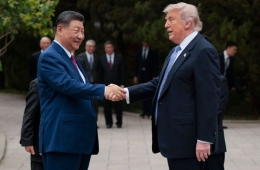
[Asia Economy Beijing=Special Correspondent Jo Young-shin] Whether to readjust the implementation of the Phase 1 trade agreement agreed upon by the United States and China last January is expected to be the first step toward easing US-China tensions. China agreed to purchase an additional $200 billion or more of US goods and services over two years from 2020 (compared to 2017), but has failed to keep the promise due to the global COVID-19 pandemic.
According to a recent report by the Peterson Institute for International Economics (PIIE), a Washington think tank, as of the end of September, China's implementation rate of the trade agreement was only 53% (based on Chinese statistics). PIIE analyzed that under the US-China Phase 1 trade agreement, the amount of US products China was supposed to import by the end of September was $124.9 billion, but actual imports from the US amounted to only $65.9 billion.
The implementation rates by sector were 52% for agricultural products, 58% for manufactured goods, and 34% for energy.
In the case of agricultural products, to meet the $36.6 billion promised this year, China needed to import $25 billion by September, but actual imports remained at $12.9 billion.
Manufactured goods also fell short, with actual imports reaching only $47.7 billion out of the $111.2 billion target for this year. The energy sector performed the worst, with a purchase target of $25.3 billion this year, but only $5.3 billion worth of US energy products were imported by September.
The low implementation rate of China's Phase 1 trade agreement is predominantly attributed to the impact of COVID-19. Although the Chinese leadership has effectively declared victory over COVID-19, China is still not free from the virus.
Park Min-young, head of the Beijing branch of the Korea International Trade Association, said, "Due to unexpected external circumstances, it is currently difficult for China to fulfill the promises of the Phase 1 trade agreement," adding, "It is expected that the new US administration and Chinese authorities will discuss ways to resolve this issue."
A diplomatic source in Beijing said, "It is true that the implementation rate of the US-China trade agreement is only 53% according to Chinese statistics and 54% according to US statistics," and added, "I understand that officials from both countries are currently aware of the low implementation rate and the reasons behind it."
Chinese media are also raising the need to readjust the implementation of the Phase 1 US-China trade agreement.
Xin Chang, deputy director of the US Studies Center at Fudan University in China, said in an interview with the Global Times, "Due to changing circumstances, there may be adjustments to the contents of the Phase 1 trade agreement." The Hong Kong South China Morning Post (SCMP) reported that the Chinese government wants to renegotiate the US-China trade agreement with President-elect Biden.
Professor Si In-hong of the School of International Relations at Renmin University said, "China will try to lower the excessive import targets and export tariffs in the renegotiation," adding, "Biden will also want to renegotiate soon because the trade agreement is unrealistic, which aligns with China's wishes."
Wang Huiyao, director of the Center for China and Globalization, expressed hope for the possibility of trade renegotiations with China, saying, "Biden is a rational person with experience in international relations and an understanding of multilateralism."
Hot Picks Today
 "Suspicious Timing?"...Trump Traded Stocks After Praising Wartime Capabilities
- After US-China Summit... China Opposes US 'Hormuz Resolution'
- There Is a Distinct Age When Physical Abilities Decline Rapidly... From What Age Do Strength and Endurance Drop?
- "I Went to 10 Convenience Stores and Still Couldn't Buy It": The Bread Sensation That Sold 100 Million Units Already [The Way We Shop Now]
- "Contact Me First If Houses Are Built": Wealthy Clients Eyeing... Will Ultra-High-End Residences Worth 20 Billion Won Be Developed? [Real Estate AtoZ]
Some voices suggest that the Chinese leadership could use the low implementation rate of the Phase 1 trade agreement as leverage to ease US-China tensions. It is suggested that the Chinese leadership might push to increase the implementation rate to support President-elect Biden.
© The Asia Business Daily(www.asiae.co.kr). All rights reserved.