[2020 National Audit] Forest Service Staff Visited Panmunjom 32 Times Due to a Single Word from a North Korean General

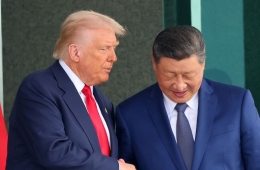
Just before the 2018 'April 27 Inter-Korean Summit,' the leaders of North and South Korea met and planted a commemorative tree at Panmunjom (Military Demarcation Line Cattle Path) and took a commemorative photo. Photo by Office of Assemblyman Hong Moon-pyo
View original image[Asia Economy (Daejeon) Reporter Jeong Il-woong] It has been revealed that the Korea Forest Service sent more than 80 public officials to Panmunjom a total of 32 times at the word of a North Korean general. The purpose of the Panmunjom visits was to manage the commemorative trees planted during the 2018 ‘April 27 Inter-Korean Summit,’ and it has been confirmed that the management of these commemorative trees was carried out at the request of the North Korean general.
According to the ‘Panmunjom Inter-Korean Summit Commemorative Tree Inspection Log’ submitted to Hong Moon-pyo, a member of the National Assembly’s Agriculture, Food, Rural Affairs, Oceans and Fisheries Committee from the People Power Party (representing Yesan and Hongseong), the Korea Forest Service sent its officials to Panmunjom to inspect and confirm the growth status of the commemorative trees after the Inter-Korean Summit.
The issue is that at the request (a single word) of the North Korean general, the Korea Forest Service dispatched between 1 and 9 officials per visit from its headquarters in Daejeon to Panmunjom a total of 32 times to manage the commemorative trees. While it is true that the commemorative trees symbolize the Inter-Korean Summit, Hong’s point is that the Korea Forest Service’s actions were somewhat excessive given the unclear standards for managing the commemorative trees.
Hong stated, “During the inter-Korean military talks at the time of the summit, the North Korean representative requested the management of the pine trees, and this was conveyed to the Korea Forest Service by the Joint Security Area (JSA) officials, which marked the official start of the commemorative tree management,” adding, “It is regrettable that South Korean public officials acted in a coordinated manner at the mere word of a North Korean general without clear grounds for managing the commemorative trees.”
He also pointed out, “I hope the Korea Forest Service will put more effort into restoring and managing forests damaged by wildfires with the same passion it showed in visiting Panmunjom multiple times.”
Hot Picks Today
 No Bacteria Detected in Arisu After 24 Hours of Repeated Drinking from a Tumbler
- "We Can't Just Let Them Be Damaged Inside"... Samsung Electronics Removes 360,000 Wafers in Preparation for Strike
- "Up to 100 Trillion Won in Losses Feared, It's Not About Second Place but Catastrophe"... Industry Minister: 'Emergency Mediation Unavoidable If Samsung Strike Occurs'
- Wife in $6.7 Million Debt Took Out $3 Million in Husband's Life Insurance, Poisoned Him... US Court: "She Can Never Be Released"
- "He's Handsome, It's Such a Pity?"... Lawyer Responds to Bizarre 'Appearance Evaluation' of High School Girl Murder Suspect
Meanwhile, the commemorative trees are pine trees born in 1953, the year the Armistice Agreement was signed. The inter-Korean leaders planted them using soil from Hallasan and Baekdusan and water from the Daedong River and Han River, combined together as ‘Hapto Hapsu’ (combined soil and water).
© The Asia Business Daily(www.asiae.co.kr). All rights reserved.