Korea to Become a Leading AI Semiconductor Nation by 2030... Achieving the 'Second D-RAM Miracle'
Prime Minister Jeong Sye-kyun Chairs the 13th Science and Technology Ministers' Meeting
"Challenge to Foster Top-Tier Companies Competing with Google and Nvidia"
"Record High 24 Trillion KRW R&D Budget... Discovering Achievements and Providing Follow-up Support"

[Asia Economy Reporter Moon Chaeseok] "I firmly believe that an era will come when devices without artificial intelligence (AI) semiconductors will not sell."
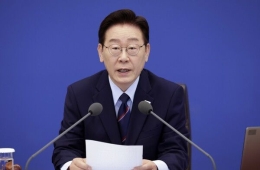
Prime Minister Chung Sye-kyun made this remark on the 12th while presiding over the '13th Science and Technology Ministers' Meeting' at the Pangyo System Semiconductor Design Support Center during his opening remarks.
Prime Minister Chung emphasized, "I hope you take on the future with confidence that we can nurture world-class companies that can compete boldly with Google and NVIDIA."
At the meeting, the original proposals on the 'AI Semiconductor Industry Development Strategy' and the 'Plan to Promote Cross-Ministerial Relay of Excellent R&D Achievements' were approved as agenda items for discussion.
The 'Follow-up Measures for National Research Institutes within the Public Research Institutions R&D Innovation Plan' was accepted as a report agenda item in its original form.
"Achieving the 'Second DRAM Miracle' by 2030... Developing NPU and Securing PIM Technology"

The government has prepared the 'AI Semiconductor Industry Development Strategy' to establish a foundation for leaping forward as an AI powerhouse, realize the Digital New Deal, and advance as a comprehensive semiconductor powerhouse.
The global AI semiconductor market, valued at $18.4 billion (approximately 21 trillion KRW) this year, is expected to grow to $117.9 billion (approximately 135 trillion KRW) by 2030.
The government's goal is to make South Korea a leading AI semiconductor nation by 2030.
To achieve this, the government plans to complete the stages of 'securing independent technological capabilities (by 2022) → securing global industrial competitiveness (by 2026) → achieving the 'Second DRAM Miracle' (by 2030)'.
First, by 2024, the government aims to independently develop a neural processing unit (NPU) that can compete with world-class products. The NPU is a device that mimics the human brain's neural network and is optimized for AI algorithm computations.
Next, by 2029, the government plans to implement next-generation AI semiconductors that combine new devices and fine processes, enhancing performance to perform 1,000 trillion operations per second.
The government will also challenge itself to secure the pioneering position in PIM (Processor In Memory) technology, a new concept semiconductor technology. It believes that by accomplishing three key tasks, it can secure the world's best technological capabilities.
Building Public-Private AI and Data Infrastructure... Training 3,000 Master's and Doctoral Level Experts by 2030

The government will support the proactive introduction and utilization of AI semiconductors by building public-private AI and data infrastructure such as the Gwangju AI Cluster, NAVER Sejong 2nd Center, and SK Telecom. It will help remove technological and commercialization barriers such as transitioning to fine processes.
A public-private joint investment AI semiconductor academy will be newly established. Leading universities will be nurtured to intensively train master's and doctoral level design personnel. The goal is to cultivate 1,000 high-level talents by 2024 and 3,000 by 2030.
The government will create markets and strengthen solidarity and cooperation among companies. Efforts will be made to establish growth infrastructure.
Specifically, a 'One Company One Chip Fast Track' will be established. After discovering demand through the Korea Semiconductor Industry Association and the Convergence Alliance, demonstration tests will be supported using research institute infrastructure.
By 2026, 30 customized AI semiconductors for mobile, automotive, and other sectors will be developed, increasing to 50 by 2030.
Additionally, the government will strengthen cooperation among design companies such as AI semiconductor fabless, IP companies, and design houses; enhance competitiveness in advanced foundry materials, parts, and equipment; support growth funds using semiconductor funds; establish an AI semiconductor innovation design center by 2022; and implement regulatory relaxation, startup support, and patent assistance.
Vitalizing R&D Commercialization... Pilot Implementation of 'Cross-Ministerial Relay' Policy This Year

Turning excellent 'technology' into profitable 'business' is a longstanding government goal. To this end, the 'Plan to Promote Cross-Ministerial Relay of Excellent R&D Achievements' has been prepared. With R&D support reaching 24.2 trillion KRW, the government aims to generate economic outcomes based on this.
'Customized Relay' is a policy that applies the follow-up support capabilities of government ministries to excellent R&D achievements.
First, R&D achievements with high innovation and leadership will be regularly identified. Potentially high-value achievements expected to be commercialized or industrialized once obstacles are resolved will be selected.
For each achievement, obstacles to commercialization and industrialization will be analyzed, and customized follow-up support such as subsequent R&D, linkage with public demand like innovative procurement, institutional improvements, and investment and financing support will be pursued.
An 'R&D Achievement Relay Council' involving related ministries and institutions will be operated to jointly promote regulatory improvements, legal, institutional, and policy support.
In the second half of this year, excellent R&D achievements will be selected, customized strategies will be prepared within the year, and pilot implementation of achievement relay will proceed.
From Next Year, R&D Budgets Will Reflect Performance of National Research Institutes

The government has decided to introduce a system from next year that allows increasing budgets in proportion to the R&D performance of national research institutes to strengthen their capabilities.
The 'Follow-up Measures for National Research Institutes within the Public Research Institutions R&D Innovation Plan,' reported in writing on the day, presented innovation plans for research execution and performance management systems of 16 national research institutes.
National research institutes will establish and implement institution-specific R&D roadmaps that differentiate them from universities and government-funded research institutes. They will promote open research planning involving external experts and strengthen their own research execution capabilities.
From next year, a system will be introduced to comprehensively analyze the R&D promotion strategies, execution capabilities, and performance creation of national research institutes and feed this back into R&D budget formulation and evaluation.
Hot Picks Today
 "Stocks Are Not Taxed, but Annual Crypto Gains Over 2.5 Million Won to Be Taxed Next Year... Investors Push Back"
- "Don't Throw Away Coffee Grounds" Transformed into 'High-Grade Fuel' in Just 90 Seconds [Reading Science]
- Despite Warnings of "Do Not Enter, You May Not Make It Out Alive"... Foreign Tourist Stranded After Unauthorized Climb on Jeju Sanbangsan
- Signed Without Viewing for 1.6 Billion Won... Jamsil and Seongbuk Jeonse Prices Jump 200 Million Won in a Month [Real Estate AtoZ]
- "Even With a 90 Million Won Salary and Bonuses, It Doesn’t Feel Like Much"... A Latecomer Rookie Who Beat 70 to 1 Odds [Scientists Are Disappearing] ③
The 16 national research institutes plan to independently establish and implement institution-specific promotion plans by the first half of next year.
© The Asia Business Daily(www.asiae.co.kr). All rights reserved.