Hong Nam-ki "Promoting Non-Face-to-Face and Online Activation... Facilitating Easy Sales of Popular Domestic Mall Products on Amazon and Others" (Comprehensive)
At the 218th Foreign Economic Ministers' Meeting

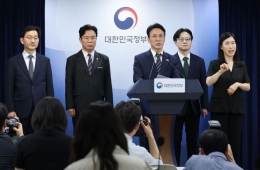
Hong Nam-ki, Deputy Prime Minister and Minister of Economy and Finance, is delivering opening remarks at the '281st Ministerial Meeting on External Economic Affairs' held on the 14th at the Government Seoul Office in Jongno-gu, Seoul. Photo by Kang Jin-hyung aymsdream@
View original image[Sejong=Asia Economy Reporter Joo Sang-don] Hong Nam-ki, Deputy Prime Minister and Minister of Economy and Finance, announced on the 14th, "We plan to establish a linkage system that allows popular products from domestic shopping malls to be easily sold on overseas malls through collaboration with seven major overseas online malls, including Amazon."
On this day, Deputy Prime Minister Hong presided over the '218th Ministerial Meeting on External Economic Affairs' at the Government Seoul Office, stating, "We have prepared support measures to accelerate the recovery of online exports."
Deputy Prime Minister Hong said, "In the second quarter of this year, the total export amount of small and medium-sized enterprises (SMEs) decreased by 13.5% compared to the same period last year, but online export volume increased by 128.9%, showing that non-face-to-face and online exports greatly contributed to the recovery of SME exports." He emphasized, "We will strengthen the integration between online and offline by linking large companies' local distribution networks with SMEs' online sales channels."
Additionally, the government plans to support the promotion of 'BrandK,' the national representative joint brand for SMEs, by facilitating connections with various online channels such as local home shopping and live commerce. It will also introduce an export support system utilizing big data to analyze the competitiveness of our SMEs and assist in preparing customized market entry strategies for promising markets.
At the meeting, topics such as leveraging non-face-to-face and online trends, achievements and future tasks in supporting SME exports, trends and response directions regarding countervailing duties against Korea, and plans for Korea-Uzbekistan economic cooperation and trade agreements were also presented and discussed.
With the global expansion of protectionism, investigations and measures on countervailing duties against Korean companies are increasing and expanding. As the burden on companies is expected to grow, the government plans to establish an inter-ministerial 'Countervailing Duty Response Task Force (TF)' and collaborate through public-private joint responses. To enhance public-private response capabilities to import regulations, legal advisory support for SMEs in responding to import regulations will be increased from approximately 1.5 billion KRW this year to 2 billion KRW next year.
The government also intends to realize tangible results in bilateral economic cooperation projects with Uzbekistan, a key partner in the New Northern Policy along with Russia and Mongolia. Following the Korea-Uzbekistan Deputy Prime Ministers' meetings in May and July, a list of about 90 joint investment projects under discussion will be selected. Plans include expanding the Economic Development Cooperation Fund (EDCF) basic agreement (currently 500 million USD) and supporting the creation of the Angren Free Economic Zone's advanced industrial complex to further specify bilateral economic cooperation projects. Furthermore, based on the completion of joint research (July 6) and a public hearing (July 31) on the Korea-Uzbekistan trade agreement aimed at creating new trade demand and expanding promising cooperation markets, domestic procedures such as reporting to the National Assembly will be finalized this month, with plans to initiate negotiations on the Korea-Uzbekistan trade agreement within the year.
Deputy Prime Minister Hong assessed that volatility in external financial and foreign exchange markets is relatively stable compared to the crisis. He explained, "On the 10th, the government successfully issued foreign exchange stabilization fund bonds (foreign exchange bonds) worth 1.45 billion USD in overseas markets at the lowest interest rate ever. The spread on dollar-denominated bonds was 50 basis points, which is even lower than before the COVID-19 pandemic, and the euro-denominated bonds were issued at a negative interest rate (-0.059%), the first for a non-eurozone country."
Hot Picks Today
 "Now Our Salaries Are 10 Million Won a Month" Record High... Semiconductor Boom Drives Performance Bonuses at Major Electronic Component Firms
- Wallets Open Wide on Big News...300 Trillion Won Heads to the U.S., "Tax Breaks" Fail to Keep Funds at Home
- "Hope You Enjoy the 'Welfare' for Bereavement of Children"... Ridicule of Strike Non-Participants Intensifies Union Conflict at Samsung Electronics
- "Realizing How Fast Money Disappears: Should You Try Only the Essentials for 5,000 Won? [The Basics of Benefits]"
- Experts Already Watching Closely..."Target Price Set at 970,000 Won" Only Upward Momentum Remains [Weekend Money]
He expressed expectations that the successful issuance of these foreign exchange bonds would bring various direct and indirect effects. Deputy Prime Minister Hong said, "First, foreign exchange reserves were expanded at minimal cost, and as the benchmark foreign exchange bond spread declined, the foreign currency procurement costs for domestic companies and financial institutions are also expected to decrease. This reconfirms overseas investors' strong trust in Korea's COVID-19 response, economic crisis management, and the fundamentals such as external soundness. In the current global crisis situation, such indirect effects carry even greater significance."
© The Asia Business Daily(www.asiae.co.kr). All rights reserved.