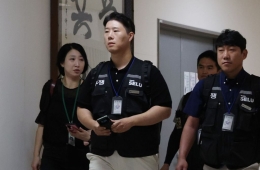
Court Orders "Kim Hong-gul, Member of Parliament, Prohibited from Disposing Donggyodong Residence"

Kim Hong-gul, a member of the Democratic Party of Korea, is attending and speaking at the Foreign Affairs and Unification Committee plenary meeting held at the National Assembly on June 16./Photo by Yoon Dong-joo doso7@
View original image[Asia Economy Reporter Moon Hyewon] In the 'preliminary battle' of the legal dispute among siblings over the inheritance of the late former President Kim Dae-jung and his wife Lee Hee-ho, the court has repeatedly ruled in favor of the second son, Kim Hong-up, chairman of the Kim Dae-jung Peace Center.
According to the legal community on the 11th, the Civil Division 51 of the Seoul Central District Court rejected the injunction objection filed by Kim Hong-gul, a member of the Democratic Party of Korea.
Previously, Chairman Kim had filed an injunction with the court to prevent the disposal of the Donggyo-dong residence and obtained a favorable ruling, and the court reaffirmed that decision.
The two half-brothers are currently disputing over the will of Mrs. Lee regarding the Donggyo-dong residence.
Mrs. Lee, who passed away in June last year, stated in her will regarding the Donggyo-dong residence, "It shall be used as the Kim Dae-jung and Lee Hee-ho Memorial Hall. If a local government or sponsors purchase it to use as a memorial hall, one-third of the compensation shall be donated to the Kim Dae-jung Memorial Foundation, and the remaining two-thirds shall be equally divided among Kim Hong-il, Hong-up, and Hong-gul."
The problem is that Mrs. Lee's will did not meet formal requirements and therefore lacks legal effect.
The third son, Congressman Kim, argues that according to civil law provisions, as the biological son, he should solely inherit the residence.
On the other hand, Chairman Kim contends that even if Mrs. Lee's will has no legal effect, the will itself should be regarded as a declaration of intention for a 'deathbed gift (sa-in jeung-yeo, 死因贈與).' A deathbed gift is a contract under civil law where the donor gives property after death. Since the will clearly intended to divide the residence equally among the three brothers, the contract was established upon Mrs. Lee's passing.
The court is reported to have initially ruled in the injunction case that "there is a possibility that the deathbed gift contract was established."
Hot Picks Today
 "Samsung and Hynix Were Once for the Underachievers"... Hyundai Motor Employee's Lament
- Samsung Enterprise Labor Union: "We Respect Court’s Injunction Decision... General Strike to Proceed on the 21st as Planned"
- "Was This Delicious Treat Enjoyed Only by Koreans?"... The K-Dessert Captivating Japan
- “Thirty Lettuce Heads Stolen”: Surge in Urban Garden Crop Thefts Prompts Action from Violent Crimes Detectives
- "That? It's Already Stashed" Nightlife Scene Crosses the Line [ChwiYak Nation] ③
However, this issue is expected to be examined more thoroughly in the main trial concerning ownership of the residence, where a final judgment will be made.
© The Asia Business Daily(www.asiae.co.kr). All rights reserved.